NEAR Intents Bitcoin Swaps vs TeleSwap: 2026 Comparison

NEAR Intents Bitcoin swaps let you sign the outcome you want and have competing solvers fill it. TeleSwap instead has a Bitcoin light client verify your BTC payment on the destination chain before anything is minted or swapped. Both swap real BTC without an exchange account, but they rely on different trust assumptions.
Say you hold native BTC and want USDC on Ethereum or ETH on Arbitrum. This comparison goes through what happens at the protocol level for each: who controls the BTC during the swap, what gets verified and by whom, how long settlement takes, and what you pay. The goal is to help you decide which tool fits which job. It isn't a ranking.
Key Takeaways:NEAR Intents is an execution layer where users sign a desired outcome and an open network of solvers competes to fill it (Bybit Wiki).On NEAR Intents, native BTC is held at addresses controlled by NEAR Chain Signatures, a threshold MPC signing network (NEAR docs).TeleSwap mints TeleBTC only after an SPV light client verifies the Bitcoin transaction, and the BTC backing it is held by Lockers whose collateral can be slashed.TeleSwap has processed $550.2M in bridged volume across 582,106 transactions on 13 supported networks (TeleSwap network stats).NEAR Intents suits broad multi-chain coverage. TeleSwap suits users who want each swap gated by a Bitcoin proof-of-work proof.
Table of Contents
- Two Models for Swapping Native BTC
- How Do NEAR Intents Bitcoin Swaps Work?
- How Does TeleSwap Verify a Bitcoin Swap?
- NEAR Intents vs TeleSwap: Side-by-Side Comparison
- Who Carries the Bitcoin Confirmation Risk?
- When Does Each One Fit?
- Walkthrough: Swapping BTC to USDC with TeleSwap
- Frequently Asked Questions
- Conclusion
Two Models for Swapping Native BTC: Intents vs Verification
Bitcoin has no general-purpose smart contracts, so no chain can "see" a BTC payment by itself. Every cross-chain BTC swap has to answer one question: who tells the destination chain that the BTC arrived, and why should it believe them?
The two protocols answer it at different layers:
- Intent-based execution (NEAR Intents). An intent is a signed message that describes an end state, such as "I give 0.05 BTC, I receive at least X USDC on Ethereum." It does not describe the path. Solvers quote against the intent, and the winning solver fills it. Native BTC gets into this system through deposit addresses signed for by NEAR's MPC network.
- Light-client verification (TeleSwap). A light client is a smart contract that tracks Bitcoin block headers and checks SPV proofs (Simplified Payment Verification). An SPV proof is a Merkle branch showing that a transaction is included in a block whose header sits in the heaviest proof-of-work chain. Satoshi described this in Section 8 of the Bitcoin whitepaper. TeleSwap mints TeleBTC only after that check passes, then routes it through a DEX into the token you asked for.
The two designs address different layers. An intent system concerns how a trade gets routed and priced. A light-client bridge concerns how a Bitcoin payment gets proven. The user-facing products bundle both, so they end up being compared directly. For background, see how Bitcoin bridges work with SPV light clients.
How Do NEAR Intents Bitcoin Swaps Work?
A NEAR Intents Bitcoin swap combines an intent and solver auction, a settlement contract on NEAR, and Chain Signatures to custody native assets on other chains. The steps below are based on public descriptions from NEAR and integrators, with unconfirmed parameters flagged.
Step 1: Quote and intent signing
Most front-ends call NEAR's 1Click Swap API, which hides solver coordination behind a quote-and-deposit flow (NEAR Protocol on X, Nov 2025). The user picks the assets, and the API returns a quote and a deposit address. According to Bybit's explainer, intent details stay private until a solver commits, and relayers pay gas so the user does not need NEAR tokens.
Step 2: Native BTC deposit via Chain Signatures
The user sends BTC to the deposit address, which is not controlled by a single key. Chain Signatures lets a NEAR account control addresses on other chains, with the public key derived from a root MPC key, the account ID and a derivation path. A network of MPC nodes produces threshold signatures, so no single node holds the full private key (NEAR Chain Signatures documentation). The integrator LeoDex says BTC swaps use 8 independent MPC nodes and accept Legacy, P2SH, Bech32 and Taproot addresses; we have not confirmed the node count against NEAR's docs.
Step 3: Settlement and payout
Once the deposit is credited, it exists as a balance in the NEAR Intents settlement contract. A solver fills the intent by supplying the destination asset. If the payout is on another chain, the withdrawal goes through the cross-chain deposit/withdrawal infrastructure. LeoDex reports typical BTC swap times of 3–5 minutes, a figure without published methodology.
Distribution is a real strength of this model. NEAR Intents is available inside KyberSwap and in Ledger Wallet through SwapKit. NEAR reported $5B in all-time volume as of November 2025 (NEAR Protocol). DefiLlama lists 26 supported chains as of November 2026.
How Does TeleSwap Verify a Bitcoin Swap?
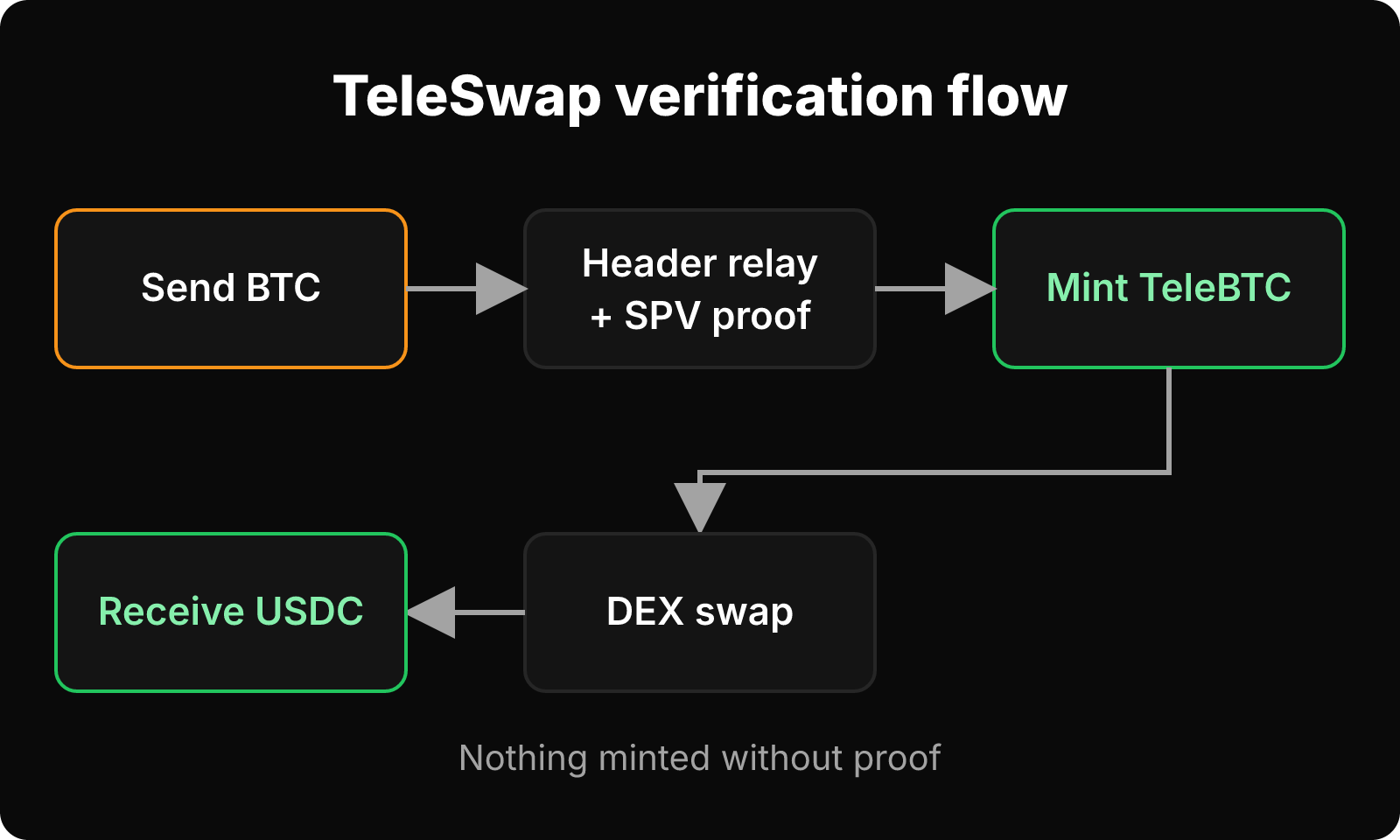
TeleSwap verifies a Bitcoin swap with an SPV light client on the destination chain, and mints TeleBTC, a 1:1 collateral-backed representation of BTC, only after the Bitcoin transaction is proven. It moves BTC to EVM chains, TON and Solana. The design rule is that nothing is minted without a verified Bitcoin transaction (TeleSwap documentation).
The transaction flow
- Request. You pick a route, for example BTC → USDC on Ethereum, and get a quote. TeleSwap fees are charged in Bitcoin terms and returned as a breakdown by the estimate APIs (TeleSwap Fees & Speed docs).
- One Bitcoin transaction. You send BTC from a Bitcoin wallet, and the transaction carries the swap request.
- Header relay and SPV proof. Bitcoin block headers are relayed to the light-client contract, which checks that each header meets its proof-of-work target. A Merkle inclusion proof then shows your transaction is in a verified block.
- Mint. When the proof passes, TeleBTC is minted 1:1 against your BTC. Custody is collateral-backed and slashable, and Lockers are a permissionless protocol role.
- Swap and deliver. TeleBTC is routed through an AMM/DEX into the token you requested. A Teleporter covers destination-chain gas, so you don't need ETH or BNB to receive your tokens.
Fast swaps settle in about 10 minutes. The reverse direction works the same way: you swap a destination-chain token back to TeleBTC, and native BTC is released to your Bitcoin address.
As of 7 November 2026, TeleSwap has bridged $550.2M across 582,106 transactions on 13 supported networks. Over the past 30 days it processed $40.5M, averaging about $1.4M per day, with a peak of $2.1M on 5 November 2026 (TeleSwap network stats).
NEAR Intents vs TeleSwap: Side-by-Side Comparison
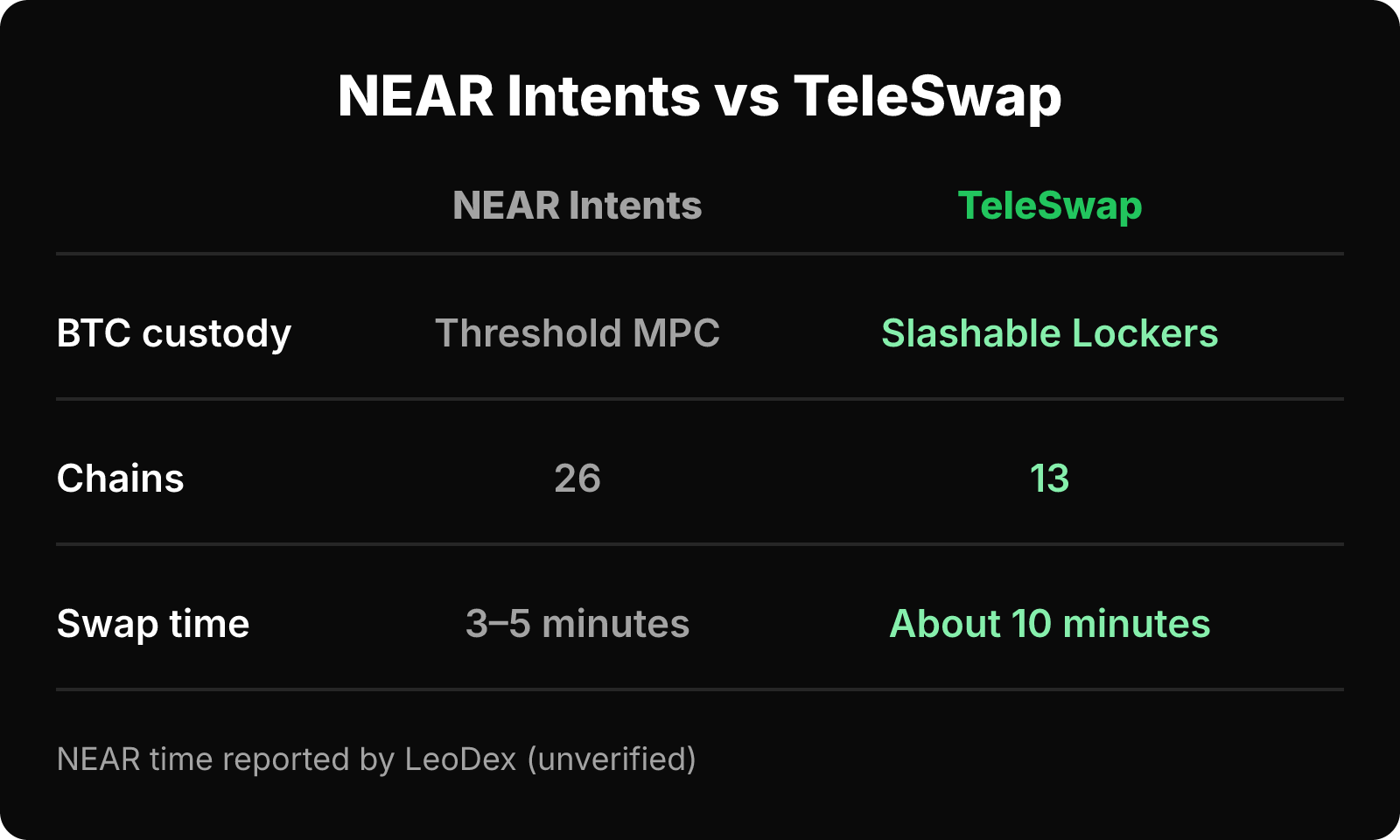
The table compares the two on the model, custody, chain coverage, fees, time and sign-up. Third-party claims are attributed to their source.
| Criterion | NEAR Intents | TeleSwap |
|---|---|---|
| Core model | Signed intents filled by an open solver network (Bybit Wiki) | SPV light-client verification of Bitcoin transactions, then DEX routing (TeleSwap docs) |
| Who holds BTC during the swap | Addresses controlled by Chain Signatures threshold MPC (NEAR docs) | Collateral-backed, slashable Lockers; mint only after a verified Bitcoin transaction |
| What proves the BTC arrived | The MPC/deposit infrastructure credits the balance on NEAR | A light client on the destination chain checks proof-of-work headers and a Merkle inclusion proof |
| Supported chains | 26 (DefiLlama, Nov 2026) | 13 networks, including EVM chains, TON and Solana (TeleSwap network stats) |
| Fees | Built into the solver quote, plus any front-end fee | Charged in Bitcoin terms with a breakdown in the estimate API (docs) |
| Typical BTC swap time | 3–5 minutes reported by LeoDex (unverified) | About 10 minutes for fast swaps |
| Destination gas | Paid by relayers (Bybit Wiki) | Paid by a Teleporter; all fees paid in Bitcoin assets |
| Sign-up | No protocol account; connect a wallet in an integrating front-end | No protocol account; send one transaction from a Bitcoin wallet |
| Where you can access it | KyberSwap, Ledger Wallet (via SwapKit), 1Click API integrators | teleswap.xyz; Rango, Rubic and DZap aggregators; MetaMask and Trust Wallet via Rango |
| Developer access | 1Click Swap API | SDK (BTC → EVM/TON/Solana quote in under a minute) wrapping a REST API; third-party ID for fee sharing |
Reading the custody rows correctly
Both systems are designed so that no single party holds the full key to your BTC. The difference is in what you have to trust. On NEAR Intents, you trust that a threshold of MPC nodes signs honestly. On TeleSwap, a mint depends on Bitcoin proof-of-work as checked by a contract, and the BTC behind TeleBTC is held by Lockers whose collateral can be slashed.
Compared with wrapped-BTC designs that rely on custodians or multi-sig committees, TeleBTC is the trust-minimized option because its minting inherits Bitcoin's own security model. See also Bitcoin bridge security in 2026.
Who Carries the Bitcoin Confirmation Risk?
Bitcoin targets a block roughly every 10 minutes on average (Bitcoin whitepaper), and a payment has no confirmation until a block is mined. So if a cross-chain BTC swap delivers well under one block interval, some participant is accepting lightly confirmed BTC and the risk of a reorganization.
That is a normal service, and the point is to know who carries the risk:
- In an intent model, the solver or deposit infrastructure decides how many confirmations it needs. The user gets speed, and the risk is priced into the quote.
- In a light-client model, the contract will not mint until a block containing your transaction has been proven. Settlement follows Bitcoin's block cadence, which is why TeleSwap's fast swaps take about 10 minutes.
Neither choice is better in general. Which one you prefer depends on whether you care more about minutes or about what the settlement relies on.
NEAR Intents vs TeleSwap: When Does Each One Fit?
NEAR Intents tends to fit when you:
- Need a destination chain outside TeleSwap's 13 networks. DefiLlama lists 26 chains for NEAR Intents.
- Already use KyberSwap or Ledger Wallet and want to swap from there.
- Care most about wall-clock speed and are comfortable with a threshold-MPC custody assumption.
- Want solver competition on pricing across many asset pairs.
TeleSwap tends to fit when you:
- Want the mint gated by an SPV proof of Bitcoin proof-of-work, with no signing committee deciding whether your BTC arrived.
- Are swapping BTC into EVM tokens, Jettons on TON, or SPL tokens on Solana, for example BTC to USDC on Ethereum or BTC to ETH on Arbitrum.
- Want to pay every fee in Bitcoin assets without holding destination-chain gas tokens.
- Plan to keep using your BTC afterwards. TeleSwap also offers earning in BTC: staking TST for fee rewards, depositing native BTC into teleBTC pools in one Bitcoin transaction, or running a protocol role such as Locker, Teleporter, Relayer or Filler. See earning yield on native Bitcoin.
- Are building an app and want a BTC quote from an SDK in under a minute, with a third-party ID that earns a share of fees on the volume you bring.
Some users run both: NEAR Intents for long-tail routes, and TeleSwap for routes where proof-gated settlement matters more than a few minutes.
Walkthrough: An Intent-Based Bitcoin Swap Alternative with TeleSwap
Here is the TeleSwap flow for a BTC → USDC swap on Ethereum.
- Open the route. Go to teleswap.xyz/btc-to-usdc.eth.
- Enter the amount and review the quote. The estimate shows the fee breakdown in Bitcoin terms (Fees & Speed). You don't need any ETH.
- Paste your Ethereum recipient address. This is where the USDC will be delivered.
- Send one Bitcoin transaction. Use any Bitcoin wallet.
- Proof and mint. Once your transaction is in a block, the light client verifies the SPV proof and TeleBTC is minted 1:1.
- Swap and delivery. TeleBTC is routed through the DEX into USDC, and a Teleporter pays the Ethereum gas. Fast swaps settle in about 10 minutes.
To go back, use the reverse route (USDC on Ethereum to BTC).
For developers: the same flow is available through the TeleSwap SDK, or directly over the REST API that the SDK wraps. Register a third-party ID to earn a share of fees. See the TeleSwap documentation.
Frequently Asked Questions
Is a NEAR Intents BTC swap a bridge?
Not in the lock-and-mint sense: NEAR Intents is an intent-based execution layer, where solvers fill your requested outcome. Your native BTC goes to an address controlled by NEAR Chain Signatures, a threshold MPC network, and the swap settles on NEAR's settlement contract. Payouts on other chains go through its deposit/withdrawal infrastructure.
How does TeleSwap verify my Bitcoin transaction?
TeleSwap uses an SPV light client that checks Bitcoin block headers for valid proof-of-work and verifies a Merkle proof that your transaction is in one of those blocks. TeleBTC is minted 1:1 only after that check passes. The BTC behind it is held by Lockers whose collateral can be slashed.
Which is faster for native Bitcoin swaps?
NEAR Intents reports faster BTC swaps, about 3–5 minutes according to integrator LeoDex, while TeleSwap fast swaps settle in about 10 minutes. LeoDex's figure is unverified. TeleSwap waits for an on-chain proof, which ties settlement to Bitcoin's block interval.
Do I need gas tokens on the destination chain?
No, neither protocol requires them. NEAR Intents uses relayers to pay gas. TeleSwap uses a Teleporter to pay destination-chain gas and lets you pay all fees in Bitcoin assets.
Do I need an account to use either one?
Neither protocol needs a protocol account: NEAR Intents is used through a connected wallet in an integrating app, and TeleSwap needs only a Bitcoin transaction and a destination address. Individual front-ends or aggregators may have their own terms, so check the app you use.
How many chains do NEAR Intents and TeleSwap support?
NEAR Intents supports 26 chains according to DefiLlama, and TeleSwap supports 13 networks according to TeleSwap network stats (November 2026). TeleSwap lets you swap BTC into ERC-20s, Jettons and SPL tokens.
Can I use TeleSwap from inside another app?
Yes: TeleSwap is integrated as a Bitcoin swap provider in the Rango, Rubic and DZap aggregators, and in MetaMask and Trust Wallet through the Rango integration. Developers can also integrate it directly with the TeleSwap SDK or REST API.
Conclusion: Picking the Right Native Bitcoin Swap
NEAR Intents and TeleSwap both let you swap native BTC without an exchange account, but they work at different layers and rely on different guarantees. NEAR Intents is an intent and solver network whose BTC custody depends on threshold MPC, with wide chain coverage and solver-driven pricing. TeleSwap mints TeleBTC only against a verified Bitcoin transaction, and has handled $550.2M across 582,106 transactions on 13 networks (TeleSwap network stats).
If you need a long-tail chain or the fastest reported delivery, NEAR Intents is a reasonable choice. If you want settlement tied to a Bitcoin proof, with fees paid in BTC and gas covered for you, TeleSwap is designed for that.