Binance Opens Crypto Withdrawals in Phases After $6.3B Hack

Late on October 29, 2026, attackers drained an estimated $6.3 billion from Binance hot wallets, the largest crypto theft on record. On November 1, Binance opened crypto withdrawals in phases, starting with bitcoin, after replacing most of the stolen assets with its own funds, according to CoinDesk.
Most coverage of Binance's phased reopening after the $6.3 billion hack stops at the headline numbers. This article covers what the public sources do and don't establish: how an Ethereum account-delegation primitive could keep an attack running after the exchange shut its own systems down, why bitcoin's UTXO model makes it easier to restore first, who actually lost money, and what to change in your own setup. For a deeper incident write-up, see how the $6.3B Binance hack happened.
Key Takeaways:Binance estimates that roughly $6.3 billion was stolen from its hot wallets on October 29, 2026, and blockchain analytics firms attribute the attack to the North Korea-linked group TraderTraitor, per CoinDesk.TRM Labs data cited by CoinDesk puts the haul at 18,270 BTC, 200,630 ETH, 1.875 billion USDT and 823 million USDC, plus XRP and SOL.Reports say the attacker used EIP-7702, the Ethereum mechanism that lets a regular account delegate its execution to contract code, which would explain why pausing Binance's withdrawal systems did not stop the drain.Binance reopened withdrawals on November 1, 2026 with a 06:00–09:00 UTC first window, and between 06:00 and 15:30 UTC it processed $4.65 billion out against $1.01 billion in, per mlq.ai.Binance says it is absorbing the losses itself, so customer balances were not cut, though users of less liquid assets waited longer for withdrawals.
Table of Contents
- What Happened in the Binance Hack? A Dated Timeline
- How Did the Attack Work, Step by Step?
- Why Didn't Halting Withdrawals Stop the Drain?
- Why Binance Opens Crypto Withdrawals Starting With Bitcoin
- Who Lost What?
- How Do Custody Models Compare After This Hack?
- How Can You Protect Yourself Now?
- Frequently Asked Questions
- Conclusion
What Happened in the Binance Hack? A Dated Timeline
Each date below comes from reporting published in the days after the exploit. Where sources disagree, the conflict is noted.
| Date (2026) | Event | Source |
|---|---|---|
| Oct 29 (late) | Hot-wallet exploit. Binance estimates ~$6.3B stolen. | CoinDesk |
| Oct 30 | Binance sets aside ~$6B to cover losses. CEO Richard Teng says the exchange will absorb them rather than pass them to users. | Wikipedia (secondary) |
| Oct 31 | ~90% of affected assets replaced with company funds. ~$3B of stolen assets reported located or frozen with industry partners. | CryptoNews; Dawn News |
| Nov 1, 06:00–09:00 UTC | Phase 1 withdrawal window opens for BTC, ETH, USDT, USDC, BNB, XRP and others (about 15 assets/networks). Replacement at ~95%. | CoinDesk; CryptoNews |
| Nov 1, 06:00–15:30 UTC | $4.65B withdrawn, $1.01B deposited. Net outflow ≈ $3.64B. | mlq.ai |
| Nov 1 (late morning ET) | Snapshot shows 531 of 552 listed coins still suspended. BTC and ETH among 14 partially restored. | mlq.ai citing The Block |
| Nov 3 | ~98% of stolen tokens reported replenished (single-source claim). | Wikipedia |
Binance's own statement, quoted by CoinDesk, said it would "continue to monitor closely as services return in phases." Deposits stayed open the whole time.
Sources also disagree on which assets were in phase one. Some reports put Dogecoin and Solana in the first batch, and others say they came later. If you held a long-tail asset, check Binance's network-status page rather than relying on press lists.
How Did the Attack Work, Step by Step?
The short version: attackers got control of Binance hot wallets, the online accounts that sign routine customer payouts, and reportedly used Ethereum's EIP-7702 delegation to set up on-chain permissions that stayed in place after Binance cut off its own infrastructure. Binance has not published a full root-cause postmortem, so the reconstruction below separates reported facts from protocol-level inference.
What is a hot wallet, mechanically?
A hot wallet is a set of private keys (or key shares) kept online so a signing service can authorize withdrawals automatically. At a large exchange, a withdrawal request typically goes through a risk engine and then to a signer, often built on multi-party computation (MPC) or hardware security modules (HSMs). Cold wallets hold most reserves offline and refill hot wallets in batches.
Binance has not disclosed its threshold scheme, signer count or HSM setup for the affected wallets. Without that information, nobody outside the company can say whether the breach happened at the key layer, the policy layer or the network layer.
What is EIP-7702?
Wikipedia's incident page says the attacker "used EIP-7702" and that the attack "involved granting network permissions directly on Ethereum," per its summary of reporting. The same page calls EIP-7702 "a multi-signature protocol." That is wrong. According to the EIP-7702 specification, which shipped in Ethereum's Pectra upgrade in May 2025, it works like this:
- It adds a new transaction type,
0x04("set code transaction"), which carries anauthorization_list. - Each authorization is a tuple
[chain_id, address, nonce, y_parity, r, s], signed by an externally owned account (EOA) overkeccak256(0x05 || rlp([chain_id, address, nonce])). - Once processed, the EOA's code is set to a delegation designator,
0xef0100 || address. From then on, any call to the EOA runs the code ataddressin the EOA's own context, with its balance, its token approvals and its storage. - The delegation persists until another authorization replaces it. Pointing it at the zero address clears it.
- Any account can submit the set-code transaction (it can be sponsored by someone else), and a
chain_idof 0 makes the authorization valid on every EVM chain.
Put plainly, one signature from a key can turn a plain EOA into a programmable account whose logic was written by someone else.
A plausible attack sequence
The steps below are an inference that fits the public facts. They are not a confirmed forensic account and should be checked against Binance's postmortem once it is published.
- Initial access. TraderTraitor has a documented record of social engineering and compromised signing interfaces, and the FBI attributed the ~$1.5B Bybit theft of February 2025 to the same group, per its advisory.
- Getting an authorization signed. The attacker gets a hot-wallet signer to produce an EIP-7702 authorization pointing to an attacker-controlled contract, either by compromising the signing pipeline or by disguising the request as a routine operation.
- Delegation goes live. A type
0x04transaction sets the hot wallet's code to the malicious delegate. The attacker no longer needs Binance's off-chain systems. - Draining. The delegate exposes a function gated to the attacker's address, which moves ETH and ERC-20s (USDT, USDC) out of the wallet. Wikipedia reports a single transaction of more than $2.5B, which is unverified.
- Non-EVM assets. BTC, XRP, SOL and TRON assets were also taken. EIP-7702 cannot touch those chains, so their loss points to a compromise of the signer itself, not only an on-chain permission.
- Laundering. The FBI reportedly said stolen assets were being converted to ETH. That claim comes from a broadcast transcript, not a primary FBI document.
Step 5 deserves attention. A loss spread across several chains does not fit a single smart-contract bug. It fits a breach of the signing layer, with EIP-7702 possibly making the EVM part of the theft faster and harder to stop.
Why Didn't Halting Withdrawals Stop the Drain?
Halting withdrawals stops Binance's own signer from producing new signatures. It does nothing to code that has already been delegated on-chain. Once an EOA's code points to an attacker's contract, the attacker can call it directly through any Ethereum node.
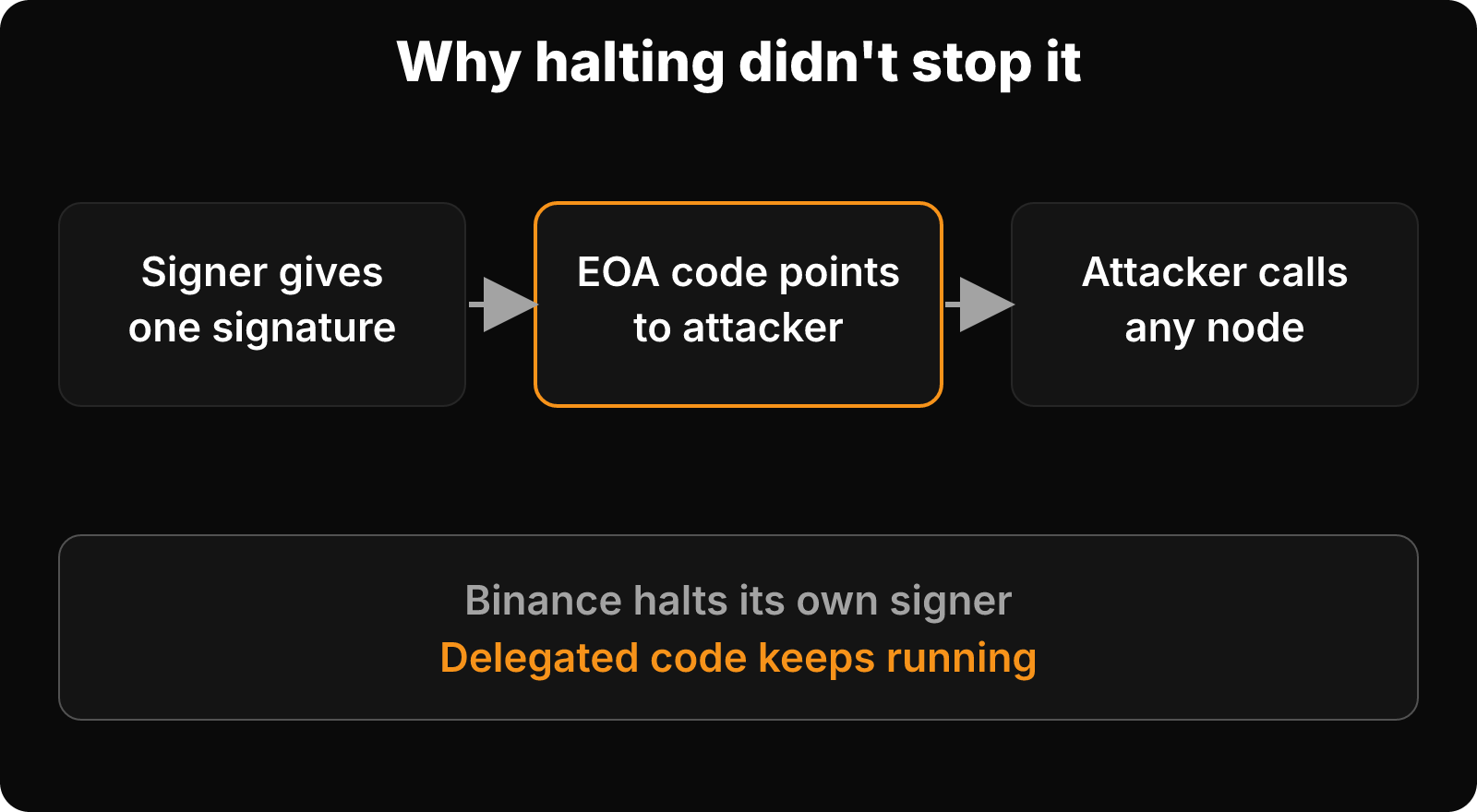
With account abstraction, "freezing withdrawals" is no longer a kill switch. Before Pectra, an EOA could only move funds through a fresh ECDSA signature from its key. After Pectra, an EOA can carry standing logic that runs on someone else's call.
To recover, the legitimate key holder has to sign a new authorization (to address(0) or to a benign contract) and get it included before the attacker's next sweep. The cleaner fix is to stop using the address: move remaining balances out and rotate to new keys.
The same idea showed up in February 2025. Bybit's loss came from a Safe multisig whose implementation was swapped through a transaction the signers approved without understanding it, which the FBI attributed to TraderTraitor. Different primitive, same lesson: get one signature that changes what the account's code does, and the funds follow. For more cases, see how private key attacks on bridges work.
Why Binance Opens Crypto Withdrawals Starting With Bitcoin
Binance's stated reason was demand: "the most requested networks prioritized," with each chain clearing its own "security and stability checks" first, per CoinDesk. There may also be a technical reason Binance did not spell out: bitcoin is arguably the easiest chain to secure again after a breach like this. That part is our analysis, not Binance's statement.
The UTXO model vs. the account model
- Bitcoin (UTXO model). Coins sit in unspent transaction outputs locked by a script. An address has no persistent code and no standing approvals. To restore integrity, you generate new keys, sweep every UTXO to new addresses, and wait for confirmations.
- Ethereum (account model). A compromised EOA can carry an EIP-7702 delegation, outstanding ERC-20
approve()allowances, and Permit2 signatures. All of them have to be found and revoked across every EVM chain where achain_id = 0authorization could replay. That is a far larger audit.
How the phased gating works
Withdrawals were gated per asset and per network, and users were sent to a status page instead of being given a fixed schedule, per mlq.ai. Binance has not published its criteria. Plausible conditions are fresh hot-wallet keys, enough replacement liquidity, and monitoring that confirms no attacker-controlled permissions remain, but these are inferences.
Deposits stayed open while withdrawals were closed, as Binance stated. Deposits are only observed on-chain and need no signature from Binance.
Who Lost What?
The attacker took assets from Binance's hot wallets, and Binance says it will absorb the loss rather than cut customer balances. Here is the on-chain haul as reported by TRM Labs through CoinDesk:
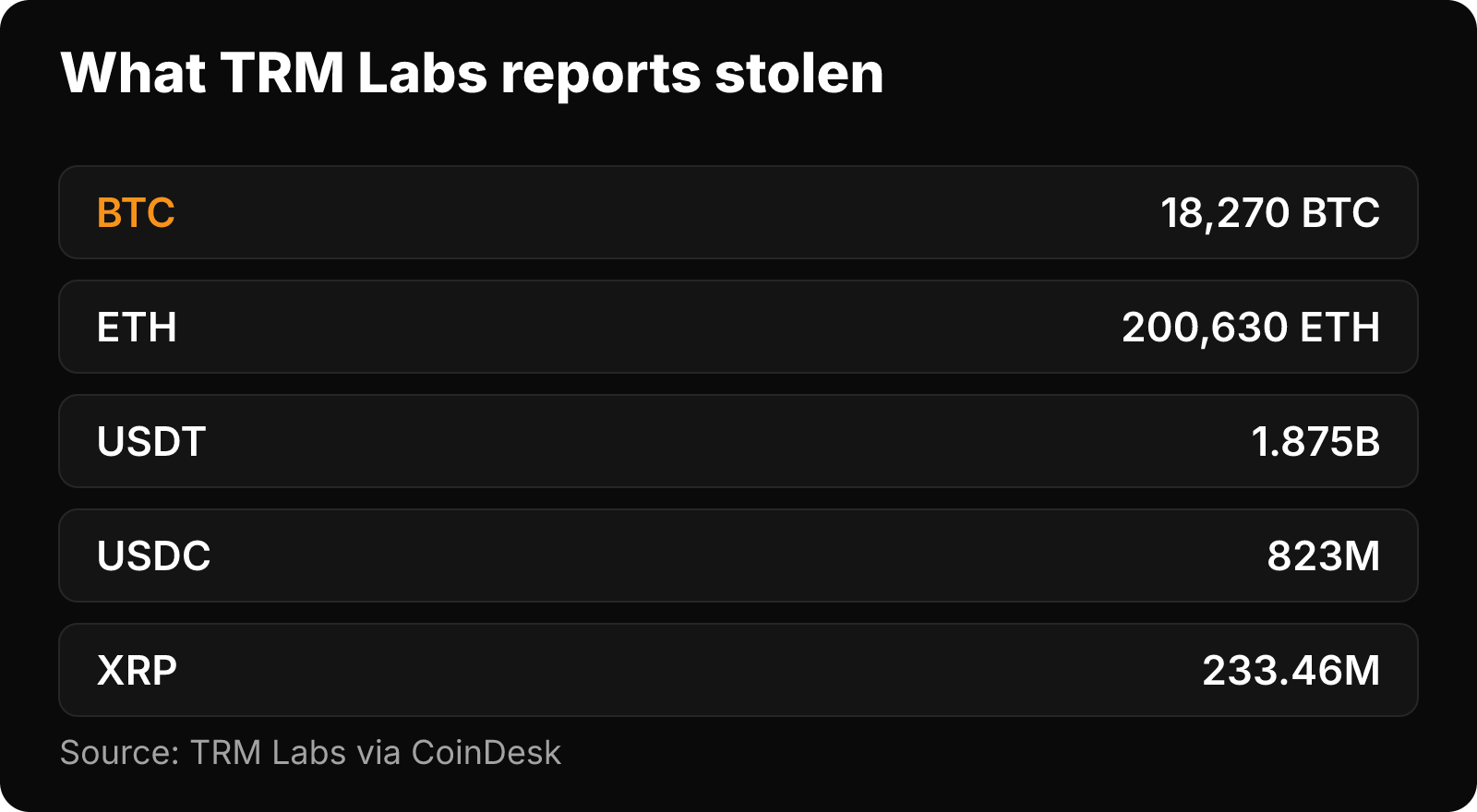
| Asset | Amount stolen | Chain | Source |
|---|---|---|---|
| BTC | 18,270 BTC (~$1.47B) | Bitcoin | TRM Labs via CoinDesk |
| ETH | 200,630 ETH | Ethereum | TRM Labs via CoinDesk |
| USDT | 1.875B | Ethereum | TRM Labs |
| USDC | 823M | Ethereum | TRM Labs |
| XRP | 233.46M | XRP Ledger | TRM Labs |
| SOL | 970,500 | Solana | TRM Labs |
Wikipedia's chain-level split is roughly $3.8B on Ethereum, $1.5B on Bitcoin, $628M on TRON, $296M on XRP and $96M on Solana. That breakdown comes from a single source.
The losses fell into three groups:
- Binance: about $6B in reserves set aside. Its SAFU emergency fund was reportedly drawn down, though that is unverified.
- Users: no reported balance cuts. The cost was time, especially with 531 of 552 coins still suspended at The Block's November 1 snapshot.
- Market structure: DefiLlama data showed about $4.05B in 24-hour net outflow from Binance, while the next 10 exchanges took about $368M in net inflows, led by OKX, per mlq.ai.
The $3.64B net outflow on November 1 was only about 2.1% of the $171B in assets Binance cites from its own proof of reserves. That is not a classic bank run, and $1.01B was deposited in the same window. The $171B figure is self-reported and not independently audited in these sources.
How Do Custody Models Compare After This Hack?
This hack shows what each custody model relies on. If you want BTC exposure on Ethereum or other EVM chains, the options trust very different things:
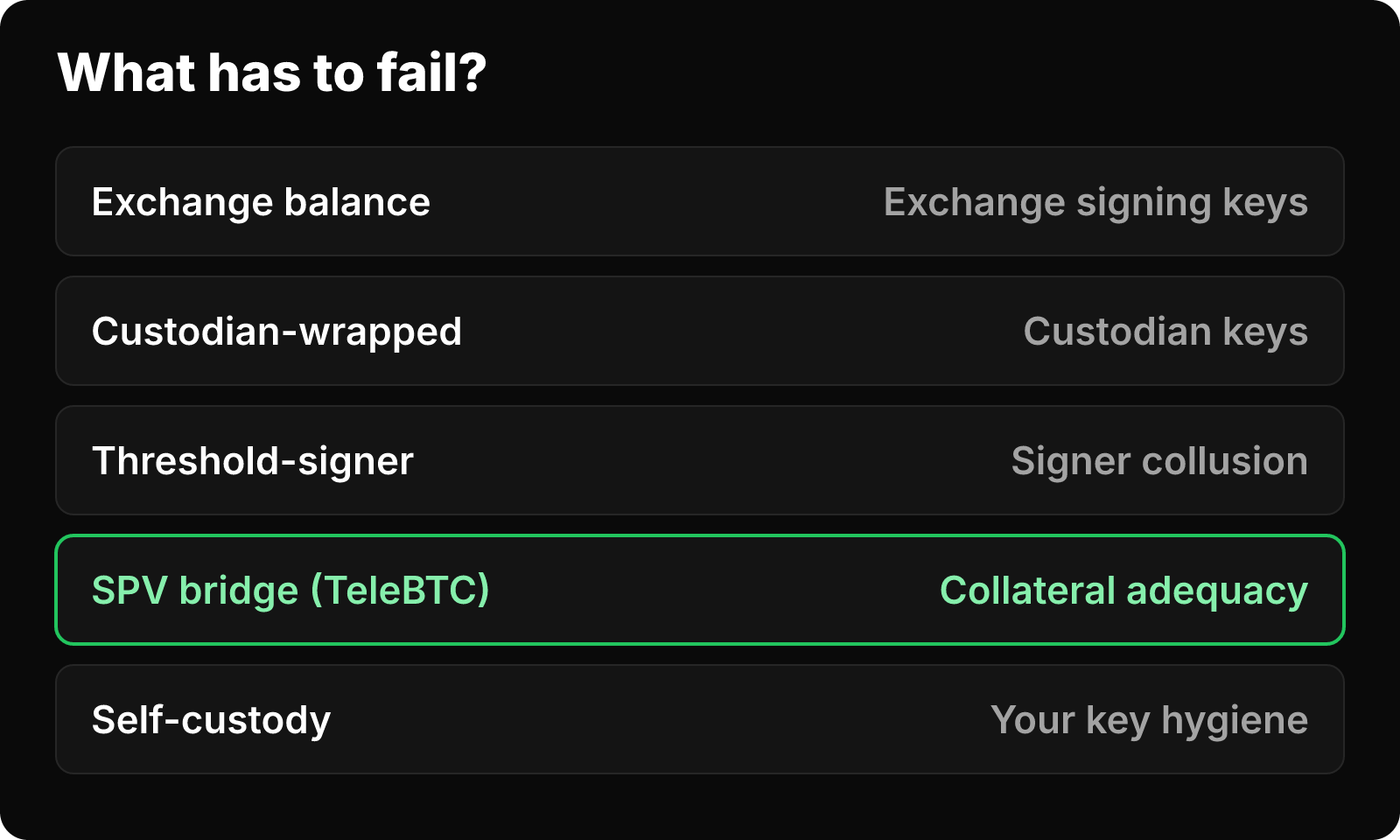
| Model | Who can move your BTC | Single point of failure | Example |
|---|---|---|---|
| Exchange balance | Exchange signer + policy engine | Exchange key/signing infrastructure | Binance account |
| Custodian-wrapped BTC | Custodian(s) holding the backing BTC | Custodian keys and governance | WBTC, cbBTC |
| Threshold-signer wrapped BTC | A rotating signer group via threshold ECDSA | Collusion of a signer threshold | tBTC |
| SPV light-client bridge | Collateral-backed lockers; minting needs a verified Bitcoin proof | Collateral adequacy and Bitcoin header verification | TeleBTC |
| Self-custody | You | Your key hygiene | Hardware wallet |
None of these models is free of risk. They differ in what has to fail. An SPV (Simplified Payment Verification) light client checks Bitcoin block headers and Merkle inclusion proofs on the destination chain, so a token can only be minted against a Bitcoin transaction that actually exists. TeleSwap uses this design: TeleBTC is minted 1:1 only after a verified Bitcoin transaction, and custody is collateral-backed and slashable. See trustless swaps vs custodial exchanges for more.
TeleSwap network stats show $563.1M bridged across 597,641 transactions on 13 supported networks as of November 14, 2026. If you are moving BTC off an exchange and want stablecoin exposure on Ethereum, a direct BTC → USDC route is available.
How Can You Protect Yourself Now?
The risky window is often the weeks after a major hack, when phishing campaigns copy "withdrawal reopening" notices. Work through this list:
- Use only official status channels. Check withdrawal status on Binance's own network-status page. Never use links from DMs, emails or search ads.
- Check your own EOAs for EIP-7702 delegations. On a block explorer, look at your address's code. If it starts with
0xef0100, it is delegated. If you didn't set that up on purpose, move the funds to a fresh address. - Never sign an authorization you can't read. Treat any "upgrade your account" prompt from a dapp with suspicion, especially a
chain_id = 0one that is valid on every chain. - Revoke stale token approvals. Old
approve()allowances to unused contracts are standing permissions. - Turn on withdrawal-address allowlisting on every exchange account, and check the first and last characters of each address to defeat address-poisoning lookalikes.
- Keep only trading balances on exchanges. Coins you don't plan to trade belong in self-custody. A promise to "absorb losses" depends on the exchange's balance sheet.
If you run infrastructure, add EIP-7702 authorization detection to your signing policy engine, and have signers refuse messages with the 0x05 magic prefix unless they pass a separate, high-friction approval path.
Frequently Asked Questions
When did Binance reopen withdrawals after the $6.3 billion hack?
Binance began reopening withdrawals on November 1, 2026, with a first window from 06:00 to 09:00 UTC. Phase one covered about 15 assets/networks, including BTC, ETH, USDT, USDC, BNB and XRP. Other assets followed in later phases as each network passed security and stability checks.
Why did Binance start withdrawals with bitcoin?
Binance said it prioritized the most requested networks. Bitcoin may also be simpler to secure again, because under the UTXO model addresses carry no persistent code or token approvals, whereas EVM chains require revoking delegations and allowances. The second point is analysis, not a Binance statement.
Did Binance users lose money in the hack?
No customer balance cuts have been reported, because Binance said it would absorb the losses with company funds. Binance reported replacing about 90% of affected assets by October 31 and about 95% by November 1, and Wikipedia reports about 98% by November 3. Users of less liquid assets waited longer to withdraw.
What is EIP-7702 and how was it reportedly used?
EIP-7702 is an Ethereum standard, live since the May 2025 Pectra upgrade, that lets a regular account delegate its execution to contract code through a signed authorization. Reports say the attacker used it to set standing on-chain permissions on Binance hot wallets. That would let funds be drained even after Binance halted its own withdrawal systems. A primary postmortem has not yet confirmed this.
Who was behind the Binance hack?
Blockchain analytics firms attribute the hack to TraderTraitor, a North Korea-linked group. The FBI reportedly made the same link, but President Trump reportedly said North Korean responsibility has not been established, so attribution remains contested.
How much bitcoin was stolen from Binance?
TRM Labs reported 18,270 BTC stolen, valued at about $1.47 billion. Ethereum-based assets made up the largest share of the total, including 200,630 ETH, 1.875 billion USDT and 823 million USDC.
How can I check whether my own wallet has a malicious delegation?
Look up your address on a block explorer and check whether its code field starts with 0xef0100. If it does, your account is delegated to the contract address that follows. If you didn't set it up yourself, move your funds to a new address and revoke any outstanding token approvals.
Conclusion
Binance's phased reopening, starting with bitcoin after the $6.3 billion hack, shows how much a single signature can now do. The theft reportedly used EIP-7702 to install on-chain logic that kept working after Binance shut down its own systems. Bitcoin's UTXO model arguably makes recovery simpler. And users were protected because one company's balance sheet could absorb a loss of about $6 billion.
Do the six-step check above this week. If you keep BTC on an exchange only to get it onto an EVM chain, you can bridge it directly at teleswap.xyz, where minting depends on a verified Bitcoin transaction rather than a custodian's key.