Best Way to Bridge Native BTC to USDC: 2026 Guide

What's the best way to bridge native BTC to USDC? Use a one-step route that takes real BTC from your own Bitcoin wallet and delivers USDC straight to your wallet on the destination chain, then compare a live quote from at least two routes before you send anything. The quote is worth checking. In a September 14, 2026 benchmark, the best and worst quotes for 1 BTC → USDC were 503.50 USDC apart (77,513.72 vs. 77,010.22), according to BOB's native BTC bridge comparison. BOB is one of the providers it tested, so read it as a rough guide, not a final ranking.
Key Takeaways:On 1 BTC → USDC, quotes from different routes differed by up to 65 basis points (about 503 USDC) in BOB's September 2026 benchmark, a vendor-run, one-day, five-test snapshot.Circle's CCTP moves USDC from one chain to another, but it cannot take native BTC as the starting asset.Vendors state native BTC to USDC swaps take roughly 3 to 15 minutes at the low end of the range, and Bitcoin produces a block about every 10 minutes.TeleSwap has bridged $560,507,894 across 594,845 transactions as of November 13, 2026, according to TeleSwap network stats.
Table of Contents
- Why can't a normal USDC bridge do this?
- What are the ways to bridge BTC to USDC?
- Which route is the most trust-minimized?
- How do you do it safely?
- Frequently Asked Questions
Why Can't a Normal USDC Bridge Do This?
Bitcoin and Ethereum-style chains can't read each other's records directly. Think of a British bank and a Japanese bank that use different ledgers: someone has to confirm money arrived on one side before paying out on the other.
Circle's Cross-Chain Transfer Protocol (CCTP) is the official way to move USDC between chains. It does that by destroying USDC on one chain and creating the same amount on another. It only works with USDC, though, so it can't start from BTC. To turn native BTC (real bitcoin on the Bitcoin network, not a wrapped copy) into USDC, you need a route that checks a Bitcoin payment and releases USDC in exchange.
What Are the Ways to Bridge BTC to USDC?
Almost every route falls into one of four groups. The difference that matters most is who you have to trust, not speed. For a deeper look at one design, see how HTLC atomic swaps settle cross-chain trades.
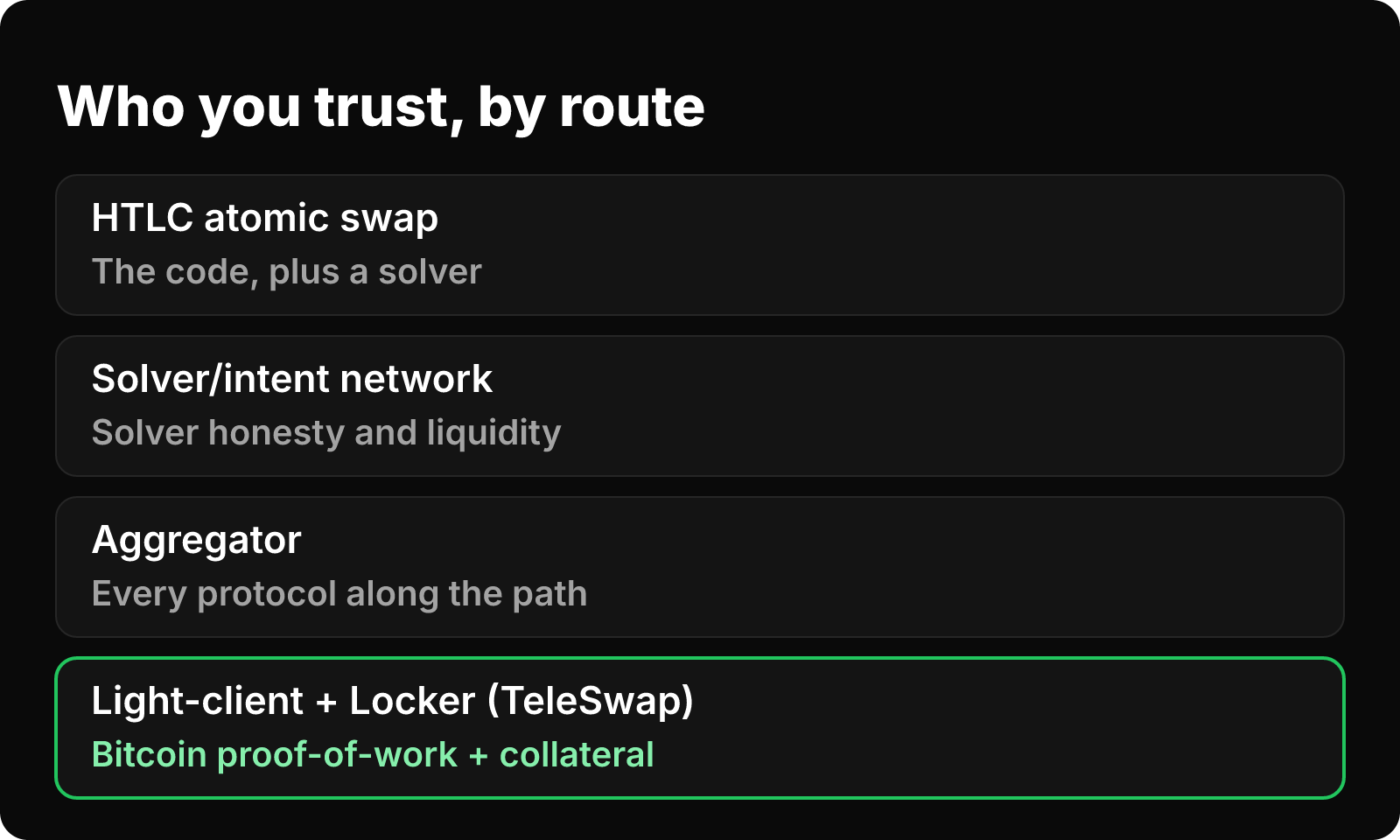
| Route type | How it works | Who you trust | Typical time |
|---|---|---|---|
| HTLC atomic swap (e.g., Garden) | Both sides of the trade complete, or your BTC is refunded after a set time | The code, plus a solver willing to fill your order | 3–6 min (Garden, vendor-stated) |
| Solver/intent network (e.g., BOB Gateway, NEAR Intents, Relay) | Solvers fill your order from their own funds | Solver honesty and the liquidity they hold | Minutes, depending on Bitcoin confirmations |
| Aggregator (e.g., Symbiosis) | Picks a path for you across partner liquidity, such as THORChain | Every protocol along the path | 13 min median (Symbiosis, vendor-stated, routes into BTC) |
| Light-client + Locker (e.g., TeleSwap) | Smart contracts check the Bitcoin transaction themselves, then a swap delivers USDC | Bitcoin proof-of-work plus collateral that can be slashed (taken as a penalty) | ~10 min |
"Basis points" (bps) are hundredths of a percent. A 65 bps gap on a $77,000 swap is about $500, and that is the gap in indicative quotes, not executed trades.
Which Route Is the Most Trust-Minimized?
Getting the cheapest quote is a different question from how safe a route is. In BOB's benchmark, the quote gap between the leading routes was often just a few basis points. A design that relies on trusted parties can fail completely. So we'd decide on the trust model first and compare price second.
A light client is a small program that checks Bitcoin's block headers and SPV proofs (short proofs that a transaction is included in a block) without storing the whole blockchain. TeleSwap uses this approach, explained in how SPV light-client bridges work. Its contracts mint TeleBTC, a 1:1 collateral-backed BTC token, only after they verify a Bitcoin transaction themselves. That means no custodian and no multi-sig committee has to vouch for your deposit. TeleBTC is then swapped into USDC in the same step, and a Teleporter covers destination-chain gas so you don't need any ETH. You can swap BTC to USDC on Ethereum or bridge BTC to USDC on Base. Usage over the last 30 days came to $43.5M, peaking at $2.1M on November 5, 2026 (TeleSwap network stats).
The trade-off: you have to wait for Bitcoin to confirm your payment. A route that claims to be faster is fronting you funds before that confirmation, and it carries the risk until it arrives.
How Do You Bridge BTC to USDC Safely?
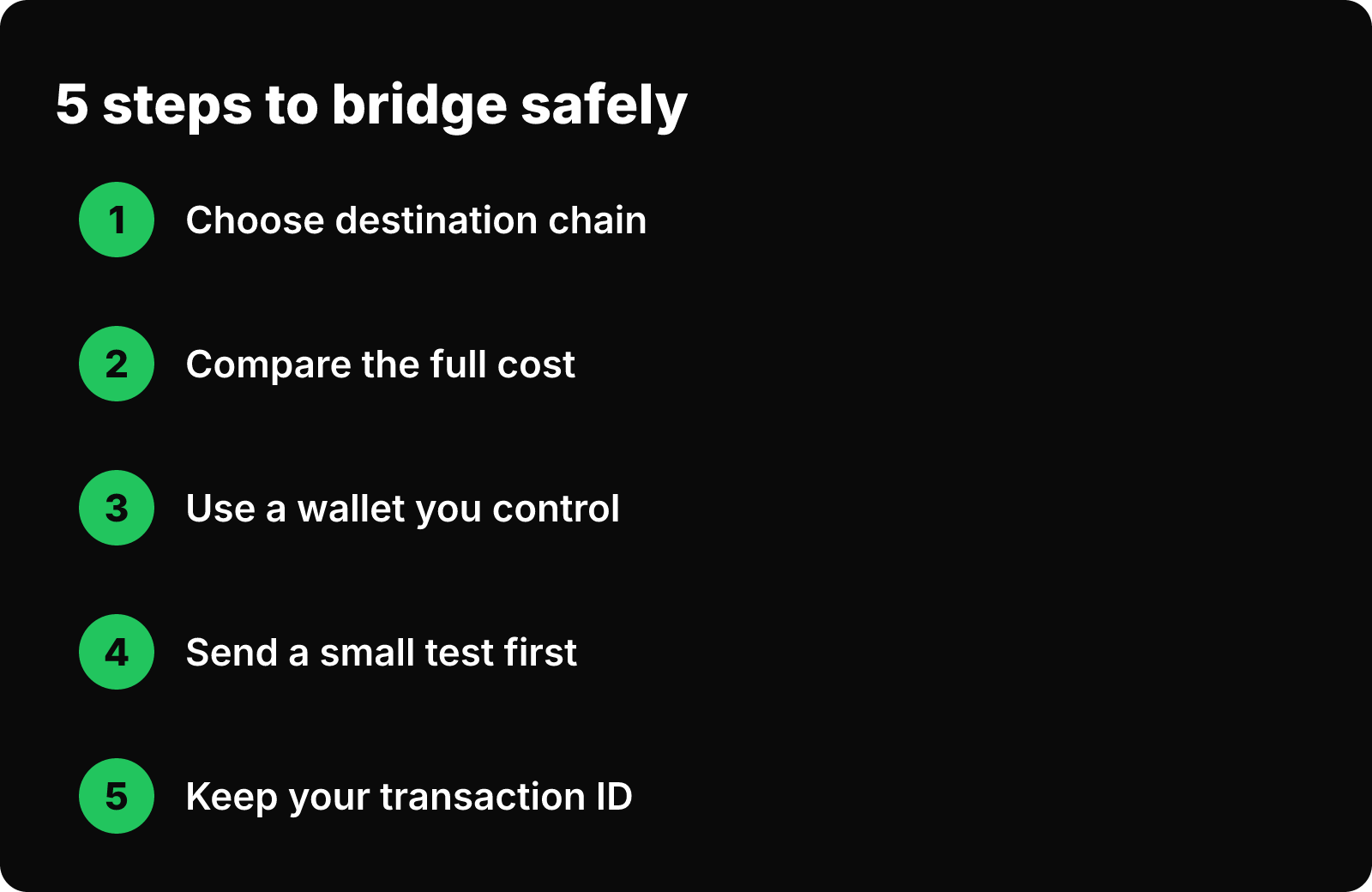
- Choose your destination chain first. USDC on Ethereum has deep liquidity, but gas there can reach about $15 when the network is busy (Symbiosis, vendor claim). On a small swap, that fee alone can cost more than the bridge fee. Base or Arbitrum are usually cheaper.
- Compare the full cost. Add up the protocol fee, the Bitcoin network fee, and the destination gas. Some quotes don't include origin-network gas.
- Use a wallet you control. Never send directly from or to an exchange deposit address.
- Send a small test amount first, then the full amount.
- Keep your Bitcoin transaction ID so you can track the transfer on a block explorer.
Frequently Asked Questions
Can I bridge BTC to USDC without an exchange?
Yes, cross-chain swap protocols turn native BTC into USDC without a centralized exchange account. You send BTC from your own wallet, and USDC arrives at the destination address you choose.
How long does a native BTC to USDC swap take?
Vendors state roughly 3 to 15 minutes. The main factor is Bitcoin's ~10-minute block time, and slow periods can push it longer.
Is wrapped BTC the same as native BTC?
No, wrapped BTC is a token on another chain that represents BTC held somewhere else. How safe it is depends on who holds that BTC: a custodian, a group of signers, or verified collateral.
Do I need ETH to receive USDC on Ethereum?
Not always, because some routes cover destination gas for you. On TeleSwap, a Teleporter covers destination-chain gas; check the quote on any other route so you don't receive USDC you can't move.
Which chain should I receive USDC on?
Pick the chain where you plan to spend or use the USDC. Layer-2 networks like Base and Arbitrum usually cost less to use afterward than Ethereum mainnet.
Conclusion
There isn't one best bridge for everyone. Quotes varied by up to 65 bps in one benchmark, the time is mostly decided by Bitcoin's block time, and the trust model is what protects your funds if something goes wrong. Pick a route that checks Bitcoin itself, test with a small amount, and compare full costs. When you're ready, get a live BTC → USDC quote at teleswap.xyz.