Trustless Crypto Swap vs Custodial Exchange: Key Differences (2026)

A trustless crypto swap settles through code and cryptography, so no company holds your coins during the trade. A custodial exchange holds your private keys and gives you a balance that is a claim against the company. Say you hold some Bitcoin and want some of it in USDC or ETH. You can sign up for an exchange, upload your ID, deposit your BTC and trust the company while you trade. Or you can use a trustless swap and never hand your coins to anyone.
This guide covers what "custodial" and "trustless" mean, how the main options compare on custody, time, fees and sign-up, and when each is the better choice.
Key Takeaways:A custodial exchange holds your private keys, so your balance is a claim against the company rather than coins you control.A trustless crypto swap settles through smart contracts or cryptographic proofs, so no company can freeze, lose or lend out your funds mid-trade.Skipping sign-up does not make a swap trustless, because many "instant swap" services still hold your coins for the length of the trade.TeleSwap verifies every Bitcoin deposit with SPV light-client proofs before minting TeleBTC, and has processed $560.5M across 594,845 bridge transactions according to TeleSwap network stats.Custodial exchanges still make sense for fiat on-ramps and active trading, while non-custodial swaps fit holders who want to stay in control of their coins.
Table of Contents
- What is a custodial exchange?
- What is a trustless crypto swap?
- Custodial vs trustless swap: side-by-side comparison
- Why "no sign-up" doesn't mean "trustless"
- How a non-custodial crypto swap works with TeleSwap
- Walkthrough: swapping BTC to USDC without a custodian
- When each option fits
- Frequently Asked Questions
- Conclusion
What is a custodial exchange?
A custodial exchange is a platform that holds the private keys to your crypto for you. The private key is the secret that controls coins on a blockchain. When you deposit, the coins go to addresses the exchange controls, and your account shows a number in the company's internal database.
Think of a coat check. You hand over your coat and get a ticket back. Usually you return the ticket and get your coat, but the ticket is only a promise. If the venue closes or refuses to give the coat back, the ticket is just paper.
As Ramp's guide to custodial vs non-custodial wallets explains, trades on a custodial platform settle on internal ledgers. That is why they feel instant. Nothing touches the blockchain until you withdraw, and the exchange decides when, and whether, that withdrawal goes through.
What custodial exchanges do well
- Fiat on-ramps: you can buy crypto with a bank card or transfer.
- Speed of trading: orders fill in seconds because they never leave the company's database.
- Customer support and account recovery: forget your password and you can reset it.
- Advanced tools: order books, limit orders and, in some places, margin trading.
Where the custodial model breaks
The risk is concentrated in one company. Hacks, account freezes, insolvency and withdrawal restrictions are the recurring failure modes. FTX filed for bankruptcy in November 2022, and the U.S. SEC later charged its founder with diverting customer funds. In February 2025, the FBI attributed the roughly $1.5 billion Bybit hack to North Korean actors.
None of this means every exchange is unsafe. It means that on a custodial platform, your safety depends on the company's security, solvency and honesty.
What is a trustless crypto swap?
A trustless crypto swap is an exchange of one cryptocurrency for another where no company or person ever takes control of your funds. Smart contracts, which are programs that run on a blockchain and execute automatically, or cryptographic proofs enforce the rules. You keep your keys until the swap settles.
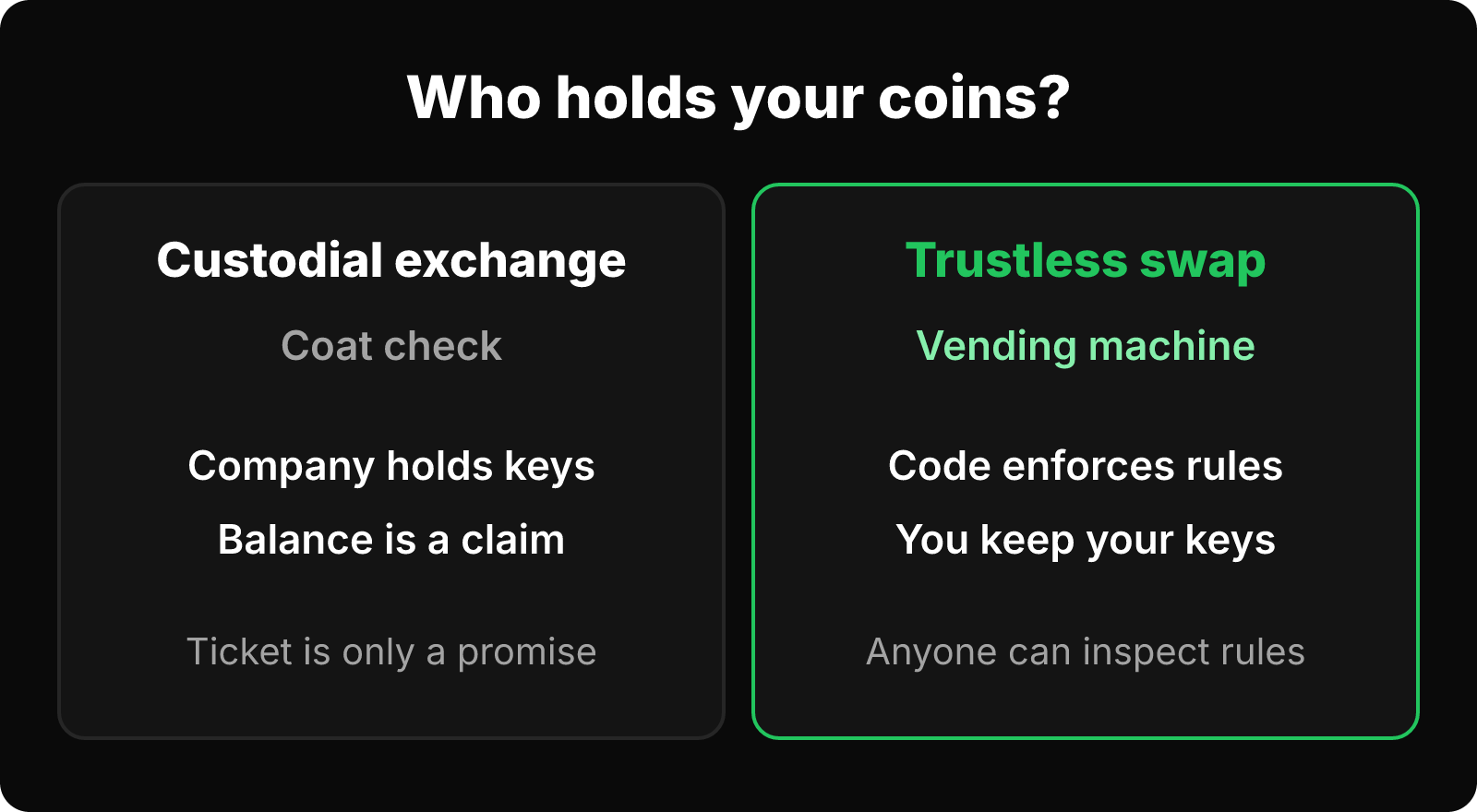
For a trustless swap, think of a vending machine. You put money in, the machine checks it, and the snack drops out. There is no clerk who could pocket your cash, and anyone can inspect the rules.
The Gemini Cryptopedia definition of "trustless" describes it as removing the need to trust an intermediary, because the system's rules are enforced by code and consensus. You are trusting math and open-source code instead of a company's promise. Trustless means trust-minimized, not risk-free.
The main types of non-custodial crypto swap
- DEX/AMM swaps (for example Uniswap). You connect a self-custody wallet and trade against a liquidity pool managed by a smart contract. See the Uniswap protocol docs. These work within a single blockchain.
- Atomic swaps. Two people lock funds under the same cryptographic "hash time-lock." Either both sides complete or both are refunded. They need no custodian, but liquidity is thin and the number of trading pairs is small.
- SPV-verified bridges (for example TeleSwap). A smart contract on the destination chain checks a mathematical proof that your Bitcoin transaction really happened before releasing anything. This is a practical way to move native BTC into tokens on other chains without a custodian. For the mechanics, see how Bitcoin bridges work with SPV light clients.
Custodial vs trustless swap: side-by-side comparison
We compared six common ways to swap crypto on what beginners ask about most: who holds the funds, how long it takes, what you pay, and whether you need an account. The table draws on Paybis' swap vs trade guide, Ramp, Gemini, and the TeleSwap documentation. Times are self-reported by vendors.
| Method | Who holds your funds | Typical time | Fees you pay | Sign-up / KYC | Main risk |
|---|---|---|---|---|---|
| Custodial exchange (CEX) | The exchange | Seconds to trade; withdrawal adds blockchain time | Trading fee + withdrawal fee | Account + ID verification | Hack, freeze, insolvency |
| DEX / AMM (e.g. Uniswap) | You (smart contract during the trade) | Minutes, depending on the chain | Pool fee + gas + slippage | Wallet only | Smart-contract bugs, slippage; one chain only |
| Atomic swap | Nobody (hash time-lock) | Often 20–60 min (vendor-reported) | On-chain fees on both chains | None | Thin liquidity, few pairs, must stay online |
| Instant swap service | The service, during the swap | Minutes | Spread built into the rate | Varies; can be requested | Custody mid-swap, discretionary freezes |
| P2P marketplace (Bisq, RoboSats) | Multisig escrow + mediator | Hours (fiat legs) | Trade fee + mining fees | None by platform | Counterparty and payment fraud |
| TeleSwap (SPV-verified bridge + swap) | No custodian; collateral-backed, slashable Lockers | ~10 min for fast swaps | Paid in Bitcoin assets; Teleporter covers destination gas | None, just a wallet | Smart-contract risk |
Two things stand out. A custodial exchange is only "instant" until you withdraw, because the real time to coins-in-your-wallet includes the withdrawal queue. And non-custodial options trade one kind of risk for another: instead of company risk, you take on smart-contract risk and the duty to protect your own keys.
Why "no sign-up" doesn't mean "trustless"
The most common beginner mistake is assuming that a swap without an account is a trustless swap. It often isn't.
Many "instant swap" websites work like this: you send BTC to an address they control, they convert it, and they send you the other coin. There's no sign-up, so it feels non-custodial. In practice the service holds your BTC for the length of the swap, and if its compliance team flags the transaction, your funds can sit frozen.
Ask one question: at any point, can a third party decide not to give my money back?
- If yes, the service is custodial, even if it never asks for your name.
- If no, because a smart contract or cryptographic lock enforces delivery or a refund, it is trust-minimized.
"No KYC" also doesn't mean "private." Bitcoin's ledger is public, and as the Bitcoin whitepaper notes, every transaction is announced to the whole network. A trustless swap protects your custody, not your anonymity. For a hands-on example, see swapping BTC to ETH without KYC.
How a non-custodial crypto swap works with TeleSwap
TeleSwap is a Bitcoin bridge and swap protocol that lets you move native BTC to EVM chains, TON and Solana, and swap it into tokens there, without handing your coins to a custodian. It works on a "check the proof, then pay out" model.
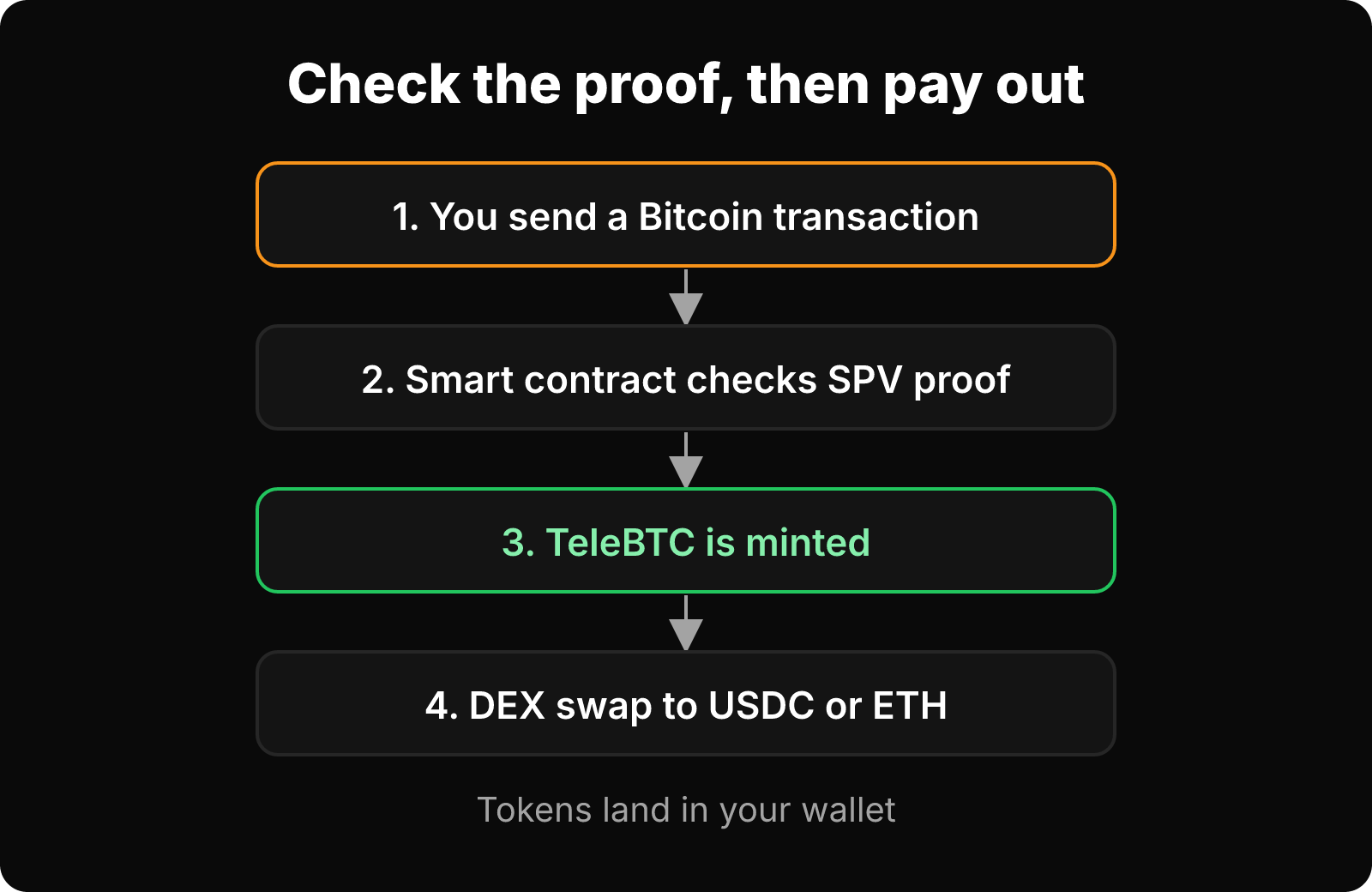
- You send a normal Bitcoin transaction.
- The destination chain verifies it with an SPV light-client proof. SPV (Simplified Payment Verification) is described in section 8 of the Bitcoin whitepaper. A light client checks a transaction against Bitcoin's proof-of-work block headers without downloading the whole blockchain. TeleSwap runs this check inside a smart contract.
- Only then is TeleBTC minted. TeleBTC is a 1:1, collateral-backed representation of BTC. Nothing is minted without a verified Bitcoin transaction.
- The swap happens in the same flow. TeleBTC is routed through a DEX into the token you asked for, such as USDC or ETH, and lands in your wallet.
BTC on the Bitcoin side is held by Lockers, permissionless operators who post collateral that can be slashed if they misbehave. This is the key difference from wrapped-BTC designs that rely on a single custodian or a multi-sig committee: TeleBTC is secured by SPV proofs of Bitcoin's own proof-of-work record, with economic guarantees from posted collateral. Full details are in the TeleSwap documentation.
According to TeleSwap network stats (retrieved 2026-11-13), the protocol has bridged $560.5M across 594,845 bridge transactions on 13 supported networks. In the last 30 days it processed $43.5M, about $1.4M per day on average, with a peak of $2.1M on 2026-11-05.
You may already be able to use it without visiting the site. TeleSwap is integrated as a Bitcoin swap provider in the Rango, Rubic and DZap aggregators, and it is available in MetaMask and Trust Wallet through the Rango integration.
Walkthrough: swapping BTC to USDC without a custodian
Here is what a trustless BTC → USDC swap on Arbitrum looks like. The same flow applies to other routes, such as BTC to ETH on Ethereum.
- Prepare two wallets. You need a Bitcoin wallet holding the BTC, and a destination address on Arbitrum (MetaMask or any EVM wallet). You don't need ETH for gas, because a Teleporter covers destination-chain gas and fees are paid in Bitcoin assets.
- Open the route. Go to the BTC to USDC (Arbitrum) page on TeleSwap.
- Enter the amount and destination address. Review the quote: the USDC you'll receive, the fees, and the estimated time.
- Send the Bitcoin transaction from your own wallet, as instructed. No exchange account is involved.
- Wait for verification. Once the Bitcoin transaction is confirmed, its SPV proof is checked on-chain, TeleBTC is minted, and it is swapped into USDC. Fast swaps settle in about 10 minutes.
- Check your wallet. USDC arrives at your Arbitrum address. To go back later, use USDC (Arbitrum) to BTC.
Beginner tip: Ramp notes that picking the wrong network is a common mistake when moving funds between wallets. An Arbitrum address and an Ethereum address look the same but are different networks, so check before you send.
When each option fits
This isn't all-or-nothing. Ramp's guidance describes a common pattern: keep a small working balance on an exchange and the rest in self-custody.
| Your situation | Better fit | Why |
|---|---|---|
| Buying your first crypto with a bank card | Custodial exchange | Fiat on-ramps and account recovery |
| Day-trading with limit orders | Custodial exchange | Order books and instant internal settlement |
| Moving BTC you hold long-term into stablecoins or DeFi | Trustless swap (e.g. TeleSwap) | Your coins never sit in a company's wallet |
| Swapping between tokens on one EVM chain | DEX / AMM | On-chain liquidity, wallet-only access |
| BTC ↔ another chain's token, no account | SPV-verified bridge (TeleSwap) | Native BTC in, destination token out, no custodian |
| Peer-to-peer BTC ↔ cash | P2P marketplace | Escrow handles the fiat side |
Custody risk scales with time and size. A small amount on an exchange for an hour is a minor exposure; a large amount there for months is a much bigger one. If you plan to hold BTC or put it to work in DeFi, a non-custodial crypto swap removes the step where you trust an exchange with it.
The trade-off is responsibility. With self-custody, no help desk can recover a lost seed phrase. Write it down offline, consider a hardware wallet for larger holdings, and test any new route with a small amount first.
Frequently Asked Questions
What is the difference between a custodial and a trustless swap?
In a custodial swap a company holds your funds during the trade, while in a trustless swap code and cryptographic proofs enforce the exchange and you keep control. On a custodial exchange, your balance is a claim against the company. With a trustless swap, a smart contract or hash time-lock delivers your coins or refunds them.
Is a trustless crypto swap completely risk-free?
No, a trustless swap removes custodian risk but not every risk. You still face smart-contract risk, slippage on DEX trades, and the risk of losing your own keys or sending to the wrong network. "Trustless" means you rely on open code and math instead of a company's promise.
Do I need to create an account or pass KYC for a non-custodial crypto swap?
Usually not, since a non-custodial swap only needs a self-custody wallet. Skipping sign-up doesn't by itself make a service trustless, though. Some instant swap sites take custody of your coins during the trade and can freeze them.
How does TeleSwap keep swaps trustless?
TeleSwap only mints TeleBTC after a smart contract verifies your Bitcoin transaction with an SPV light-client proof. The BTC is held by permissionless Lockers whose collateral can be slashed, rather than by a single custodian or multi-sig committee. The minted TeleBTC is then routed through a DEX into your chosen token in the same flow.
How long does a TeleSwap BTC swap take?
Fast swaps on TeleSwap settle in about 10 minutes. A Teleporter covers destination-chain gas, so you don't need to hold that chain's native token first.
Are custodial exchanges ever the better choice?
Yes, custodial exchanges are usually better for buying crypto with fiat and for active trading. They offer bank on-ramps, order books, instant internal settlement and account recovery. Many people keep a small working balance on an exchange and hold the rest in self-custody.
Is TeleBTC the same as WBTC?
No, TeleBTC is backed 1:1 by BTC and verified by SPV light-client proofs rather than a custodian. TeleBTC's minting depends on a verified Bitcoin transaction and collateral-backed, slashable Lockers, so it inherits Bitcoin's security model more directly than designs that rely on a custodian or multi-sig committee.
Conclusion
The difference between a custodial exchange and a trustless crypto swap comes down to one question: who holds your coins while the trade happens? Custodial exchanges give you speed, fiat access and support, but your balance is only as safe as the company. A trustless swap replaces that promise with verifiable code. The remaining risks are smart-contract bugs and keeping your own keys safe.
For Bitcoin holders who want to move BTC into USDC, ETH or other tokens without an account or a middleman, TeleSwap offers SPV-verified, collateral-backed swaps that settle in about 10 minutes, with $560.5M bridged to date per TeleSwap network stats. Start with a small amount, check your destination network, and see how it works.