Binance Hack Explained: How $6.3B Vanished in 20 Minutes

The Binance hack explained in two sentences: at 20:05 UTC on October 29, 2026, attackers started draining Binance's hot wallets, and about 20 minutes later roughly $6.3 billion had left the exchange across 10 blockchains, according to McAfee's summary of TRM Labs' analysis. Nobody broke Binance's cryptography. The attackers got in through a fake job interview.
This article explains how the attack worked step by step, who lost money, and what you can do so your own coins are not caught up in the next one. You don't need any crypto background. Where a technical term comes up, we explain it.
Key Takeaways:Attackers drained about $6.3B from Binance hot wallets across 10 blockchains in roughly 20 minutes on October 29, 2026, per TRM Labs as cited by McAfee.Binance's investigation traced the breach to an engineer who was tricked into installing malware during a fake job interview, according to BBC reporting from November 2026.The blockchain accepted every stolen transfer because the attackers controlled Binance's own withdrawal-signing system, so each transaction carried a valid signature.Roughly $3B of the stolen assets, mostly USDT and USDC, was frozen by stablecoin issuers, while TRM Labs estimated about $2.4B stayed out of reach.Binance said its reserves covered more than 100% of the loss, but customers could not withdraw from October 29 until withdrawals reopened around November 1, 2026.
Table of Contents
- What Is a Hot Wallet, and Why Do Hackers Target It?
- How Did the Binance Hack Work, Step by Step?
- Why Didn't the Blockchain Stop the Theft?
- Who Lost What in the Binance Hack?
- How Does It Compare to Other Crypto Hacks?
- What Does This Teach Us About Bridge Hack Prevention?
- How to Protect Your Crypto From Hacks: 8 Steps
- The Three-Question Test for Any Place You Store Crypto
- Frequently Asked Questions
- Conclusion
What Is a Hot Wallet, and Why Do Hackers Target It?
A hot wallet is a crypto wallet that stays connected to the internet so it can send funds right away. Exchanges rely on them to pay out withdrawals automatically, as McAfee explains in its breakdown of the heist.
Think of an exchange as a bank branch. The cold wallet is the vault in the basement: offline, slow to open, hard to break into. The hot wallet is the cash drawer at the teller's window. It holds enough money for the day's withdrawals, and it has to be easy to open.
That convenience is why most crypto exchange hacks start at the hot wallet. In crypto the teller is a signing system: software that holds or controls the private key, the secret number that proves ownership, and approves each outgoing transaction.
An attacker doesn't need to steal the key. Taking control of the teller works just as well.
How Did the Binance Hack Work, Step by Step?
The attack took weeks of patient human manipulation and ended in a 20-minute drain. Binance's account changed between its first statement on October 29 and its fuller investigation around November 3. The later account adds detail to the first more than it contradicts it. Here is the sequence as reported:
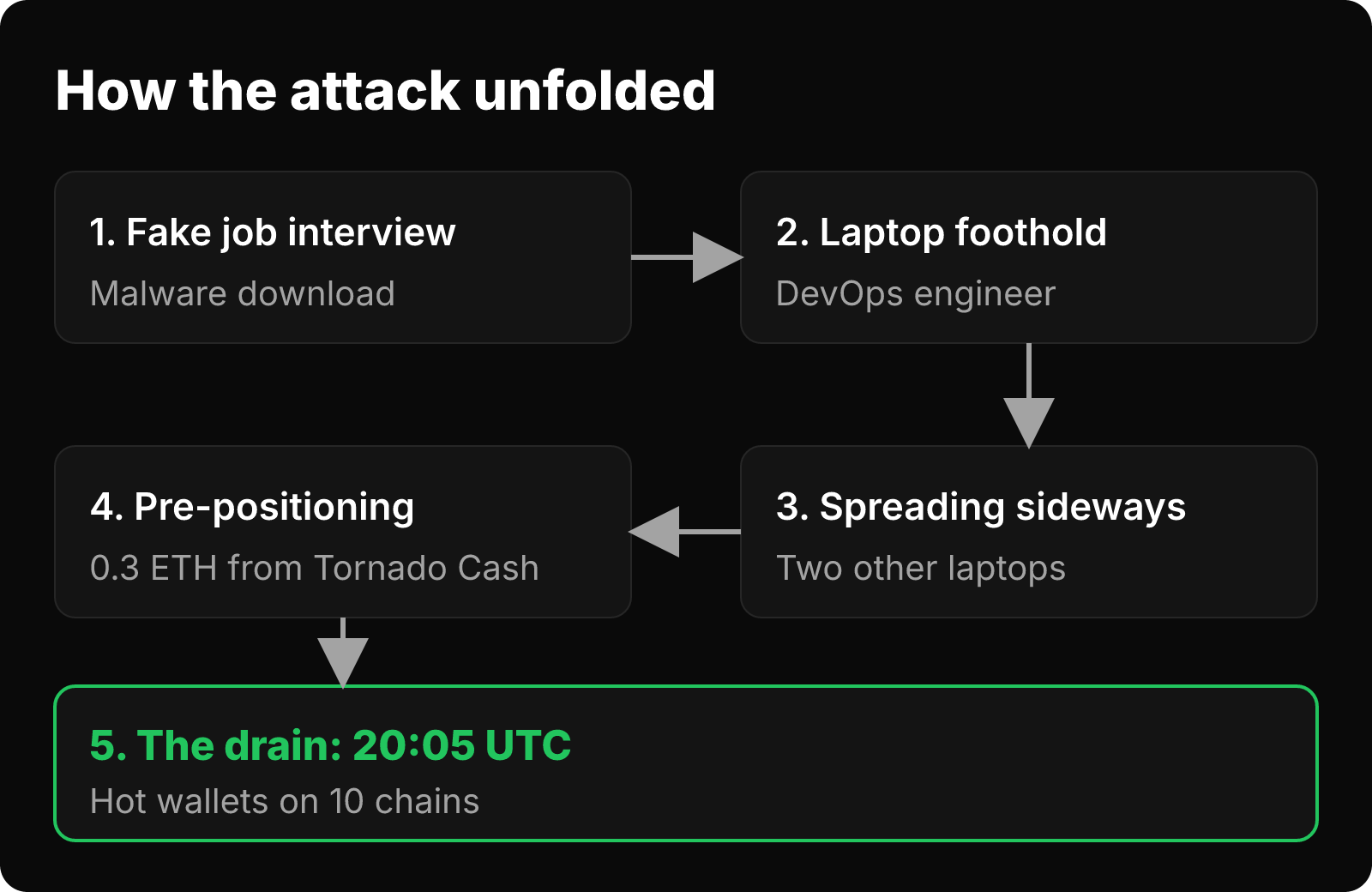
- The fake job interview. A Binance engineer was approached about a job. In a second interview, they were asked to download an "assignment" that was actually malware, and it used obfuscation techniques to avoid detection, according to the BBC.
- A foothold on a work laptop. Binance's first statement said the incident "may involve a compromised DevOps engineer's laptop, which allowed an attacker to gain access to a service container and submit unauthorized withdrawal transactions," as quoted by CoinDesk. (A DevOps engineer maintains the company's internal infrastructure, which is why that access was so valuable.)
- Spreading sideways. Using the first compromised computer and an internal AI tool, the attackers took over two other engineers' laptops (BBC). Security people call this "lateral movement."
- A long, quiet wait. The security group SEAL reportedly described an intrusion window of about 8 weeks before the exploit, per Cointelegraph. This figure comes from a headline-level source and is not confirmed in full reporting. If it holds, the attackers were inside for roughly two months without being caught.
- Pre-positioning. On October 28, the address later used to receive the stolen funds got 0.3 ETH from Tornado Cash, a mixing service that hides where coins came from. The attackers also reportedly rehearsed, according to The Conversation.
- The drain. At 20:05 UTC on October 29, the attackers used Binance's withdrawal system to empty hot wallets on 10 chains. One transaction alone moved 64 different tokens worth about $2.5B (The Conversation).
- Running from the freezes. The attackers hurried to swap stablecoins into Ether, which has no central issuer that can freeze it, Redwerk notes.
- Laundering. By November 4, the attackers had reportedly moved 81% of the stolen SOL and kept laundering through THORChain, a cross-chain swap network (Cointelegraph).
Not one of these steps required breaking encryption. The way in was a person, a laptop, and a download that looked legitimate. For a beginner, that is the most useful lesson about how crypto exchange hacks happen.
Why Didn't the Blockchain Stop the Theft?
The blockchain processed the theft because every transfer was signed correctly. A blockchain checks one thing: does this transaction carry a valid signature from the key that owns these funds? It has no idea who was at the keyboard.
Redwerk sums it up: from the blockchain's point of view, "a stolen key and a hijacked signer look the same." Binance said it found "no evidence of any wallet private key leak" (CoinDesk), and CNBC reported the early conclusion of unauthorized transfers from withdrawal systems.
One big question is still open. The Conversation points out that valid Binance signatures were needed to drain the wallets, and nobody has explained how the attackers got them. Investigators reportedly believe one signing system may have served Binance's wallets on every chain (Redwerk). That would explain how a single breach opened 10 chains within minutes, but it is unconfirmed.
Our view: the industry has spent years arguing about key storage: hardware security modules, multi-signature setups, cold storage ratios. This hack is a reminder that the dangerous component is often the software that decides when to use the key. If one automated signer can approve withdrawals on every chain, the whole system is only as secure as that signer.
Who Lost What in the Binance Hack?
Binance absorbed the financial loss and customers lost access for about three days, if the exchange's numbers are accurate. The table below brings the main figures together. Some differ by source and by when they were reported.
| Metric | Figure | Source |
|---|---|---|
| Total stolen | ~$6.3B (Binance); ~$6.36B (TRM Labs) | CoinDesk, McAfee |
| Frozen by issuers (late Oct 29) | ~$3B, including $2.3B in USDT and USDC | CoinDesk, WSJ |
| Frozen (Chainalysis, Oct 30) | ~$2.8B | Redwerk |
| Out of reach, held by attacker | ~$2.4B | TRM Labs via WSJ |
| SAFU emergency fund | ~$1B | CNBC, McAfee |
| Company funds reserved | >$6.34B (~$5B in the exact stolen tokens) | Richard Teng, via McAfee |
| Net withdrawals after reopening (Nov 1) | $3.6B (~2.1% of exchange assets) | Redwerk |
Customers
Binance suspended withdrawals worldwide on October 29. It said 98% of affected token assets had been "replenished" by Saturday and restored withdrawals on Sunday, the BBC reported, and claimed reserves covered "more than 100%" of the loss. Customers who needed their money during those days couldn't reach it. Bitcoin, Ether, and other major coins also fell sharply on the news.
Binance
The SAFU fund (Secure Asset Fund for Users) held about $1B. That was a small fraction of a $6.3B loss, so Binance had to draw on company funds. Its balance sheet was large enough to cover the loss, and no insurance pool could have done it alone.
The attacker
TRM Labs attributes the attack with "high confidence" to TraderTraitor, a North Korean hacking group, according to CoinDesk. North Korea denied involvement. The FBI and Secret Service are helping trace the funds, but our sources contain no formal US government attribution.
Freezable stablecoins limited the damage: Tether and Circle began blocking tokens less than an hour after the attack (Redwerk). The power to freeze funds is the centralization many crypto users distrust, and here it kept roughly half the stolen value out of the attacker's hands.
How Does It Compare to Other Crypto Hacks?
The Binance hack is the largest crypto theft on record, about four times the $1.5B Bybit hack of February 2025, per McAfee.
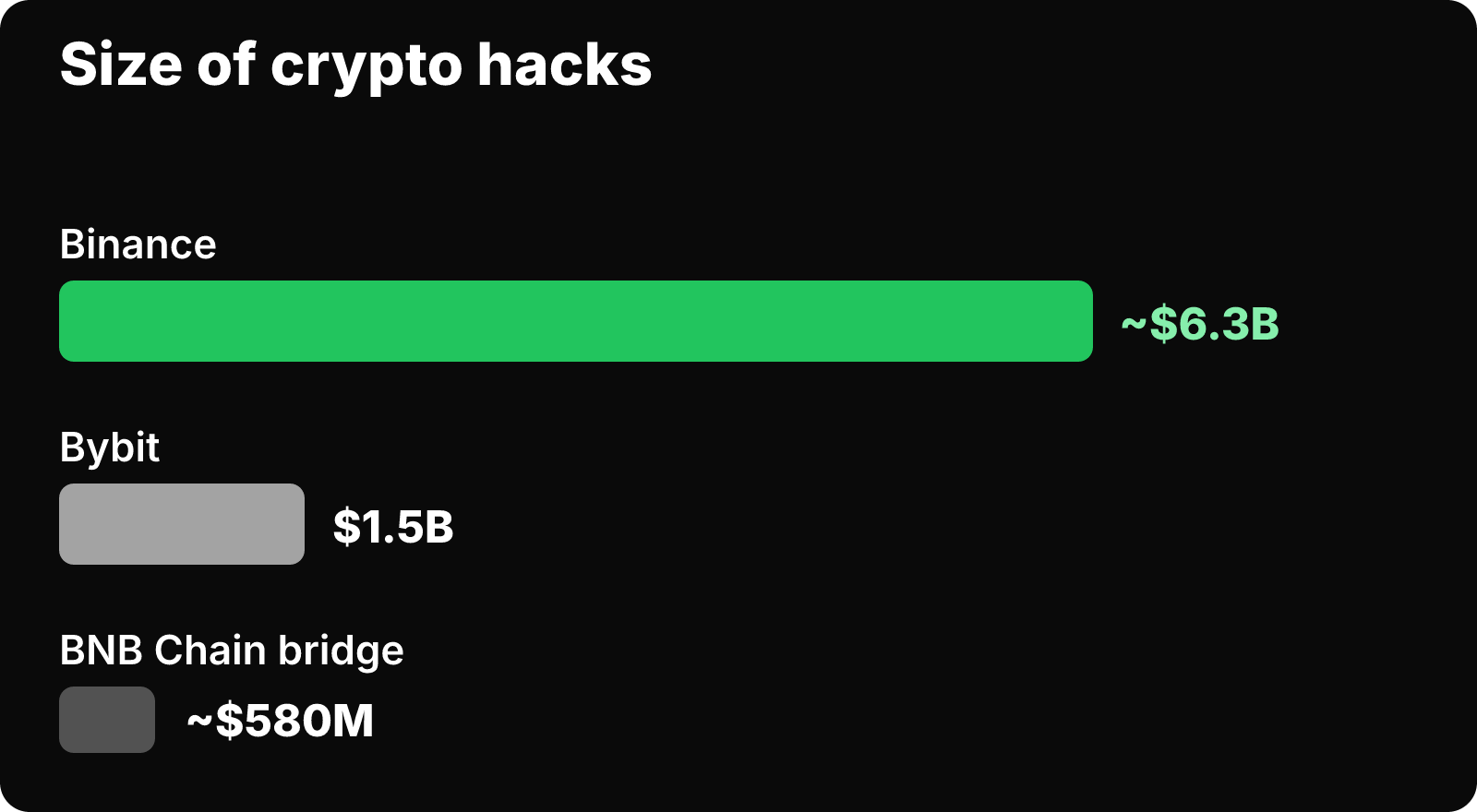
| Incident | Date | Amount | Attack surface | Entry point |
|---|---|---|---|---|
| Binance | Oct 29, 2026 | ~$6.3B | Exchange hot wallets, 10 chains | Fake job interview → malware → hijacked withdrawal system |
| Bybit | Feb 2025 | $1.5B | Exchange wallet | Previous record holder |
| BNB Chain bridge | Older event (date not confirmed in our sources) | ~$580M | Cross-chain bridge | Bridge exploit, per Investing.com |
The BNB Chain bridge exploit was a separate, older event and had nothing to do with the 2026 hack. We include it because it shows a related weakness: a bridge or an exchange is only as strong as whatever decides that a withdrawal is legitimate. For more, see biggest crypto bridge hacks.
What Does This Teach Us About Bridge Hack Prevention?
The main lesson for bridges is to avoid any single party, or single machine, whose approval is enough to release funds. A blockchain bridge moves assets from one chain to another, usually by locking them on the first chain and issuing a matching token on the second. The weak spot is the step that confirms "yes, the deposit really happened."
Many bridges and wrapped-Bitcoin products answer that question with a trusted party, such as a custodian (WBTC, cbBTC) or a committee of signers (tBTC). If those parties are compromised, and the Binance hack shows that people and laptops can be, the attacker can authorize withdrawals that look valid. Whoever controls the signer controls the money.
A trust-minimized bridge checks the source chain directly instead. TeleSwap, a Bitcoin bridge, uses SPV light-client proofs (compact cryptographic evidence that a transaction is included in a Bitcoin block) so that TeleBTC, its 1:1 wrapped BTC, is minted only after a verified Bitcoin transaction, with custody that is collateral-backed and slashable rather than held by a custodian or multi-sig committee. The bridge has processed 600,781 transactions and $566.6M in total volume, according to TeleSwap network stats. No design removes risk completely, since smart contracts and the people running infrastructure can still fail. The aim is to reduce how much depends on any one human. See how SPV light-client bridges work.
How to Protect Your Crypto From Hacks: 8 Steps
The best protection is to limit how much of your crypto depends on someone else's security. These steps are ordered from most to least important for a typical user:
- Keep only what you actively trade on an exchange. Coins you plan to hold should go to a wallet where you control the keys (self-custody). Binance users got their money back, but your access still depended on one company's balance sheet.
- Use a hardware wallet for long-term holdings. A hardware wallet keeps your private key offline, like having your own cold vault. Write down your seed phrase (the backup words) on paper and store it somewhere safe.
- Never share your seed phrase, with anyone, for any reason. Scammers take advantage of breach news. McAfee warns users to use only official apps and to ignore "urgent" messages offering to "secure" or "recover" funds.
- Read your exchange's terms. CNBC suggests checking whether the terms say you "retain title" to your assets, whether customer funds are segregated, and whether the exchange can lend your coins out, in its post-hack guide.
- Spread your risk. If you need exchange accounts, don't put everything in one. A three-day withdrawal freeze is easy to live with on 20% of your holdings. On 100% it's a real problem.
- Use a hardware security key or authenticator app for 2FA. Text-message codes can be stolen through SIM swaps.
- Treat unexpected downloads as hostile. The Binance attack began with an "assignment" file in a job interview. Never run files from strangers on a device that touches your funds.
- Check how a bridge verifies deposits before you use it. Ask whether a custodian, a committee, or on-chain proof of the source-chain transaction decides that your deposit is real. If you're moving BTC from your own wallet, for example swapping BTC to USDC on Ethereum, you can avoid depositing it on an exchange at all.
Self-custody comes with its own trade-off. Nobody can drain an exchange wallet you aren't using, but nobody can reimburse you if you lose your seed phrase either. Take the time to set it up properly.
The Three-Question Test for Any Place You Store Crypto
This is the simplest crypto hack lesson for users that we can offer. Before you trust any exchange, bridge, or app with your coins, ask three questions. For a deeper comparison, see trustless swaps vs custodial exchanges.
| Question | Exchange (e.g., Binance) | Custodial / multi-sig bridge | Light-client bridge | Self-custody wallet |
|---|---|---|---|---|
| 1. Who holds the key? | The exchange | A custodian or committee | Collateral-backed operators; minting gated by on-chain proofs | You |
| 2. Who can approve a withdrawal? | The exchange's signing system | The signer set | Smart contracts checking proofs of the source chain | Only you |
| 3. Who can make you whole? | The company's reserves (e.g., SAFU, treasury) | Varies by operator | Slashable collateral, depending on the design | No one, so backups are your job |
Each answer tells you where the single point of failure is. In the Binance case, the answer to question 2 was one hijackable system. Binance passed question 3, which is why customers got their funds back. You won't always be dealing with a company that can cover $6.3B on its own.
Frequently Asked Questions
How did the Binance hack happen?
Attackers tricked a Binance engineer into installing malware during a fake job interview, then used that access to take over Binance's withdrawal system. From there they spread to two other engineers' laptops with the help of an internal AI tool. On October 29, 2026, they drained about $6.3B from hot wallets across 10 blockchains in about 20 minutes, according to reporting by the BBC and TRM Labs.
Did Binance users lose their money?
Binance says customers were covered by its SAFU fund and company reserves. The exchange said its reserves covered more than 100% of the loss and that 98% of affected token assets were replenished by the Saturday after the attack. Users could not withdraw from October 29 until withdrawals reopened around November 1, 2026.
Who was behind the Binance hack?
TRM Labs attributes the hack with high confidence to TraderTraitor, a North Korean hacking group. North Korea has denied involvement. The FBI and Secret Service are helping trace the funds, but no formal US government attribution appears in the sources available as of mid-November 2026.
Were Binance's private keys stolen?
Binance said it found no evidence that any wallet private key leaked. The attackers appear to have hijacked the system that signs withdrawals, which makes the real key approve the attacker's transactions. How they obtained valid signatures has not been explained.
Is it safe to keep crypto on an exchange?
It is reasonable for funds you actively trade, but it means trusting the exchange's security and its finances. Exchanges keep hot wallets online for fast withdrawals, and that makes them targets. Long-term holdings are generally better kept in a self-custody wallet such as a hardware wallet, as long as you back up your seed phrase safely.
How can I protect my crypto from hacks?
Keep only trading balances on exchanges, store long-term holdings in a hardware wallet, and never share your seed phrase. Also use app-based or hardware-key 2FA, spread funds across platforms, read exchange terms about asset ownership and lending, and be wary of scams that follow breach news.
Are crypto bridges safer than exchanges?
It depends on how the bridge verifies deposits. Bridges that rely on a custodian or a small committee of signers share the Binance weakness: compromise the signer and the funds move. Bridges that verify the source chain directly with light-client proofs remove that single point of approval, although smart-contract and operational risks remain.
Conclusion
The Binance hack, at about $6.3B and roughly 20 minutes, was a human-security failure. Attackers got in through a fake job interview and drained the hot wallets by hijacking the system that signs withdrawals, without breaking any cryptography. Binance says it covered customers from its reserves, and freezable stablecoins kept roughly half the stolen value from the attacker.
For your own crypto: keep exchange balances small, hold long-term coins in self-custody, and before using any bridge or platform, ask who can approve a withdrawal. If you move Bitcoin across chains, consider a bridge where the answer is on-chain proof of a real Bitcoin transaction rather than a trusted signer. You can read how that model works at teleswap.xyz/docs.