
Binance Hack Bitcoin Sell-Off Explained for Bridge Users (2026)


In two sentences: On the afternoon of October 29, 2026, attackers used Binance's own compromised signing keys to empty the exchange's hot wallets on about 10 blockchains, taking somewhere between $3.3 billion and $6.3 billion depending on who you ask. Bitcoin dropped about 5% over the next two days and mostly recovered, then fell another 13.5% in mid-November as leveraged traders were forced out of their positions.
That second sentence is where most headlines get it wrong. This article explains the Binance hack and the Bitcoin sell-off step by step for readers who are new to crypto. We cover how the theft worked, who lost what, why a hack at one company moved the price of an asset nobody can hack directly, and what you should change about how you store and move your own Bitcoin, including when you use a bridge.
Key Takeaways:The October 29, 2026 Binance theft was not a blockchain bug or a bridge exploit: every stolen transfer was signed with Binance's own keys, according to Redwerk's analysis.Reported losses range from $3.3 billion (Blockaid's count of hot-wallet outflows) to $6.3 billion (Binance's figure), and the total had not been finalized as of late November 2026.Bitcoin's first drop after the hack was 5.1% and was nearly erased by November 4, 2026, according to 21Shares.The deeper 13.5% fall to $63,821 between November 11 and 14, 2026 was mainly attributed by 21Shares to forced liquidations of leveraged bets, not to the attacker selling stolen coins.The attacker's 18,270 BTC were still unspent in mid-November 2026, per Elliptic data cited by 21Shares.
Table of Contents
- What Happened in the Binance Hack?
- How Did the Attack Work, Step by Step?
- Who Lost What?
- How Do Exchange Hacks Move the Bitcoin Price?
- What Does This Mean for Bitcoin Bridge Security?
- Crypto Exchange Hack Lessons: 7 Steps to Protect Yourself
- Frequently Asked Questions
- Conclusion
What Happened in the Binance Hack?
Attackers took control of the approval system Binance uses to send crypto out of its online wallets, then drained those wallets across Bitcoin, Ethereum, Tron, Solana and several other chains on October 29, 2026. That's the short version, based on Redwerk's technical breakdown. For a deeper account, see our Binance hack explainer.
Here's how the following days played out, with every date tied to a source:
| Date (2026) | Event | Source |
|---|---|---|
| Oct 29, afternoon | Hot wallets on ~10 chains drained | Redwerk |
| Oct 29–30 | Bitcoin slides from a 24-hour high of $81,890 to $78,177 | Bitcoin Magazine |
| Oct 30 | Deposits open, withdrawals paused; Binance targets resumption "within 48 hours" | Open The Magazine |
| Oct 30 (Fri) | Bitcoin hits a six-week low; more than $1.6B in liquidations | Yahoo Finance/Stocktwits |
| Nov 4 | Bitcoin has recovered almost all of its 5.1% post-hack drop | 21Shares |
| Nov 11–14 | Bitcoin falls 13.5% to $63,821 as leveraged longs are liquidated | 21Shares |
One warning before going further. Many of these numbers were still changing in late November 2026. Binance and law enforcement had not published a formal root-cause report, and some widely shared claims, including that North Korea's TraderTraitor group was behind the attack, came from a single outlet and are unconfirmed.
How Did the Attack Work, Step by Step?
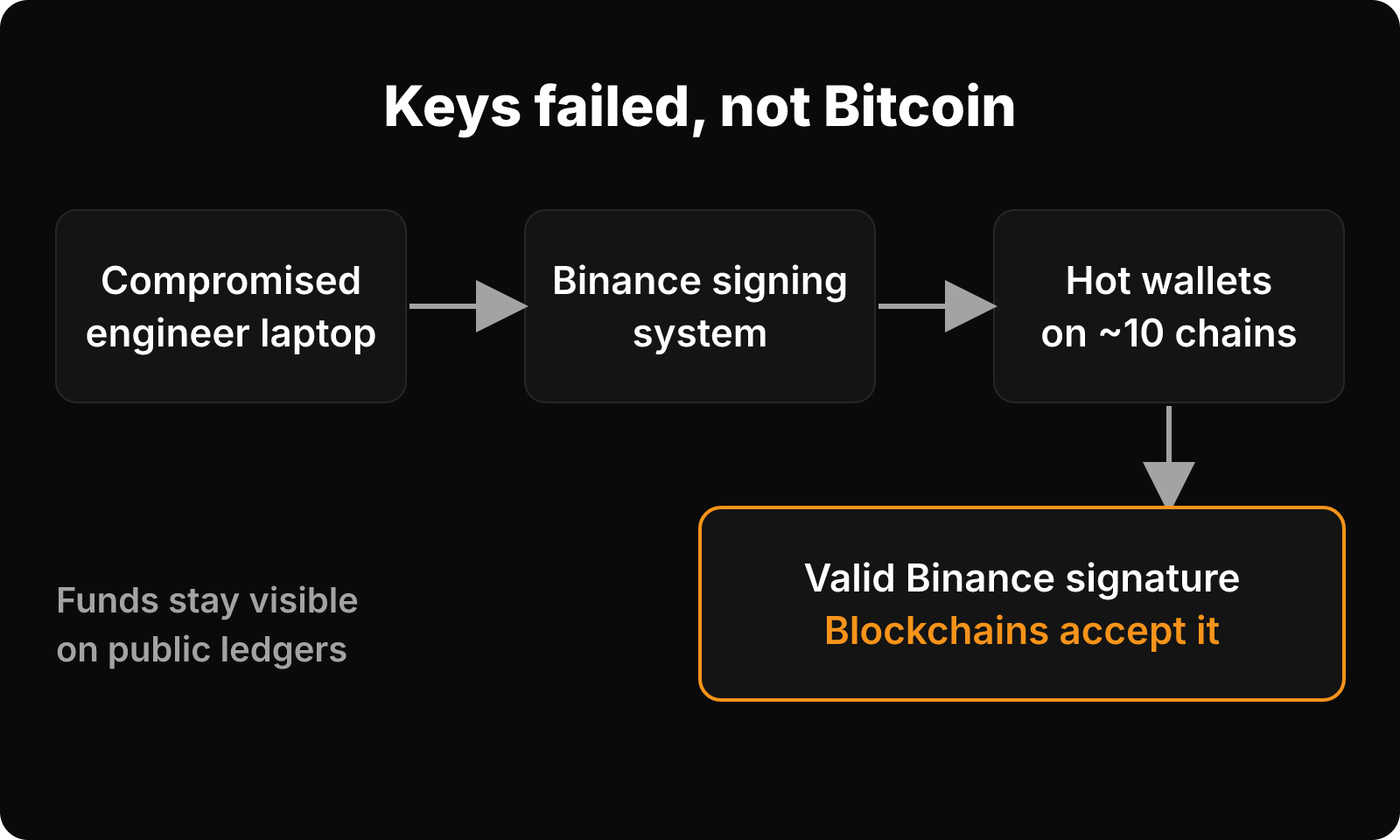
The attackers didn't break Bitcoin. They got hold of the keys Binance uses to approve withdrawals, so the blockchain accepted the stolen transfers as legitimate. The vocabulary is easier to follow with an analogy.
Hot wallets vs. cold storage: the cash register and the vault
Picture a large store. Most of its money sits in a back-room vault that is hard to open. That's cold storage, meaning crypto held on devices that never connect to the internet. A smaller amount stays in the cash register at the front so customers can be served quickly. That's the hot wallet, an internet-connected wallet the exchange uses to process your withdrawal within minutes.
Whoever holds the register key can open the register. On a blockchain, that "key" is a private key, a secret number that produces a digital signature. Bitcoin's network checks one thing only: whether the signature is valid. It does not check who is holding the pen.
The attack, in five steps
- Initial access. Binance said the entry point was a compromised engineer's laptop. It later mentioned "additional points of breach," so the full root cause is still open, per Redwerk's summary of Binance updates.
- Reaching the signing system. From inside, the attackers got their withdrawals approved by Binance's own systems.
- Draining hot wallets on many chains. Funds left Binance's hot wallets on roughly 10 networks, including Bitcoin, Ethereum, Tron and Solana.
- The blockchains accepted every transfer. Each transaction carried a valid Binance signature, so miners and validators had no basis to reject it.
- The money stayed visible. Public ledgers let investigators trace where the funds went afterward.
Step 4 is the part beginners most often misread. "Bitcoin got hacked" is the wrong takeaway. A company's key management failed. Bitcoin's ledger did exactly what it was built to do: it recorded validly signed transactions, and confirmed transactions generally cannot be reversed.
Who Lost What?
Binance itself took the direct loss, and it has said it set aside reserves to cover customers. Ordinary users were hit in other ways: withdrawals paused, prices fell, and leveraged traders were liquidated.
How much was stolen?
| Estimate | Who said it | What it measures |
|---|---|---|
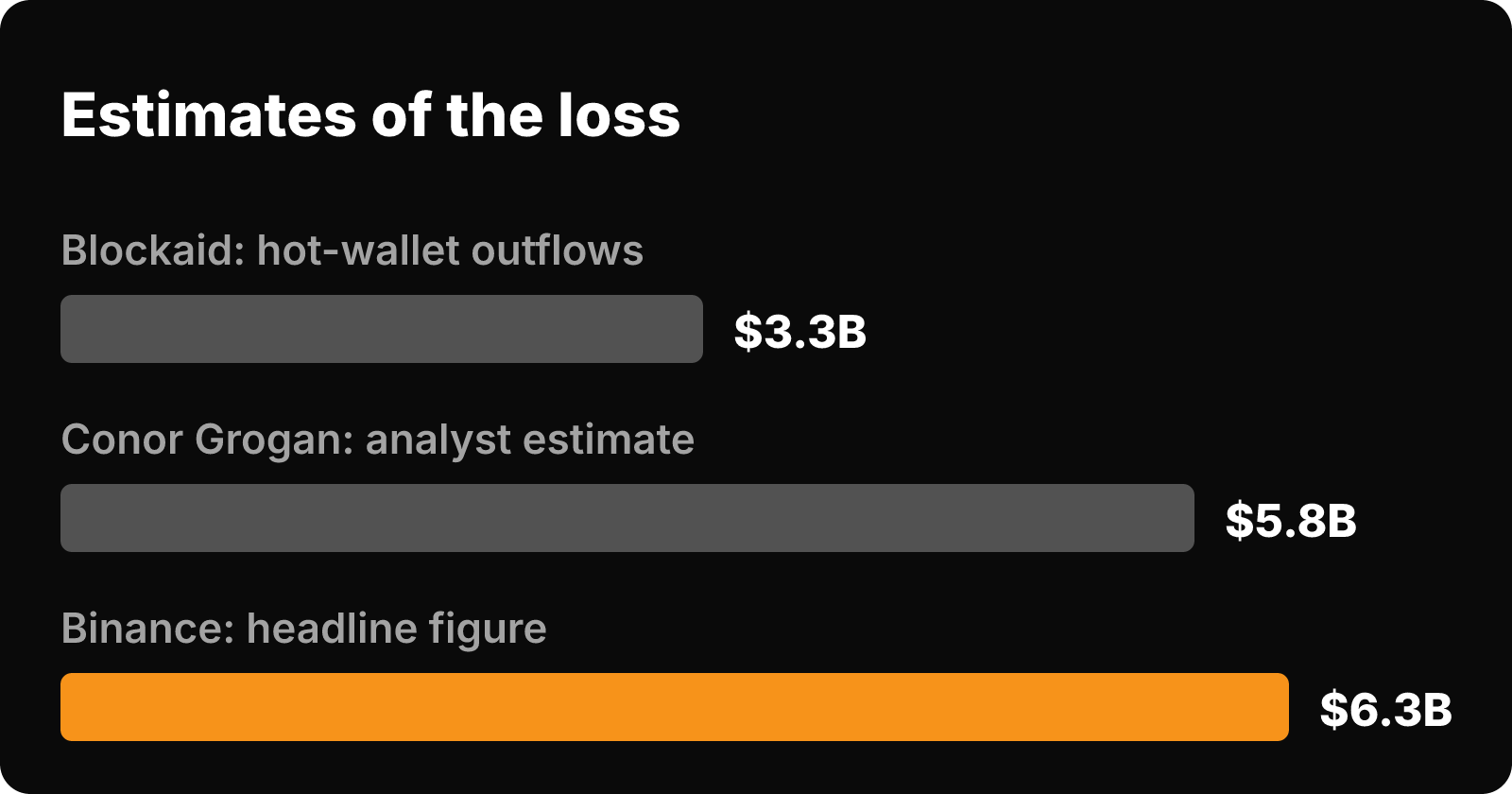
| $3.3B | Blockaid | Outflows from hot wallets |
| $5.8B | Conor Grogan (Coinbase), on social media | Analyst estimate |
| $6.3B | Binance, as reported by Stocktwits | Headline loss figure |
| ~0.7% of customer assets | Estimate cited by Bitcoin Magazine | Estimated realized loss; unverified |
Why are the estimates so far apart? They likely measure different things, and sources disagree. "Funds that left the wallet" is a different quantity from "funds that are gone for good." About $3 billion was frozen and in the process of being recovered, according to Open The Magazine.
Who absorbed it
- Binance: said it set aside more than $6.34 billion in company funds, including $5 billion in the affected tokens, per Yahoo Finance/Stocktwits. Binance also has its Secure Asset Fund for Users (SAFU), an emergency reserve it used after a 2019 hot-wallet breach of about 7,000 BTC.
- Stablecoin issuers: Tether reportedly froze more than $1.567 billion in USDT, and Circle about $823 million in USDC (a secondary-source figure), per Bitcoin Magazine.
- Binance customers: could deposit but not withdraw while the pause lasted. Former CEO Changpeng Zhao, now a shareholder, said he expects "all user funds will be fully covered." That is a statement from a shareholder, not an audited accounting.
- Leveraged traders: were hit hard by liquidations. They're covered in the next section.
How Do Exchange Hacks Move the Bitcoin Price?
Exchange hacks move the Bitcoin price mostly through fear and leverage, not through the stolen coins being sold. The October 2026 case shows this clearly.
Phase one: the fear dip
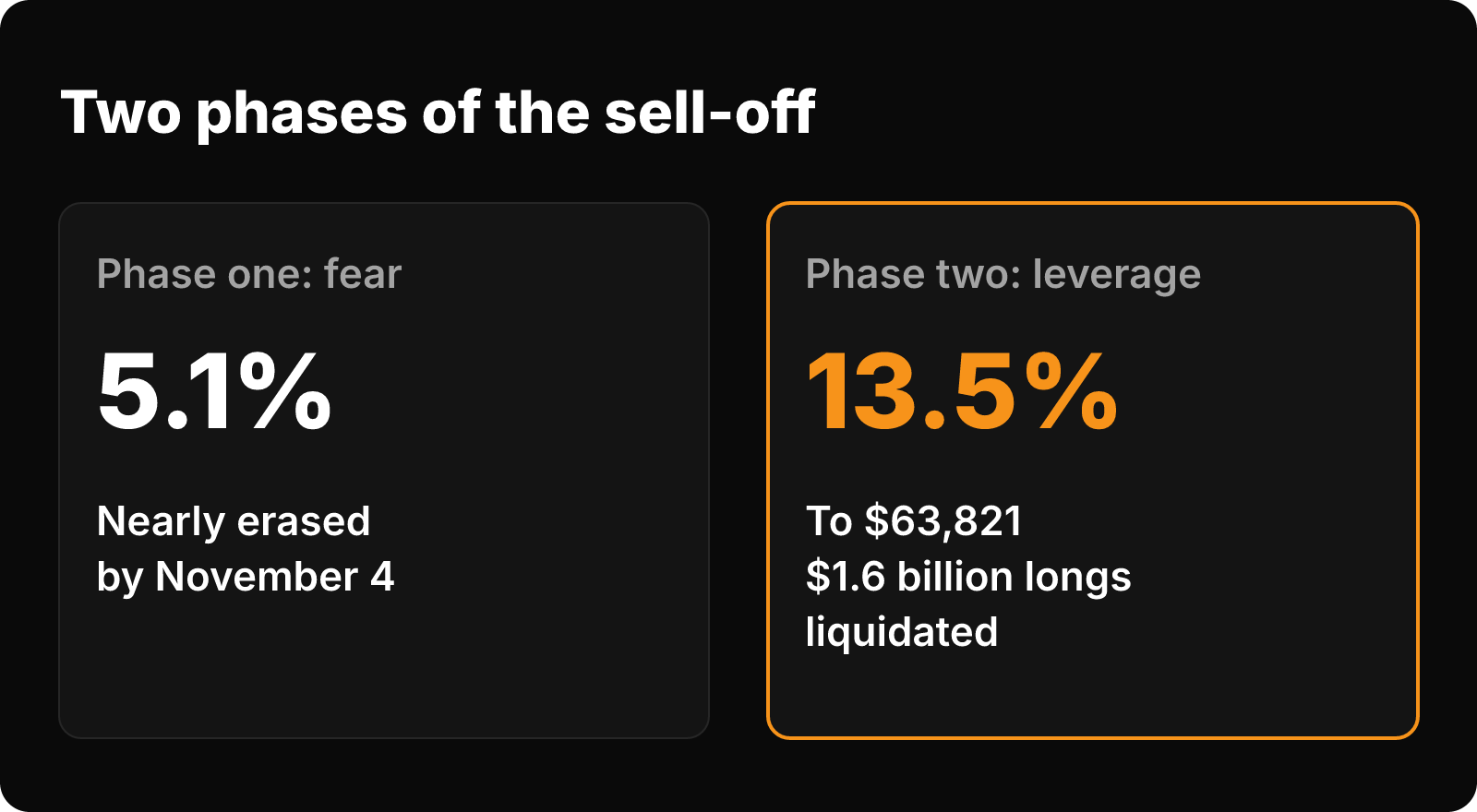
When the news broke, traders afraid of contagion sold, and arbitrage desks that relied on moving funds through Binance couldn't do so. Bitcoin dropped 5.1% over two days, according to 21Shares. Ether fell 3.9% to about $2,270, and BNB, Binance's own token, fell more than 5%.
By November 4 the dip was almost entirely gone.
Phase two: the liquidation dominoes
Then came the larger drop. Between November 11 and 14, Bitcoin fell 13.5% to $63,821. In that window, $1.6 billion in Bitcoin futures longs were liquidated, making up 92% of Bitcoin liquidations on those days, per 21Shares citing CoinGlass data.
Here's what a liquidation means in plain English. Suppose you borrow money to buy more Bitcoin than you can afford. That's leverage. If the price falls far enough, the exchange sells your Bitcoin automatically to cover the loan. Each forced sale pushes the price a bit lower, which can trigger the next trader's forced sale, like a row of dominoes.
Trading volumes were roughly normal during the November 11–14 drop, so 21Shares attributes the extra decline to forced selling, not new sellers. The hack may have contributed to the mood, but leverage drove the move.
What the attacker didn't do
The attacker's 18,270 BTC and 522,409 ETH were still unspent in mid-November, per Elliptic data cited by 21Shares. Long-term holders weren't dumping either. Miners sent the fewest coins to exchanges since at least 2020, and Strategy bought 2,332 BTC between October 26 and November 15. About a third of the "old coins moving" that alarmed people on October 30 was Binance moving its own old reserves.
So was it a Binance hack sell-off? Partly. The more accurate description is a hack-triggered panic that a leveraged market then amplified.
What Does This Mean for Bitcoin Bridge Security?
The 2026 Binance theft was not a bridge hack, but it shows the risk that bridges and exchanges share: a small set of keys or a single verification check that controls a large pool of funds. Bridge users should take the lesson seriously without blurring the two incidents together.
A bridge moves value between blockchains. Think of a coat check: you hand over your Bitcoin on one chain, and you get a ticket, a "wrapped" token, on another chain. That ticket is only as good as whatever decides when tickets are printed.
Binance has been involved in a real bridge exploit before. In 2022, an attacker forged cross-chain messages to the BSC Token Hub bridge and minted new BNB out of nothing. Immunefi's Adrian Hetman said the attacker "tricked" the contract "into thinking the message was indeed valid," as reported by Yahoo Finance. Early reports put the haul at about $100 million, and NBC News later reported roughly $570 million worth of BNB. Our Nomad bridge hack breakdown covers another 2022 case.
Compare the failures:
| Design | What authorizes funds to move | How it failed / main risk | Example |
|---|---|---|---|
| Exchange hot wallet | The exchange's private keys | Keys or signing system compromised | Binance, Oct 2026 ($3.3B–$6.3B reported) |
| Exchange hot wallet | The exchange's private keys | Signing process compromised | Bybit, Feb 2025 (~$1.5B) |
| Message-verifying bridge | A contract that accepts a submitted proof | Forged proof passed verification | BSC Token Hub, 2022 (~$100M–$570M) |
| Light-client bridge (e.g., TeleBTC) | An on-chain SPV proof that a real Bitcoin transaction was confirmed | Smart-contract bugs; relies on collateral-backed, slashable Lockers | Design risk, not an incident |
The question to ask of any bridge is the same one this hack raises: what exactly has to happen before funds move, and how many people or keys would an attacker need to compromise? TeleSwap's design answers it by minting TeleBTC only after an SPV light-client proof shows that a real Bitcoin transaction was confirmed, not when a committee or custodian signs off. The BTC backing it is held by collateral-backed Lockers who can be slashed if they misbehave. That is trust-minimized, not trust-free. As the 2022 case shows, verification code is itself an attack surface, so audits and a track record still matter. For comparison with other wrapped tokens, see our wrapped Bitcoin tokens list. For context, TeleSwap has bridged $580.4M across 618,373 transactions on 13 supported networks, per TeleSwap network stats (retrieved November 25, 2026).
One more point that rarely gets discussed: stablecoin freezes cut both ways. Tether's and Circle's freezes limited what the attacker could do. The same power can freeze an innocent user's USDT or USDC. If you bridge BTC into stablecoins, you've swapped one risk for another.
Crypto Exchange Hack Lessons: 7 Steps to Protect Yourself
Keep only what you actively trade on an exchange, and hold the rest in a wallet whose keys you control. The full checklist:
- Treat exchanges like a checking account, not a vault. Binance's withdrawal pause showed that even the largest exchange can lock access. Withdraw long-term savings to self-custody, ideally a hardware wallet.
- Back up your seed phrase offline. Self-custody removes exchange risk and puts recovery entirely on you. Confirmed Bitcoin transactions cannot be reversed, and there is no help desk to call.
- Avoid leverage during news shocks, or avoid it altogether. Leveraged longs made up the bulk of the November liquidations. Spot holders who did nothing saw the first dip largely reverse by November 4.
- Before you use a bridge, ask what authorizes minting. Is it a multisig committee, a custodian, or a cryptographic proof of a Bitcoin transaction? Prefer designs where an attacker would need more than a few keys.
- Send a small test transaction first. This applies to every new wallet, bridge or route. Check the address character by character.
- Watch for "refund" scams. After major hacks, phishing messages promising compensation are common. Be wary of any request to connect your wallet or sign a transaction to get covered.
- Separate verified facts from rumors. In this incident, loss estimates differed by about $3 billion and the attribution was unconfirmed. Wait for primary sources before you act.
For example, if you want stablecoin exposure without leaving coins on an exchange, you can go from native Bitcoin to USDC on Ethereum and later swap USDC back to BTC. See also trustless swaps vs custodial exchanges.
Frequently Asked Questions
Why did Bitcoin fall after the Binance hack?
Bitcoin fell first because of fear and disrupted trading, then much further because leveraged positions were force-sold. The initial 5.1% drop was nearly reversed by November 4, 2026. The later 13.5% drop to $63,821 (November 11–14) came mostly from $1.6 billion in long liquidations, according to 21Shares.
Was Bitcoin itself hacked?
No, the Bitcoin network was not hacked. Attackers compromised Binance's signing keys, so the stolen transfers carried valid signatures. Bitcoin processed them correctly, just as it would process any properly signed transaction.
How much money was stolen from Binance in October 2026?
Estimates range from $3.3 billion to $6.3 billion. Blockaid counted $3.3 billion in hot-wallet outflows, and Binance cited $6.3 billion. About $3 billion was reported frozen and being recovered, so the final realized loss may be lower than the headline figure.
Will Binance users get their money back?
Binance has said it reserved more than $6.34 billion to cover the losses, and Changpeng Zhao said he expects users to be fully covered. No audited accounting had been published in our sources, so check Binance's official announcements for current withdrawal status.
Was the Binance hack a bridge exploit?
No, the 2026 theft drained exchange hot wallets and did not exploit a bridge. The separate 2022 BSC Token Hub incident was a bridge exploit, in which forged cross-chain messages minted new BNB. The two incidents are often mixed up in coverage.
How can I tell if a Bitcoin bridge is safe?
Check what has to happen before the bridge mints or releases funds. Bridges that rely on a few keys or a custodian carry risks similar to an exchange hot wallet. Light-client bridges verify a cryptographic proof of the Bitcoin transaction instead, which reduces trust but does not eliminate smart-contract risk.
Conclusion
The Binance hack Bitcoin sell-off comes down to three points. A company's keys failed, and Bitcoin did not. The first price drop was mostly fear and faded within a week. The larger November drop was attributed mainly to leverage, not to the attacker selling.
For you, the practical lessons are to hold your own keys, skip leverage when headlines turn bad, and before you move Bitcoin across chains, ask what actually authorizes your funds to move. If you want to bridge native BTC without handing it to an exchange or a multisig committee, compare routes and get a quote at teleswap.xyz.