Wrapped Bitcoin Tokens List: 7 Types and Who Holds the BTC (2026)


Every wrapped bitcoin token is a promise. Somewhere a real bitcoin is locked away, and a token on another blockchain stands in for it. The question most beginners never ask is the one that matters most: who is holding that bitcoin?
This wrapped bitcoin tokens list covers seven wrappers you are likely to run into in 2026: WBTC, cbBTC, tBTC, BTCB, BTC.b, LBTC and SolvBTC. For each one we explain who holds the BTC, how you get real bitcoin back, and what you are trusting. We finish with the one option that has no custodian at all.
The eight largest wrappers together held roughly 255,000 BTC, about 1.3% of all circulating bitcoin, as of September 24, 2026, according to Upshift's CoinGecko-based tally.
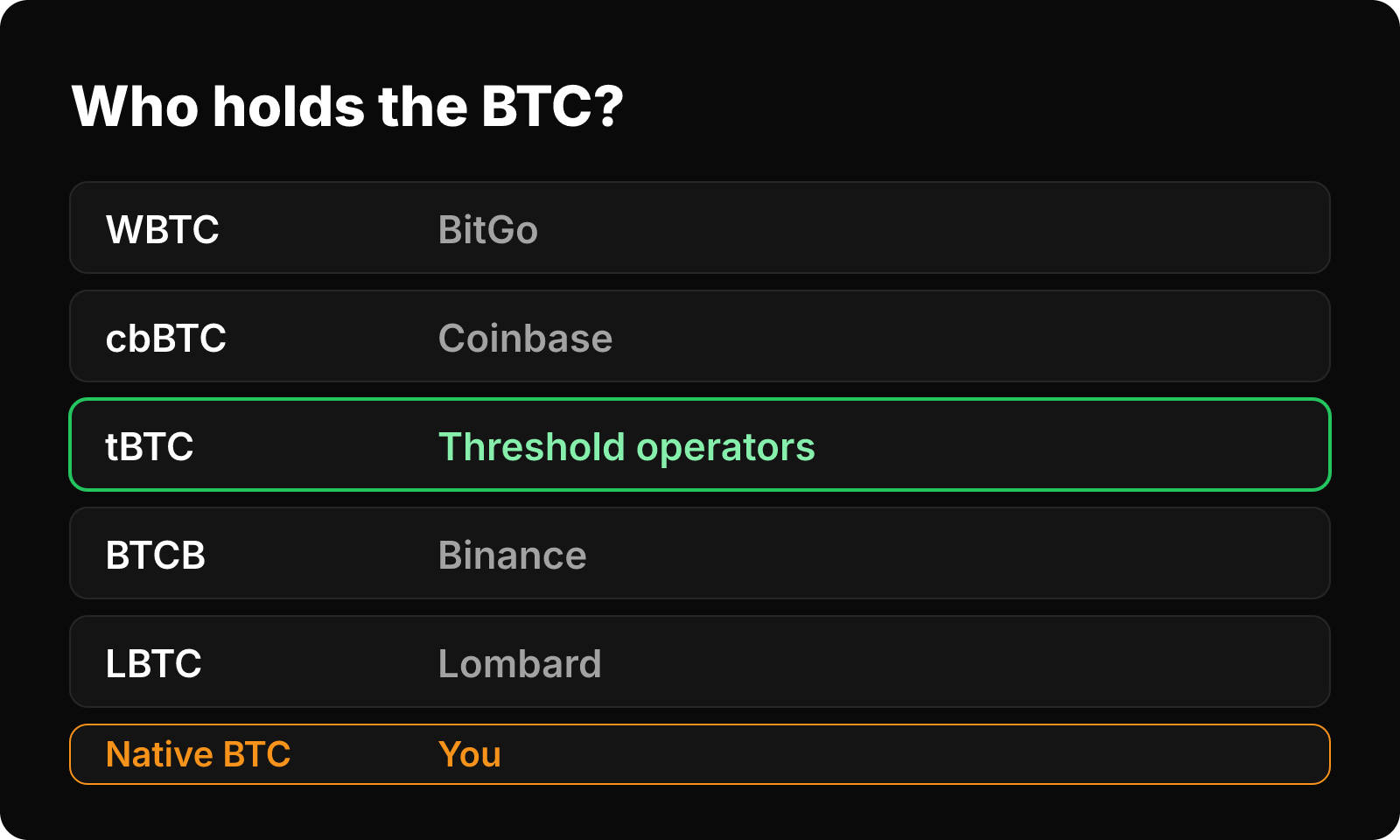
Key Takeaways:A wrapped bitcoin token is an IOU on another blockchain that is redeemable for BTC held by a custodian, a signer group, or a protocol.WBTC was the largest wrapper at about 116,000 BTC and cbBTC was second at about 98,000 BTC as of September 24, 2026, per Upshift.WBTC, cbBTC and BTCB each depend mainly on one company or custodian arrangement (BitGo, Coinbase and Binance) that holds the bitcoin.tBTC spreads control of the BTC across a decentralized group of operators, and anyone can redeem it directly for a 0.2% fee, according to Upshift.Native BTC in your own wallet is the only form of bitcoin with no custodian of any kind.
Table of Contents
- What Is a Wrapped Bitcoin Token?
- 1. WBTC: Who Holds the BTC Behind WBTC?
- 2. cbBTC: Coinbase as Custodian
- 3. tBTC: A Network of Operators
- 4. BTCB: Binance's Bitcoin on BNB Chain
- 5. BTC.b: Avalanche's Bridged Bitcoin
- 6. LBTC: Lombard's Yield-Bearing Bitcoin
- 7. SolvBTC: A Multi-Custodian Reserve
- Native BTC: The Option With No Custodian
- Wrapped BTC Custodians Compared
- How Should a Beginner Choose?
- Frequently Asked Questions
- Conclusion
What Is a Wrapped Bitcoin Token?
A wrapped bitcoin token is a token on a non-Bitcoin blockchain, such as Ethereum, BNB Chain or Avalanche, that represents one real bitcoin locked somewhere else. Bitcoin's own network can't run the smart contracts that lending apps and exchanges like Uniswap need. To use BTC in those apps, people "wrap" it.
Think of a coat check. You hand over your coat (the bitcoin) and get a numbered ticket (the wrapped token). The ticket is only worth something while the coat is still on the rack and the attendant will give it back.
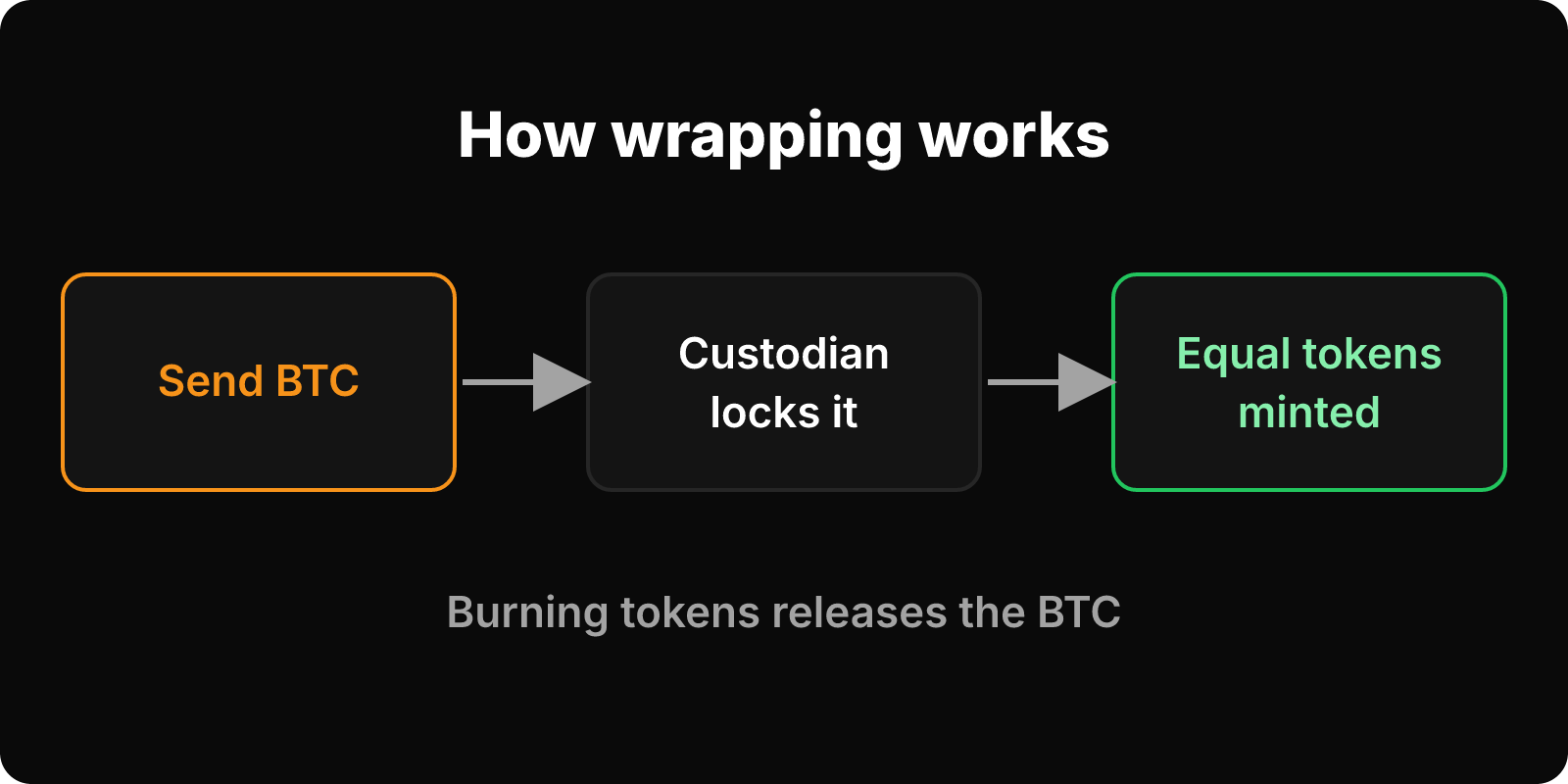
That is why "who holds the BTC" is the real question. Ledger Academy describes the classic model: you send BTC to a custodian, the custodian locks it in a reserve wallet, and an equal number of tokens is minted. Burning the tokens releases the BTC. What changes between wrappers is who controls the reserve and who is allowed to redeem from it.
Most holders never redeem directly. They sell the token on an exchange, so their real exit is market liquidity, not the custodian. Banxa notes that most people simply swap WBTC for BTC on a trading venue. That works until the market stops trusting the custodian.
1. WBTC: Who Holds the BTC Behind WBTC?
The BTC behind WBTC is held by BitGo, and since August 2024 BitGo's arrangement has included a multi-jurisdictional custody tie-up with BiT Global. WBTC launched in January 2019 as a joint project of BitGo, Kyber Network and Ren, according to ChangeNOW. It is an ERC-20 token, the standard token format on Ethereum.
WBTC has three groups of participants. Approved merchants (institutions that have passed KYC checks) send BTC to the custodian, and a governance body called the Wrapped Tokens DAO decides who those merchants and custodians are. Ledger reports that the DAO has 15 member entities, which use a multi-sig wallet.
The August 2024 custody change matters. BitGo announced it would move WBTC to multi-jurisdictional custody with BiT Global, a firm that critics link to Justin Sun. BitGo said WBTC stayed operationally separate. In response, MakerDAO (now Sky) voted to reduce its WBTC exposure, Upshift reports. WBTC is still the biggest wrapper, at about 116,000 BTC as of September 24, 2026, with a market cap of $9.16B on October 29, 2026, per MetaMask's price page.
Getting native BTC back: only approved merchants can redeem with the custodian. Everyone else swaps. If you hold WBTC on Ethereum, you can swap WBTC (Ethereum) for native BTC and receive it in your own Bitcoin wallet. For a broader walkthrough, see our wrapped bitcoin guide.
2. cbBTC: Coinbase as Custodian
cbBTC is backed 1:1 by bitcoin that Coinbase holds. Coinbase issues it, and it circulates on Base, Ethereum and other chains. See Coinbase's cbBTC page.
The trust model is simple. Coinbase is a single, regulated company. If you trust Coinbase's solvency and conduct, you trust cbBTC. By September 24, 2026 it was backed by about 98,000 BTC, second only to WBTC, according to Upshift.
Redemption is easy if you have a Coinbase account. You send cbBTC to it and Coinbase converts it 1:1 to BTC, as ChangeNOW explains. The catch is the account itself: KYC, regional restrictions, and the possibility that the exchange limits your access.
Getting native BTC back without an account: you can swap cbBTC (Ethereum) for native BTC straight into a Bitcoin wallet you control.
3. tBTC: A Network of Operators
tBTC's bitcoin is controlled by a group of independent node operators on the Threshold Network, not by one company. ChangeNOW says tBTC "uses a group of operators to share control of the BTC." Details are in the Threshold Network documentation.
Picture a bank vault where the combination is split among many strangers and a threshold of them must agree to open it. No single person can run off with the gold. That is the core idea.
The practical advantage is redemption. Anyone can redeem tBTC directly through the Threshold bridge with no account, for a 0.2% fee, according to Upshift. You still trust that the operator set won't collude and that the smart contracts are sound. But no single company is a point of failure. Our tBTC to BTC guide covers the redemption steps.
4. BTCB: Binance's Bitcoin on BNB Chain
BTCB, also called Binance-Peg BTC, is backed by bitcoin that Binance holds, and it circulates mainly on BNB Smart Chain. It is a BEP-20 token, BNB Chain's equivalent of ERC-20.
The custody model is a single company, like cbBTC. Minting and redemption at the source go through Binance, so in practice you need a Binance account to convert BTCB to BTC one-for-one.
Getting native BTC back without an exchange account: swap BTCB (BNB Smart Chain) for native BTC and receive it directly on the Bitcoin network.
5. BTC.b: Avalanche's Bridged Bitcoin
BTC.b is bitcoin bridged to Avalanche through the Avalanche Bridge, which is operated by Ava Labs. It is accessed through Ava Labs' Core wallet and bridge.
This is a bridge model rather than a bank-style custodian. Check the bridge's documentation for how its keys and signers are set up before relying on it; you are trusting the bridge operator and its signing arrangement.
Redemption works by bridging BTC.b back through the Avalanche Bridge to a Bitcoin address. You rely on the bridge staying online and honest.
6. LBTC: Lombard's Yield-Bearing Bitcoin
LBTC is issued by Lombard, and it is designed to earn yield: the BTC behind it is put to work rather than simply held. See Lombard's documentation for how custody and staking are structured.
That yield brings extra moving parts. You trust Lombard, the staking setup and the smart contracts that issue the token. Redemption also takes time: it can take up to 10 days through Lombard, according to Upshift. For a beginner, that means LBTC is not a quick exit when markets move fast. Our LBTC to BTC guide explains the options.
7. SolvBTC: A Multi-Custodian Reserve
SolvBTC is issued by Solv Protocol and backed by BTC held through the custody arrangements described in Solv's documentation. Check that page for the current custodian list, since it can change.
Some SolvBTC can be minted against other wrappers, so a holder may end up indirectly exposed to the custodians of those tokens too. Each layer is a separate promise. Our SolvBTC to BTC guide shows how to get native bitcoin back.
Native BTC: The Option With No Custodian
Native bitcoin held in a wallet where you control the private keys is the only form of BTC with no custodian, no signer set and no redemption queue. Banxa makes the point directly: for plain holding, ordinary BTC does the same job with fewer moving parts.
Many people hold a wrapper they don't need. If your goal is to get from bitcoin to a stablecoin or ETH on another chain, you can go straight from native BTC to the asset you want, for example BTC to USDC on Ethereum, and skip the custodian layer entirely.
When you genuinely need bitcoin on another chain, there is a trust-minimized route. TeleBTC is minted only after a light client verifies the Bitcoin transaction with an SPV proof. It is backed 1:1 by BTC held by Lockers whose collateral can be slashed. No company or multi-sig committee holds the keys. TeleSwap has processed $575.7M in bridged volume across 612,300 transactions on 13 networks, according to TeleSwap network stats. Technical details are in the docs.
Wrapped BTC Custodians Compared
This table puts all seven wrappers side by side, plus native BTC. Backing figures are given only where a dated source exists.
| Token | Who holds the BTC | Trust model | Direct redemption | BTC backing (Sept 24, 2026) |
|---|---|---|---|---|
| WBTC | BitGo (with BiT Global) | Custodian + DAO-approved merchants | Approved merchants only | ~116,000 BTC |
| cbBTC | Coinbase | Single company | Via Coinbase account, 1:1 | ~98,000 BTC |
| tBTC | Threshold Network operators | Distributed operators | Anyone, 0.2% fee | Not in sources |
| BTCB | Binance | Single company | Via Binance account | Not in sources |
| BTC.b | Avalanche Bridge (Ava Labs) | Bridge operator | Via Avalanche Bridge | Not in sources |
| LBTC | Lombard | Issuer + staking | Via Lombard, up to 10 days | Not in sources |
| SolvBTC | Custodians per Solv docs | Reserve, may include other wrappers | Via Solv Protocol | Not in sources |
| Native BTC | You | Your own keys | Not needed | n/a |
Sources: Upshift, ChangeNOW, and the protocol documentation linked in each section.
How Should a Beginner Choose Between Types of Wrapped Bitcoin?
Start with what you need, not which token is trending. These four questions cover most situations:
- Do you need BTC on another chain at all? If you just want to hold bitcoin, keep native BTC. If you want a stablecoin or ETH, swap directly from BTC.
- Who would you have to trust? Name the company or group. If you would not leave a bitcoin with them overnight, don't hold their token.
- Can you redeem, and how fast? Account-gated (cbBTC, BTCB), merchant-only (WBTC), permissionless (tBTC), or delayed (LBTC).
- How many layers deep are you? A wrapper backed by other wrappers stacks up custodian risk.
A history lesson: soBTC, a wrapper tied to FTX, became irredeemable after the exchange went bankrupt, as CoinLedger recounts. The token didn't break. The coat check closed.
Also, in many jurisdictions it is unsettled whether wrapping BTC is a taxable event. Count On Sheep calls it "genuinely unsettled law." Check with a tax professional. This article is not tax or financial advice.
Frequently Asked Questions
What are the main wrapped bitcoin tokens?
The most widely used wrapped bitcoin tokens include WBTC, cbBTC, tBTC, BTCB, BTC.b, LBTC and SolvBTC. WBTC and cbBTC are the largest, backed by roughly 116,000 and 98,000 BTC respectively as of September 24, 2026, according to Upshift. Others, such as kBTC (Kraken) and FBTC, also exist.
Who holds the BTC behind WBTC?
BitGo holds the BTC behind WBTC, with a multi-jurisdictional custody arrangement involving BiT Global announced in August 2024. The Wrapped Tokens DAO, made up of 15 member entities, governs which merchants and custodians take part. Only approved merchants can mint or redeem directly.
Which wrapped bitcoin is the most decentralized?
Of the seven tokens covered here, tBTC is the most decentralized because its BTC is controlled by a group of Threshold Network operators rather than one company. Anyone can redeem it directly for a 0.2% fee without an account. You still rely on the operators not colluding and on the smart contracts working correctly.
Is wrapped bitcoin the same as bitcoin?
No. Wrapped bitcoin is a claim on bitcoin held by someone else, not bitcoin itself. Its value depends on the custodian or protocol honoring redemptions. If the custodian fails, as happened with FTX's soBTC, the token can become irredeemable.
How do I convert wrapped bitcoin back to native BTC?
Most holders convert wrapped bitcoin to native BTC by swapping it, not by redeeming with the custodian. Direct redemption is often limited to merchants (WBTC) or account holders (cbBTC, BTCB). A cross-chain swap can send native BTC straight to a Bitcoin wallet you control.
Is holding wrapped bitcoin risky?
Yes, wrapped bitcoin carries risks that native BTC does not, including custodian failure, governance changes, smart-contract bugs and redemption limits. The August 2024 WBTC custody change showed how quickly a governance decision can shift DeFi protocols' appetite for a wrapper. Native BTC in self-custody avoids these layers.
Conclusion
Every wrapped bitcoin token answers "who holds the BTC?" differently. For WBTC, cbBTC and BTCB the answer is mainly one company. For tBTC it is a distributed operator network. BTC.b, LBTC and SolvBTC rely on a bridge, an issuer and a reserve arrangement. Each is a promise with a specific keeper.
Know your exit before you buy a wrapper, and remember that native BTC is the only form of bitcoin with no custodian at all. If you're holding a wrapper you don't need, you can swap it back to native BTC, or go straight from BTC to the token you want, at teleswap.xyz.