LBTC to BTC: How to Redeem Lombard Bitcoin (2026 Guide)

Your LBTC balance says 0.5. You want bitcoin you can move with your own keys on the Bitcoin network. That leaves two questions: how much BTC is the 0.5 LBTC actually worth, and how long will you wait for it?
Going from LBTC to BTC isn't a simple 1:1 unwrap. Lombard's official redemption pays out native BTC at the current exchange rate, but its window can run up to 10 days, per Lombard's documentation. The faster option is to sell LBTC on a DEX for a liquid BTC token and then unwrap that token to native BTC through TeleSwap. That's quicker, but the price comes from the market. This guide covers both routes.
Key Takeaways:LBTC is a non-rebasing ERC-20 whose BTC value accrues through an exchange rate, which was 1.005345 BTC per LBTC on October 31, 2026, according to Lombard's monthly report.Lombard's official redemption returns native BTC at the current rate within a window of up to 10 days and charges a 0.0001 LBTC network security fee.Lombard redemptions only pay out to Native SegWit (bc1q) or Taproot (bc1p) addresses, and Legacy (1…) and Nested SegWit (3…) addresses are not supported.The fast route sells LBTC for WBTC, cbBTC, or ETH on a DEX, then uses TeleSwap to unwrap it to native BTC with a Locker payout that's verified by an SPV proof.LBTC holders on TAC, Sonic, Katana, or Berachain must bridge to Ethereum before December 10, 2026, because native redemption on those chains is deprecated.
Table of Contents
- What Is LBTC and Who Holds the BTC Behind It?
- Why LBTC Isn't 1:1: The Exchange-Rate Math
- How Lombard LBTC Unstake Works at the Protocol Level
- LBTC to BTC: Three Routes Compared
- Should You Redeem or Swap? A Break-Even Framework
- How to Redeem LBTC Through Lombard, Step by Step
- How to Convert LBTC to Bitcoin Faster With TeleSwap
- What If Your LBTC Is on a Deprecated Chain?
- LBTC vs TeleBTC: Two Different Trust Models
- Frequently Asked Questions
- Conclusion
What Is LBTC and Who Holds the BTC Behind It?
LBTC (Lombard BTC) is a non-rebasing, yield-bearing Bitcoin token. According to Lombard's asset documentation, it's backed by BTC held in "institutional and Security Consortium custody." The docs describe custody arrangements rather than a script the Bitcoin network enforces by itself.
Lombard's docs split the backing into two parts:
- Active allocation (target 50–60%): deployed into a covered-call options strategy managed by Bitwise Investment Manager, LLC. Writing covered calls earns option premium but gives up upside above the strike price.
- Passive allocation (40–50%): held under Security Consortium custody.
The protocol takes a 20% fee on strategy gains, subject to a high-water mark, which means fees are charged only on new highs in performance. The LBTC page gives a target of 2.5% net APY in BTC terms and says it's variable and not guaranteed. Lombard says LBTC is live on 10 chains with more than 50 DeFi integrations.
New LBTC is minted only after the Security Consortium and the Bascule Drawbridge verify the BTC deposit. Lombard's public docs don't give the consortium's membership, signing threshold, or failure procedures in detail, so treat those as open questions rather than known guarantees.
Watch out for ticker collisions. "LBTC" is not Blockstream's Liquid Network token L-BTC. L-BTC was the asset involved in the $320M Liquid exploit Chainalysis covered on September 9, 2026. It's also not the unrelated "Lightning Bitcoin" token some price sites list. Everything in this article is about Lombard's LBTC.
One more caveat: some older third-party listings describe LBTC as Babylon-staked BTC with "reserve ratio" redemptions. Lombard's current docs describe the covered-call model above, and this article follows the docs.
Why LBTC Isn't 1:1: The Exchange-Rate Math
A rebasing token pays yield by increasing your balance. LBTC does the opposite. Your balance stays the same, and each unit of LBTC is worth more BTC over time. Everything depends on one number, the redemption rate (BTC per LBTC).
- Minting: LBTC received = BTC deposited ÷ rate
- Redeeming: BTC returned = LBTC burned × rate
Here are real numbers. Lombard's October 2026 report shows the rate going from 1.004616 (September 30) to 1.005345 (October 31), a gain of about +0.07% in BTC terms for the month. At the October 31 rate:
- Depositing 1 BTC mints about 0.99468 LBTC.
- Redeeming 0.5 LBTC returns about 0.50267 BTC before fees. If the 0.0001 LBTC fee is deducted first, that becomes roughly 0.4999 × 1.005345 ≈ 0.50257 BTC.
Many DEX pools and price feeds quote LBTC near 1 BTC, and aggregator snapshots are undated and inconsistent. If you sell LBTC "at parity," you may be giving up the yield that has already built up in the token. Before you choose a route, compare the official rate shown in the Lombard app with the live DEX quote.
How Lombard LBTC Unstake Works at the Protocol Level
A Lombard LBTC unstake burns your LBTC on the source chain and pays native BTC to the address you supply. Per Lombard's redemption docs, the practical flow is: you submit the unstake request with your LBTC amount and Bitcoin address, and the BTC arrives within up to 10 days at the current rate, less the 0.0001 LBTC network security fee.
Lombard's docs are not consistent on where payouts are funded from. One page says redemptions are funded "from the liquidity buffer first," and another says they're "funded from the passive allocation" and do "not normally" require unwinding deployed positions. Treat the exact order as unconfirmed.
Lombard says there's no gate or pause on redemptions, which is good for exit access. The docs don't describe how the payout is signed or verified in detail, so the time and the payout depend on Lombard's custody side rather than on a proof you can check on-chain.
Why only bc1q and bc1p? Lombard accepts Native SegWit (bc1q) and Taproot (bc1p) addresses only. Legacy (1…) and Nested SegWit (3…) addresses are not supported, so generate a compatible address before you start.
LBTC to BTC: Three Routes Compared
There are three practical ways to get from LBTC to BTC. They don't trade off in the same way, so it's worth laying them side by side.
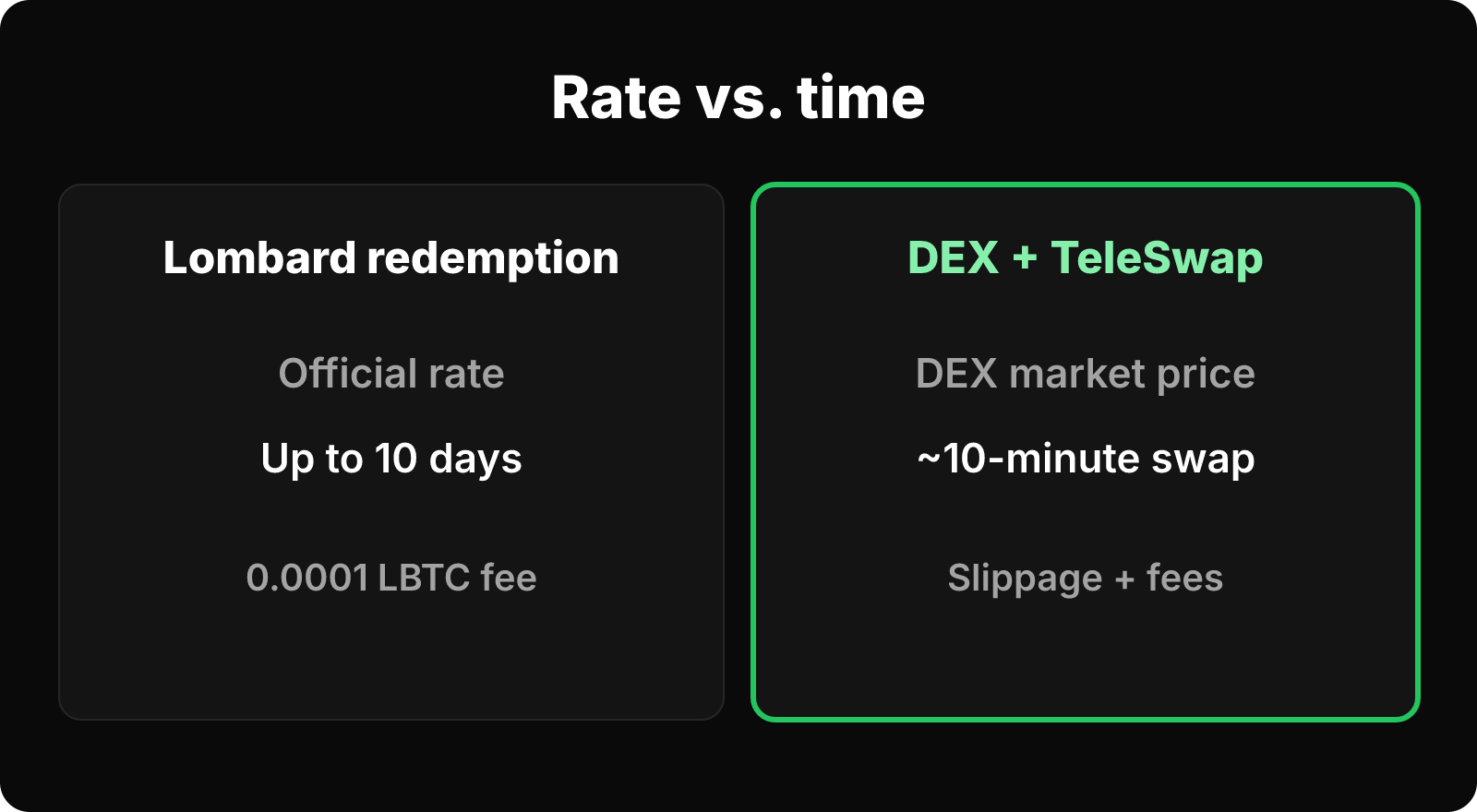
| Route | Price you get | Time to native BTC | Explicit fees | Who you trust |
|---|---|---|---|---|
| 1. Lombard official redemption | Official redemption rate (e.g., 1.005345 on Oct 31, 2026) | Up to 10 days | 0.0001 LBTC + source-chain gas | Lombard custody / Security Consortium |
| 2. DEX swap → TeleSwap unwrap | DEX market price for LBTC, then TeleSwap quote | DEX trade plus TeleSwap's ~10-minute fast swap | DEX fee + slippage + gas + TeleSwap fee (shown in the quote) | DEX pool, then TeleSwap Locker (collateral-backed, SPV-verified) |
| 3. Sell on a centralized exchange, withdraw BTC | Exchange order book | Depends on the exchange | Trading fee + withdrawal fee | Exchange custody, plus KYC (check whether LBTC is listed) |
With TeleSwap's unwrap flow, the contract burns your wrapped BTC and assigns a Locker. The Locker sends native BTC to your address and then submits that Bitcoin transaction to the contract together with an inclusion proof.
Should You Redeem or Swap? A Break-Even Framework
A lot of guides say "redeem if you're patient, swap if you're in a hurry." That leaves out how much waiting is worth. Use a simple comparison.
Swap cost (%) ≈ (official rate − DEX rate) ÷ official rate + DEX fee + slippage + TeleSwap fee
Redemption cost (%) ≈ 0.0001 LBTC ÷ amount + gas + what 10 days of not holding BTC costs you
The fixed 0.0001 LBTC fee matters a lot at small sizes and very little at large ones. At 0.001 LBTC it's about 10% of the amount. At 1 LBTC it's 0.01%. On the DEX side, check pool depth before swapping, since slippage can climb quickly in thin pools.
Here's a hypothetical. Say the DEX quote is 0.3% below the official rate. On 0.5 LBTC, that's roughly 0.0015 BTC you give up in exchange for not waiting 10 days. If you need BTC in self-custody quickly, that cost can make sense. If you're consolidating for the long term, it usually doesn't.
A split exit is also an option: swap what you need right away and redeem the rest officially.
How to Redeem LBTC Through Lombard, Step by Step
To redeem LBTC at the official rate, follow Lombard's documented flow:
- Prepare a compatible Bitcoin address. Generate a fresh bc1q (Native SegWit) or bc1p (Taproot) receive address in a wallet you control. Copy it carefully, because Bitcoin payouts can't be reversed.
- Open the unstake page at lombard.finance/app/unstake and connect the wallet that holds your LBTC.
- Check the network in the top-right selector. It has to match the chain your LBTC is on. If that chain is deprecated, read the deprecated-chains section first.
- Enter the LBTC amount. The minimum is 0.00013300 LBTC, and that includes the 0.0001 LBTC network security fee.
- Enter your Bitcoin address and check the estimated BTC output.
- Confirm the transaction.
- Wait up to 10 days for the BTC payout. Watch your address in a block explorer such as mempool.space.
How to Convert LBTC to Bitcoin Faster With TeleSwap
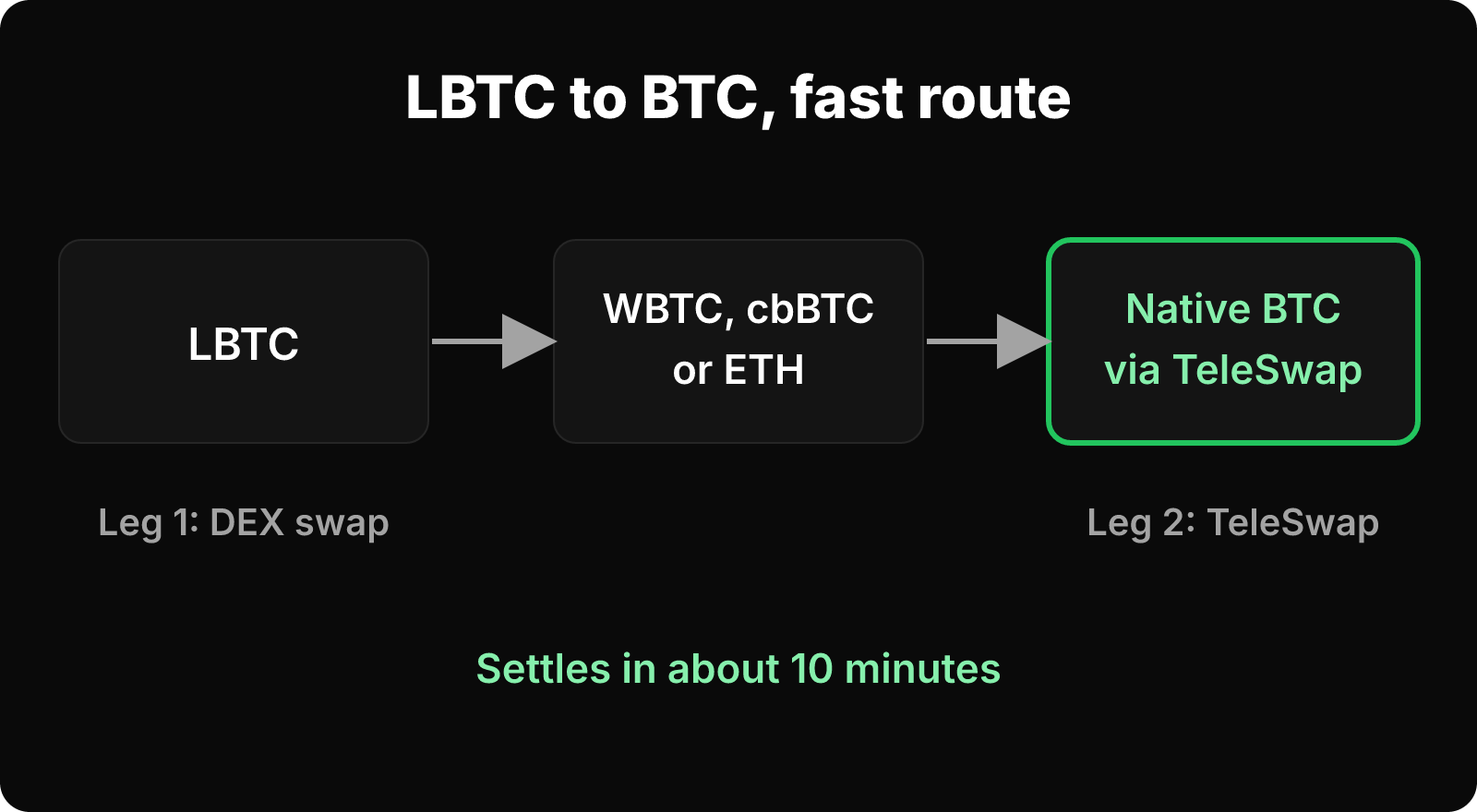
To be clear up front: TeleSwap has no LBTC route. None of its pair pages takes LBTC as an input. What TeleSwap does is take BTC-denominated assets on Ethereum, such as WBTC and cbBTC, or ETH, and deliver native BTC to your Bitcoin address. To convert LBTC to bitcoin this way, you first swap LBTC into one of those assets, then let TeleSwap complete the trip.
The two-leg flow
- Leg 1: DEX swap on Ethereum. Swap LBTC for WBTC, cbBTC, or ETH on a DEX or aggregator with LBTC liquidity. Set a tight slippage limit and compare the quote with the official redemption rate.
- Leg 2: TeleSwap to native BTC. Go to teleswap.xyz and pick the matching route: WBTC (Ethereum) → BTC, cbBTC (Ethereum) → BTC, or ETH (Ethereum) → BTC. Enter your bc1 address, review the quote, and sign.
- Receive native BTC on the Bitcoin network. TeleSwap's fast swaps settle in about 10 minutes.
What happens inside TeleSwap's unwrap
As the TeleSwap documentation describes it, a non-BTC input is first exchanged on an AMM DEX for wrapped BTC. The TeleSwap contract then burns the wrapped BTC, takes a fee for the Locker and the treasury, and the assigned Locker is responsible for sending native BTC to your address.
The Locker then submits that Bitcoin transaction to the contract with an inclusion proof. This is SPV (Simplified Payment Verification): it confirms a transaction is in a proof-of-work-secured block without trusting whoever relayed it. Lockers are collateral-backed and slashable, so a Locker that doesn't pay has something to lose.
According to TeleSwap network stats, the protocol has processed $569.6M in total bridged volume across 604,296 transactions on 13 supported networks, including $47.9M in the last 30 days (about $1.6M a day, peaking at $3.3M on 2026-11-14).
TeleSwap also works as a Bitcoin swap provider inside the aggregators Rango, Rubic, and DZap, and through Rango in MetaMask and Trust Wallet. Whether a particular aggregator will quote LBTC as an input is up to that aggregator, so check its quote screen.
What If Your LBTC Is on a Deprecated Chain?
Lombard has deprecated native mint and redeem on TAC, Sonic, Katana, Berachain, and Starknet. If you're on one of them:
- TAC, Sonic, Katana, Berachain: bridge your full balance to Ethereum before December 10, 2026. Ethereum is the only bridge destination available. Lombard hasn't said what happens to balances left behind after that date, so don't wait to find out.
- Starknet: the Ethereum–Starknet bridge has no deadline, but you can't redeem on Starknet. Bridge to Ethereum, then redeem or swap from there.
Lombard's bridge uses a hub-and-spoke model with Ethereum at the center, so transfers between two spoke chains go through Ethereum. Ethereum is also where TeleSwap's WBTC, cbBTC, and ETH exits to BTC are available. If a bridge transfer fails, the funds stay on the source chain. If tokens were burned but never minted, Lombard tells users to contact support.
LBTC vs TeleBTC: Two Different Trust Models
LBTC and TeleBTC are different products. LBTC is a yield-bearing token whose backing is actively invested. TeleBTC is a 1:1 bridge token. The useful comparison is how each one secures redemption.
| Property | Lombard LBTC | TeleSwap TeleBTC |
|---|---|---|
| Backing | BTC in institutional and Security Consortium custody, 50–60% targeted for covered calls | BTC held by collateral-backed, slashable Lockers, 1:1 |
| Mint verification | Security Consortium + Bascule Drawbridge | SPV light-client proof of a Bitcoin transaction with 4 confirmations |
| Redemption verification | Lombard-operated payout, up to 10 days | Locker payout verified on-chain by an inclusion proof |
| BTC value per token | Rises with the exchange rate (non-rebasing) | 1:1 |
Yield and instant redeemability pull against each other. LBTC's redemption window is consistent with a design where part of the backing is deployed in a strategy, while TeleBTC is a 1:1 bridge token and doesn't carry a strategy yield.
If you want BTC-denominated yield without holding a custodial token, TeleSwap Earn is another approach. Since October 14, 2026, you can deposit native BTC into the TeleBTC pools with a single Bitcoin transaction, with no EVM wallet needed. Returns aren't guaranteed. Our guide to earning yield on native Bitcoin explains how it works. For another redemption walkthrough, see our tBTC to BTC guide.
Frequently Asked Questions
How long does it take to redeem LBTC for BTC?
Lombard's official redemption can take up to 10 days. If you need BTC sooner, you can sell LBTC on a DEX and unwrap the proceeds through TeleSwap, but you'll get the market price instead of the official redemption rate.
Why do I get more BTC than the LBTC I redeem?
LBTC is non-rebasing, so its yield builds up in the exchange rate and not in your balance. On October 31, 2026, the rate was 1.005345 BTC per LBTC, so redeeming 1 LBTC returned about 1.0053 BTC before the 0.0001 LBTC network security fee.
What is the minimum LBTC redemption?
The minimum is 0.00013300 LBTC, including the 0.0001 LBTC network security fee. The fee is fixed, so it takes a large share of very small redemptions. Check the Lombard app for the current minimum before you submit.
Which Bitcoin address types work for Lombard redemptions?
Only Native SegWit (bc1q) and Taproot (bc1p) addresses are accepted. Legacy addresses starting with 1 and Nested SegWit addresses starting with 3 aren't supported, so generate a bc1 address before you start.
Can I swap LBTC to BTC directly on TeleSwap?
No. TeleSwap has no LBTC route. Swap LBTC for WBTC, cbBTC, or ETH on an Ethereum DEX first, then use TeleSwap's matching route to receive native BTC. Fast swaps settle in about 10 minutes.
Is Lombard LBTC the same as Liquid L-BTC?
No. They're unrelated assets with similar tickers. L-BTC is Blockstream's Liquid Network token, which was involved in a $320M exploit reported in September 2026. LBTC is Lombard's yield-bearing Bitcoin token.
What happens to LBTC on Sonic, Berachain, Katana, or TAC?
You have to bridge it to Ethereum before December 10, 2026. Native redemption on those chains is deprecated, and Lombard hasn't said what happens after the deadline. Starknet holders also need to bridge to Ethereum to redeem, but that bridge has no deadline.
Conclusion
Going from LBTC to BTC means choosing between rate and time. Lombard's official unstake pays the exchange rate (1.005345 BTC per LBTC as of October 31, 2026) but can take up to 10 days. The swap route trades a possible market discount for speed, and with TeleSwap handling the last leg, the release of native BTC is checked by an SPV proof.
If you're on a deprecated chain, bridge to Ethereum before December 10. If you need bitcoin back in your own wallet quickly, you can take the fast route through TeleSwap's WBTC, cbBTC, or ETH exits.