Bitcoin to Polygon: Swap Native BTC to POL or USDT (2026)

To move Bitcoin to Polygon, sign one Bitcoin transaction from your own wallet on TeleSwap and receive USDT or POL at your Polygon address. Fast swaps settle in about 10 minutes. You can't send BTC straight to a Polygon address, because the two chains can't read each other.
You start with native BTC in your own wallet and end with USDT or POL at your own Polygon address, with no exchange deposit. Each step below covers what the screen shows, what it costs and how long it takes. After that come the problems people hit most often and how to fix them.
Key Takeaways:You can't send native BTC straight to a Polygon address, so the swap needs a bridge that turns a Bitcoin payment into tokens on Polygon.TeleSwap bridges and swaps in one step: it mints TeleBTC (backed 1:1 by BTC) after a Bitcoin light client verifies your transaction, then routes it through a DEX into USDT or POL.Fast swaps on TeleSwap settle in about 10 minutes, and a Teleporter pays the Polygon gas, so you don't need POL in your wallet before you start.On small swaps the Bitcoin network fee is usually the cost that matters most, so check mempool conditions before you swap.As of 2026-11-20, TeleSwap had processed $573.7M in bridged volume across 609,113 transactions, according to TeleSwap network stats.
Table of Contents
- What you'll end up with and what you need
- How does BTC to Polygon actually work?
- Ways to bridge BTC to Polygon compared
- How to swap Bitcoin to Polygon USDT or POL, step by step
- Should you choose USDT or POL?
- Can you swap BTC to USDT on Polygon with no KYC?
- Common problems and fixes
- Frequently Asked Questions
- Conclusion
What you'll end up with and what you need
At the end of this guide you'll have USDT (or POL) at a Polygon address that you control. You'll get there by sending one Bitcoin transaction from your own wallet.
Before you start, have these ready:
- Native BTC in a self-custody Bitcoin wallet. "Self-custody" means you hold the recovery phrase. An exchange balance isn't self-custody. Leave enough BTC on top of your swap amount to pay the Bitcoin network fee.
- A Polygon address. Any EVM wallet works, such as MetaMask or Trust Wallet. Polygon uses the same address format as Ethereum (it starts with
0x), so you probably have one already. - About 15–30 minutes. Fast swaps settle in roughly 10 minutes. Leave extra time in case the Bitcoin network is busy.
- No POL is needed upfront. TeleSwap's Teleporter role pays Polygon gas for you, and you cover all fees in Bitcoin assets.
A bridge moves value from one blockchain to another. A swap trades one token for another. TeleSwap does both in a single transaction from your side.
How does BTC to Polygon actually work?
BTC to Polygon works by locking real bitcoin on the Bitcoin network and issuing a 1:1 token on Polygon that represents it. That token can then be traded for whatever you actually want. What sets bridges apart is who confirms that your bitcoin really arrived.
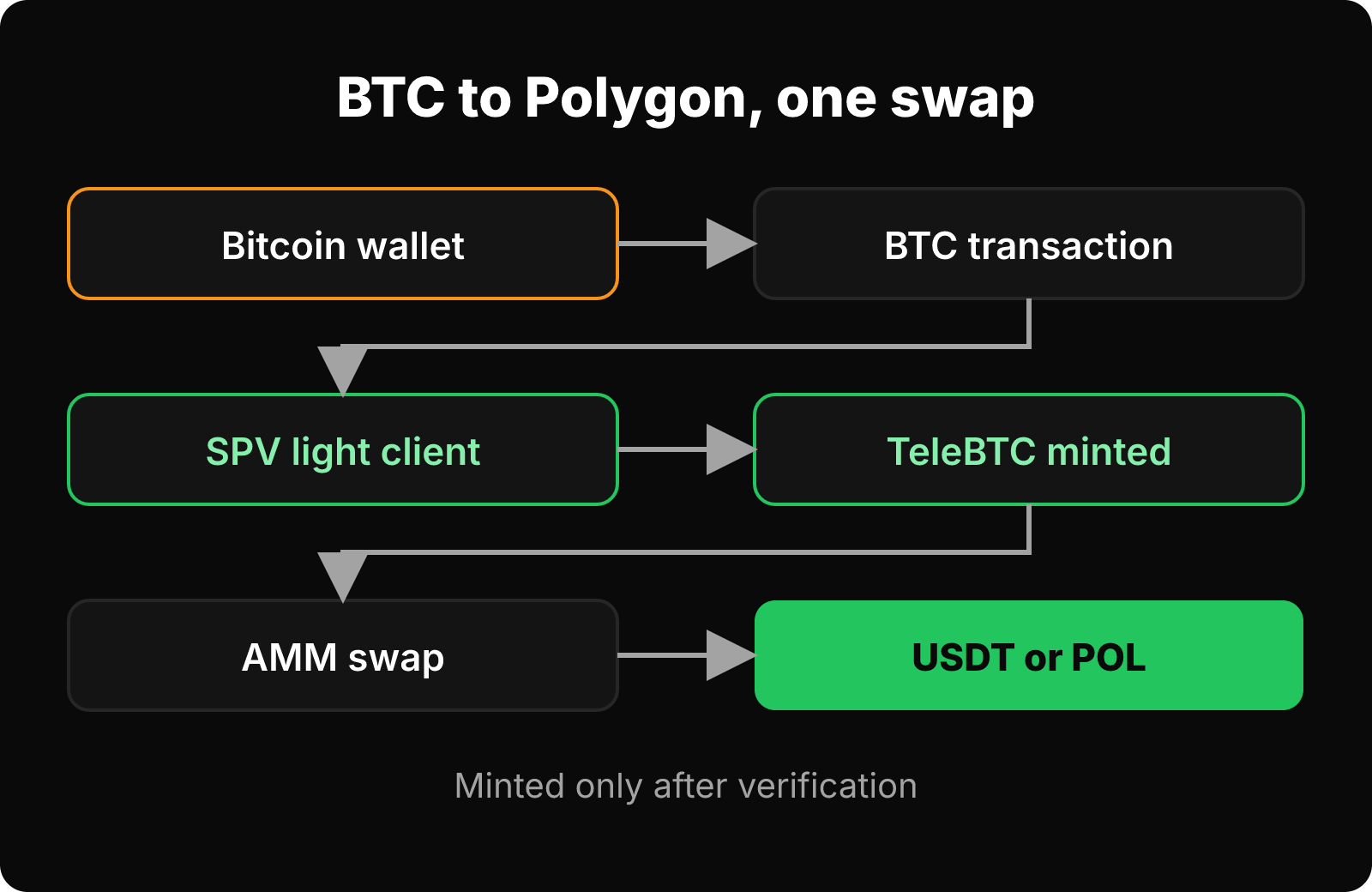
Picture a cloakroom. You hand over your coat, which is your BTC, and get a ticket back, which is the token on Polygon. With many wrapped bitcoin designs, a company or a committee of signers issues the tickets and holds the coats, so you trust them not to print extra tickets.
TeleSwap replaces that trust with verification. Its smart contracts run a Bitcoin SPV light client, a small program that tracks Bitcoin's block headers and their proof-of-work. When you pay, a SPV proof shows that your transaction is in a real Bitcoin block. TeleBTC is only minted after that check passes. The BTC sits with Lockers, whose collateral can be slashed.
For a BTC → USDT swap, TeleSwap then routes the newly minted TeleBTC through an automated market maker (AMM) on Polygon. An AMM is a DEX that prices trades from a liquidity pool. USDT arrives at your address. The protocol is described in the TeleSwap documentation.
According to TeleSwap network stats (retrieved 2026-11-20), TeleSwap supports 13 networks. It handled $48.1M in the last 30 days, about $1.6M a day, with a peak of $3.3M on 2026-11-14.
Ways to bridge BTC to Polygon compared
There are four main ways to bridge BTC to Polygon. They differ in what you end up holding, who has your funds while the swap runs, and whether you need an account.
| Route | You send | You receive on Polygon | Who verifies / holds funds | Account needed? |
|---|---|---|---|---|
| TeleSwap | Native BTC from your wallet | USDT, POL, USDC, WBTC, WETH (via TeleBTC) | SPV light client verifies the BTC transaction; Lockers post slashable collateral | No, you connect wallets |
| Centralized exchange | BTC to the exchange's deposit address | Whatever you withdraw (if Polygon withdrawals are supported) | The exchange holds your funds until withdrawal | Typically yes |
| Instant-swap services (SideShift, ChangeNOW, Paybis) | BTC to the service's deposit address | POL (per ChangeNOW's BTC→POL page) | The service receives your BTC, then sends the output | Check each service's terms |
| tBTC | BTC through the tBTC minting flow | tBTC (deployed on Polygon per BOB's 2026 bridge overview) | Threshold signer network | Check tBTC's terms |
Rates differ more than most beginners expect. ChangeNOW showed about 737,125 POL per BTC, while CoinMarketCap listed about 793,052, a gap of roughly 7.6%. The quotes were taken at different times and some of the gap may be spread. Compare the final "you receive" number, not the headline rate.
Availability can change too. In 2026, BOB reported that Symbiosis's own Bitcoin bridge was paused and that its BTC swaps were going through partner routes. Look for a bridge that explains its mechanism publicly.
How to swap Bitcoin to Polygon USDT or POL, step by step
This walkthrough uses the BTC → USDT (Polygon) route. Steps are the same for POL; you just pick a different token in step 2. Exact labels on screen may change a little as the interface is updated.
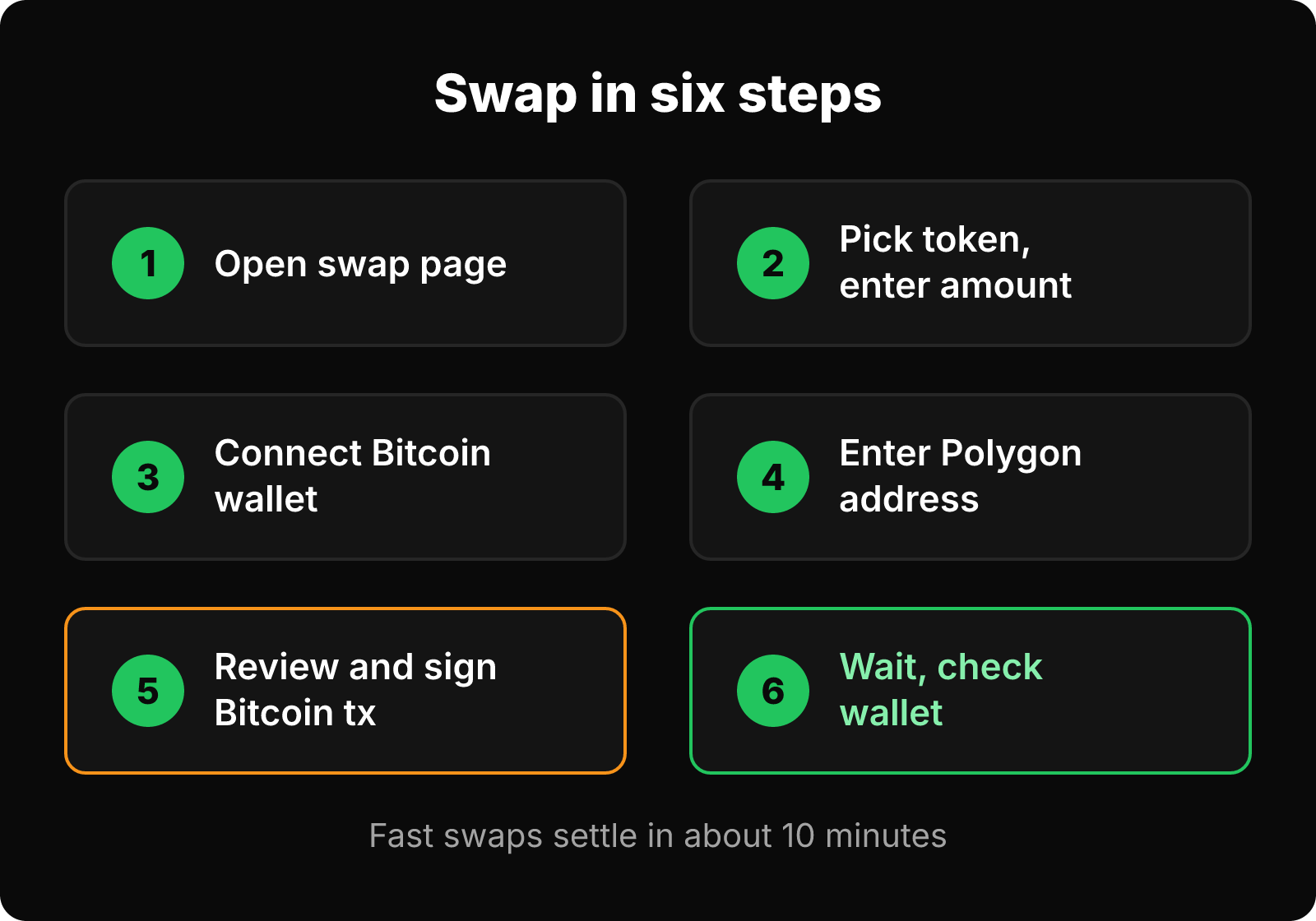
- Open the swap page. Go to the swap BTC to USDT on Polygon page on teleswap.xyz. It loads with Bitcoin as the source and USDT on Polygon as the destination.Screen: A "From" box and a "To" box. Cost: nothing. Time: seconds.
- Pick your output token and enter an amount. Keep USDT, or open the token list and pick Polygon's native gas token instead. TeleSwap lists it under its old ticker, MATIC. Type how much BTC you want to send.Screen: An estimated receive amount, the fee breakdown and a minimum received figure. Cost: nothing yet. Time: the quote updates in a few seconds.
- Connect your Bitcoin wallet. Click connect and choose your Bitcoin wallet from the list. This lets the site build the Bitcoin transaction for you to sign. The site can't move funds without your approval.Screen: A wallet pop-up asking to connect. Cost: free. Time: under a minute.
- Enter or connect your Polygon receiving address. This is where USDT will land. Paste your
0x…address or connect MetaMask or Trust Wallet. Check the first and last 4–6 characters.Screen: The destination address shown next to the quote. Cost: free; you don't need POL because the Teleporter covers destination gas. Time: under a minute. - Review and sign the Bitcoin transaction. Click swap. Your Bitcoin wallet shows the transaction that TeleSwap prepared. Don't edit the recipient or any data fields. Pick a network fee rate that matches current conditions on mempool.space, then sign.Screen: Your wallet's confirmation dialog with the amount and the network fee. Cost: the Bitcoin network fee plus the TeleSwap fees shown in the quote, all paid in BTC. Time: a minute.
- Wait for settlement and check your wallet. The Bitcoin transaction confirms in a block, which takes about 10 minutes on average. After that, TeleBTC is minted and swapped, and USDT is sent to you.Screen: A progress/status view; you can also track the incoming transfer on Polygonscan. Cost: nothing more. Time: fast swaps settle in about 10 minutes, and longer if the Bitcoin mempool is congested.
What the whole swap costs
The total cost has three parts, and the quote shows the TeleSwap fees and slippage before you sign.
- Bitcoin network fee: what miners charge to include your transaction. It's priced in sats per virtual byte, not as a percentage, so it's the same whether you send $50 or $50,000.
- TeleSwap protocol fees: shown in the quote. They include the cost of the Teleporter paying Polygon gas for you.
- Price impact/slippage: the difference between the quoted rate and the rate you actually get when the AMM fills the trade. This matters mostly on large swaps or in fast markets.
For small swaps, the Bitcoin network fee often costs more than everything else put together, and that has nothing to do with the bridge. If fees are high, don't make several small swaps. Wait for a quieter mempool or make one larger swap.
Should you choose USDT or POL?
Choose USDT if you want stable dollar value. Choose POL if you plan to use Polygon apps and need gas. Many people need a little of both.
POL replaced MATIC as Polygon's native token, which is why some interfaces, TeleSwap's pair list included, still show the MATIC label. Before you confirm, check which token the "To" box shows.
POL also moves a lot against BTC. Over 11–17 November 2026, its daily close ranged from 0.000001179 to 0.000001259 BTC, a swing of about 6.8%, according to CoinMarketCap. USDT is designed to track the US dollar.
Because the Teleporter pays your gas, your USDT can arrive at an address that holds no POL at all. You still need POL to move that USDT afterwards. A sensible plan is to send most of your amount to USDT and a small second swap to POL for gas.
Not on Polygon? You can swap BTC to BNB on BNB Smart Chain or swap BTC to ETH on Ethereum from the same site. For a deeper look at the no-account angle, see BTC to USDT with no KYC.
Can you swap BTC to USDT on Polygon with no KYC?
You can do this specific swap on TeleSwap without opening an account: you sign from your own Bitcoin wallet and receive USDT at your own Polygon address. TeleSwap is a permissionless protocol. You don't deposit into an exchange account, so there's no exchange sign-up step.
That covers this pair and this flow only. Some caveats:
- If you bought your BTC on an exchange, you probably went through identity checks there. Moving it to your own wallet doesn't change that history.
- Bitcoin and Polygon are both public ledgers. Anyone can see transactions, so "no KYC" doesn't mean anonymous.
- Your local laws and tax rules still apply to swaps.
Common problems and fixes
| Problem | Likely cause | Fix |
|---|---|---|
| Swap is taking longer than 10 minutes | Bitcoin transaction hasn't confirmed yet (busy mempool or low fee rate) | Look up your TXID on mempool.space. If it's unconfirmed, wait; settlement starts once it's in a block. |
| USDT doesn't show in MetaMask | The wallet hasn't added the token yet | Make sure the network is set to Polygon, then import USDT using the contract address shown for your received token on Polygonscan. |
| Can't send the USDT you received | No POL for gas | Get a small amount of POL (for example, a separate small BTC → POL swap). |
| Got slightly less than the estimate | Price moved between quote and execution | The amount should stay within the minimum-received figure shown in the quote. |
| Wallet won't connect | Unsupported wallet or a blocked pop-up | Allow pop-ups, refresh the page and choose a wallet from the list the site shows. |
| Swapping from an exchange balance | Exchanges send from their own wallets, not yours | Withdraw BTC to your self-custody wallet first, then swap. |
| Wrong Polygon address entered | Copy-paste error | Blockchain transfers can't be reversed. Always check the first and last characters before signing. |
If something still looks wrong, keep your Bitcoin TXID. It lets anyone trace your swap from start to finish.
Frequently Asked Questions
Can I send Bitcoin directly to a Polygon address?
No, native BTC can't be sent to a Polygon address because the two are separate blockchains. You need a bridge. TeleSwap, for example, verifies your Bitcoin transaction with an SPV light client and then delivers tokens on Polygon.
How long does a Bitcoin to Polygon swap take?
Fast swaps on TeleSwap settle in about 10 minutes. Most of that time is spent waiting for your Bitcoin transaction to confirm in a block. When the mempool is busy, or you pick a low fee rate, it can take longer.
Do I need POL to receive USDT on Polygon?
No, you don't need POL to receive. A TeleSwap Teleporter pays the destination gas, and you pay all fees in Bitcoin assets. You will need a little POL later to move or spend your USDT.
What is TeleBTC and do I end up holding it?
TeleBTC is TeleSwap's 1:1 BTC-backed token, minted only after a Bitcoin SPV light client verifies your deposit. On a BTC → USDT route it's used in the middle of the swap and routed through a DEX, so you end up with USDT, not TeleBTC.
Is POL the same as MATIC?
POL replaced MATIC as Polygon's native token. Some interfaces, including some swap pair lists, still use the MATIC label. Check the token name in the "To" field before you confirm.
Can I swap back from Polygon USDT to BTC?
Yes, TeleSwap has a USDT (Polygon) to BTC route. Double-check the Bitcoin address you enter, because Bitcoin transfers can't be reversed.
Can I use TeleSwap from MetaMask or Trust Wallet?
Yes, through the Rango integration TeleSwap is available as a Bitcoin swap provider inside MetaMask and Trust Wallet. It's also integrated with the Rango, Rubic and DZap aggregators, and you can use it directly at teleswap.xyz.
Conclusion
Going from Bitcoin to Polygon comes down to three decisions. First, choose a bridge that verifies your deposit instead of asking you to trust it. Second, choose USDT for stable value or POL for gas. Third, time your swap around the Bitcoin network fee. On TeleSwap, a light client checks your BTC transaction, TeleBTC is minted 1:1 and swapped through an AMM, and a Teleporter pays the Polygon gas.
Once you're set up, TeleSwap's Earn options let you put BTC to work, including depositing native BTC from a Bitcoin wallet into the TeleBTC pools. See the TeleSwap documentation.