Provide Bitcoin Liquidity, Get Paid in BTC: How It Works (2026)

To provide Bitcoin liquidity on TeleSwap, you deposit native BTC, WBTC (Polygon) or BTCB (BNB Smart Chain) into a TeleBTC pool at teleswap.xyz/liquidity and earn a share of the swap fees, paid in BTC. The yield is variable and not guaranteed.
Most "earn on your Bitcoin" offers have the same catch. Your BTC turns into something else, and the yield comes in a token you didn't want. The useful questions are narrow. Which swaps pay the fees, what asset are the fees paid in, and what has to fail before you lose BTC?
This guide covers where the fees come from in TeleSwap's TeleBTC pools and how the three ways in work. It also covers what can go wrong, and the steps to deposit, collect and withdraw. For a wider survey, see 7 Ways to Earn Yield on Bitcoin in 2026 (and the Risks).
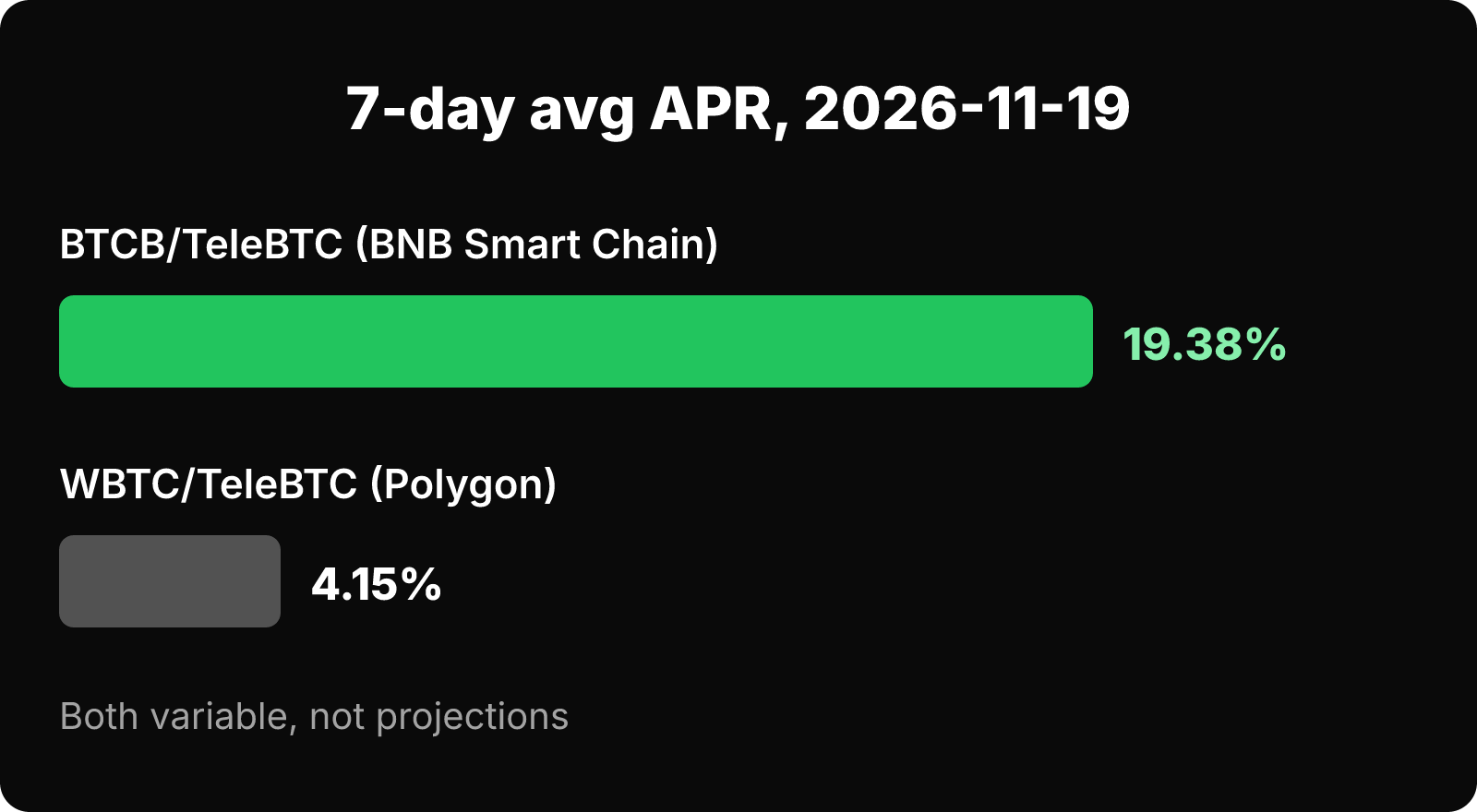
Key Takeaways:TeleSwap's Earn pools pay liquidity providers a share of the swap fees on BTC routes, paid in BTC, and the rate changes over time.Both sides of each pool are Bitcoin (TeleBTC paired with WBTC or BTCB), so the two assets trade in a very narrow range around 1:1 and there is effectively no impermanent loss, according to the TeleSwap Earn BTC docs.As of 2026-11-19, the 7-day average APR was 19.38% on BTCB/TeleBTC (BNB Smart Chain) and 4.15% on WBTC/TeleBTC (Polygon), per TeleSwap Earn. Both are variable.Native BTC can be deposited with a single Bitcoin transaction (0.0001 BTC minimum for a first deposit, 0.1% locker fee, 0% protocol fee, plus the miner fee), and you don't need an EVM wallet.The main risk is a peg or contract failure, not price divergence, because a pool of two Bitcoin assets is only as sound as the weaker of the two.
Table of Contents
- Where Do Bitcoin Liquidity Provider Rewards Come From?
- Pool Architecture: Why Both Sides Are Bitcoin
- Three Ways to Provide Bitcoin Liquidity on TeleSwap
- How TeleSwap Compares to Other BTC LP Options
- The Risks, in Plain Words
- How to Become a Bitcoin Liquidity Provider: Step by Step
- How to Collect Fees and Withdraw
- Frequently Asked Questions
- Conclusion
Where Do Bitcoin Liquidity Provider Rewards Come From?
Bitcoin liquidity provider rewards on TeleSwap come from the fees traders pay when their swaps pass through the TeleBTC pools. No token is printed to pay you. Per the TeleSwap Earn data, the yield is the fees paid by swaps through the pool, paid out in BTC. It varies, it is not a fixed rate, and it is not protocol staking.
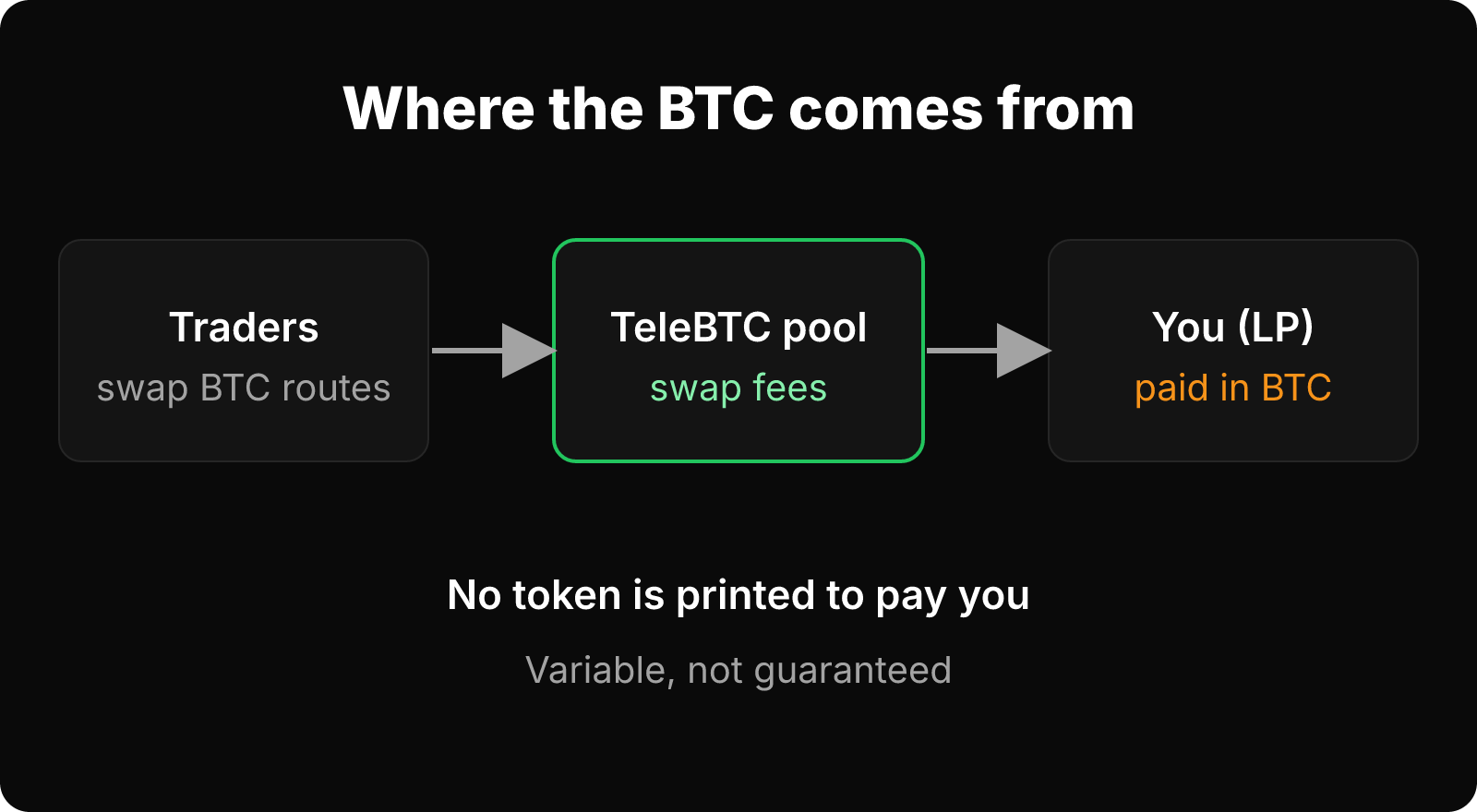
Anyone whose swap needs to convert between TeleBTC and another Bitcoin representation pays those fees. Take a user who swaps BTC to WBTC on Polygon. Their BTC is bridged, which mints TeleBTC, and the swap is routed through the AMM/DEX. The same applies on the way back, and on BNB Smart Chain, where BTC to BTCB swaps run against the BTCB/TeleBTC pool.
That's why route volume matters. The TeleSwap network stats show $572.4M bridged across 607,656 transactions on 13 supported networks. Over the last 30 days the protocol handled $48.4M, about $1.6M per day, with a peak of $3.3M on 2026-11-14. Not all of that volume passes through the Earn pools.
BTC LP rewards paid in BTC: what "paid in BTC" means mechanically
In a standard constant-function AMM, which the Uniswap v2 whitepaper describes, every swap pays a fee in the input asset. That fee goes to liquidity providers in proportion to their share of the pool. In the TeleBTC pools every asset is a Bitcoin representation, so fees build up in BTC-denominated units. The interface has a dedicated Collect Fees tab, so you can claim earnings without removing your liquidity.
Here is a simple illustration, not a projection. Say you own 1% of a pool's liquidity, and in one week swaps through that pool pay 0.05 BTC in fees. Your share is 0.0005 BTC. Double the volume and your share doubles. Double the pool's liquidity at the same volume and your share halves.
Why the APR is a ratio, not a promise
APR here means annualized trading fees relative to pool liquidity. The 7-day averages on 2026-11-19 were 19.38% for BTCB/TeleBTC on BNB Smart Chain and 4.15% for WBTC/TeleBTC on Polygon (TeleSwap Earn). Both figures change over time.
A high APR can attract deposits, and new deposits dilute the same fee flow. If you join a pool because of last week's APR, you are betting that volume will keep pace with liquidity. Read the number as a snapshot of recent demand, not a locked-in rate.
Pool Architecture: Why Both Sides Are Bitcoin
TeleSwap's Earn pools pair TeleBTC with another wrapped Bitcoin (WBTC or BTCB), so both reserves track the same underlying asset. The Earn BTC docs say these pools trade in a very narrow range around 1:1, so there is effectively no impermanent loss.
Impermanent loss, defined by mechanism
Impermanent loss is the gap between holding two assets and the value of your pool share after arbitrageurs rebalance it. In a BTC/USDC pool, a rising BTC price means arbitrage removes BTC and adds USDC, so you hold less of the asset that went up. When both reserves are claims on the same BTC, the price ratio stays near 1.0 and there is little drift to lose to. Curve's StableSwap paper makes a similar argument for pegged-asset pools.
What makes TeleBTC a sound Bitcoin leg
A pegged pool is only as strong as its pegs. TeleBTC is TeleSwap's trustless wrapped Bitcoin, backed 1:1 by real BTC and minted only after a Bitcoin transaction has been verified by a light client. The flow works like this:
- Header relay. Relayers, a permissionless TeleSwap role, submit Bitcoin block headers to a light-client contract on the destination chain.
- Proof-of-work check. The contract checks each header against the difficulty target and its link to the previous header. This is the Simplified Payment Verification (SPV) model from section 8 of the Bitcoin whitepaper.
- Inclusion proof. A Merkle proof shows the user's Bitcoin transaction is included in a verified block.
- Mint. Only then is TeleBTC minted. BTC custody sits with Lockers, whose collateral can be slashed if they misbehave.
So no TeleBTC exists without a verified Bitcoin transaction behind it (see the TeleSwap documentation). For more depth, read How Bitcoin Bridges Work: SPV Light Clients Explained.
Three Ways to Provide Bitcoin Liquidity on TeleSwap
The Earn page lists three ways in. Which one to use depends mostly on what you already hold.
1. Native BTC from a Bitcoin wallet
One Bitcoin transaction puts native BTC into the TeleBTC pools on Polygon and BNB Smart Chain. You don't need an EVM wallet, gas or an approval. This option has been live since 14 October 2026. Claiming fees and withdrawing are Bitcoin transactions too, and the BTC arrives at your Bitcoin address.
- Minimum: 0.0001 BTC for the first deposit.
- Fees: 0.1% locker fee, 0% protocol fee, plus the Bitcoin miner fee.
The miner fee is a flat cost per transaction, so it takes a much larger share of a 0.0001 BTC deposit than of a 0.1 BTC deposit. Check current mempool fee rates before you send.
2. WBTC on Polygon
If you hold WBTC on Polygon, you can add it to the WBTC/TeleBTC pool from an EVM wallet. You will need gas on Polygon. WBTC is held by a centralized custodian under the WBTC program, and you carry that custody risk whenever you hold WBTC.
3. BTCB on BNB Smart Chain
BTCB holders can add it to the BTCB/TeleBTC pool from an EVM wallet, paying gas in BNB. BTCB is a Binance-issued token backed by BTC, so its peg depends on Binance. This pool had the higher 7-day average APR on 2026-11-19, but that figure changes over time.
| Way in | Wallet needed | Fees | Pool(s) | 7-day avg APR (2026-11-19, variable) |
|---|---|---|---|---|
| Native BTC | Bitcoin wallet only | 0.1% locker fee, 0% protocol fee, plus miner fee | TeleBTC pools on Polygon and BNB Smart Chain | Depends on the pool your deposit enters |
| WBTC | EVM wallet on Polygon | Polygon gas | WBTC/TeleBTC | 4.15% |
| BTCB | EVM wallet on BNB Smart Chain | BSC gas | BTCB/TeleBTC | 19.38% |
Source: TeleSwap Earn, retrieved 2026-11-19. APRs are past 7-day averages, not projections.
How TeleSwap Compares to Other BTC LP Options
You can provide BTC liquidity elsewhere, and the designs differ. The biggest differences are what your fees arrive in and whether you are exposed to price divergence.
| Option | BTC representation | Pair | Divergence (IL) exposure | Management |
|---|---|---|---|---|
| TeleSwap TeleBTC pools | TeleBTC (SPV light client, collateral-backed Lockers) paired with WBTC/BTCB | BTC/BTC | Effectively none while pegs hold | Collect fees any time |
| Chainflip native BTC LP | Native BTC in validator-secured custody | e.g. BTC/USDC, range-based | Concentrated range, per its description as similar to Uniswap v3 | Position management needed, per Chainflip |
| Uniswap-style WBTC/ETH pool | WBTC (centralized custodian) | BTC/ETH | Yes | Passive or range-based |
Volatile pairs like BTC/USDC or BTC/ETH can carry divergence risk, and fees may arrive partly in a non-BTC asset. A BTC/BTC pool keeps your principal and fees in Bitcoin, though volume may differ. If your goal is to grow your BTC balance rather than your dollar balance, that is the trade-off to weigh.
The Risks, in Plain Words
Providing liquidity to a BTC/BTC pool removes most divergence risk, but it does not make the position risk-free. This is what can go wrong:
- Peg risk on the paired asset. If WBTC or BTCB loses its 1:1 backing, arbitrageurs can sell the broken asset into the pool and take out the sound one. LPs would end up holding mostly the depegged token.
- Smart contract risk. The pools, light-client contracts and bridge logic are code. A bug could affect your funds.
- Bridge and Locker risk. Locker custody is backed by slashable collateral, but any cross-chain system has more moving parts than a coin in cold storage.
- Variable yield. Fees depend on swap volume. When volume drops, so do your earnings. The docs say returns aren't guaranteed.
- Dilution. More liquidity in the pool means a smaller share of the same fees for you.
- Transaction costs. The miner fee, the 0.1% locker fee for native deposits and EVM gas all come out of your net return. They hit small positions hardest.
- BTC price. You still hold Bitcoin, so the dollar value of your balance moves with the market.
How to Become a Bitcoin Liquidity Provider: Step by Step
All three ways in start at teleswap.xyz/liquidity. The page shows each pool's APR, Total liquidity and Your liquidity, with three tabs: Add Liquidity, Collect Fees and Remove Liquidity.
Path A: native BTC (no EVM wallet)
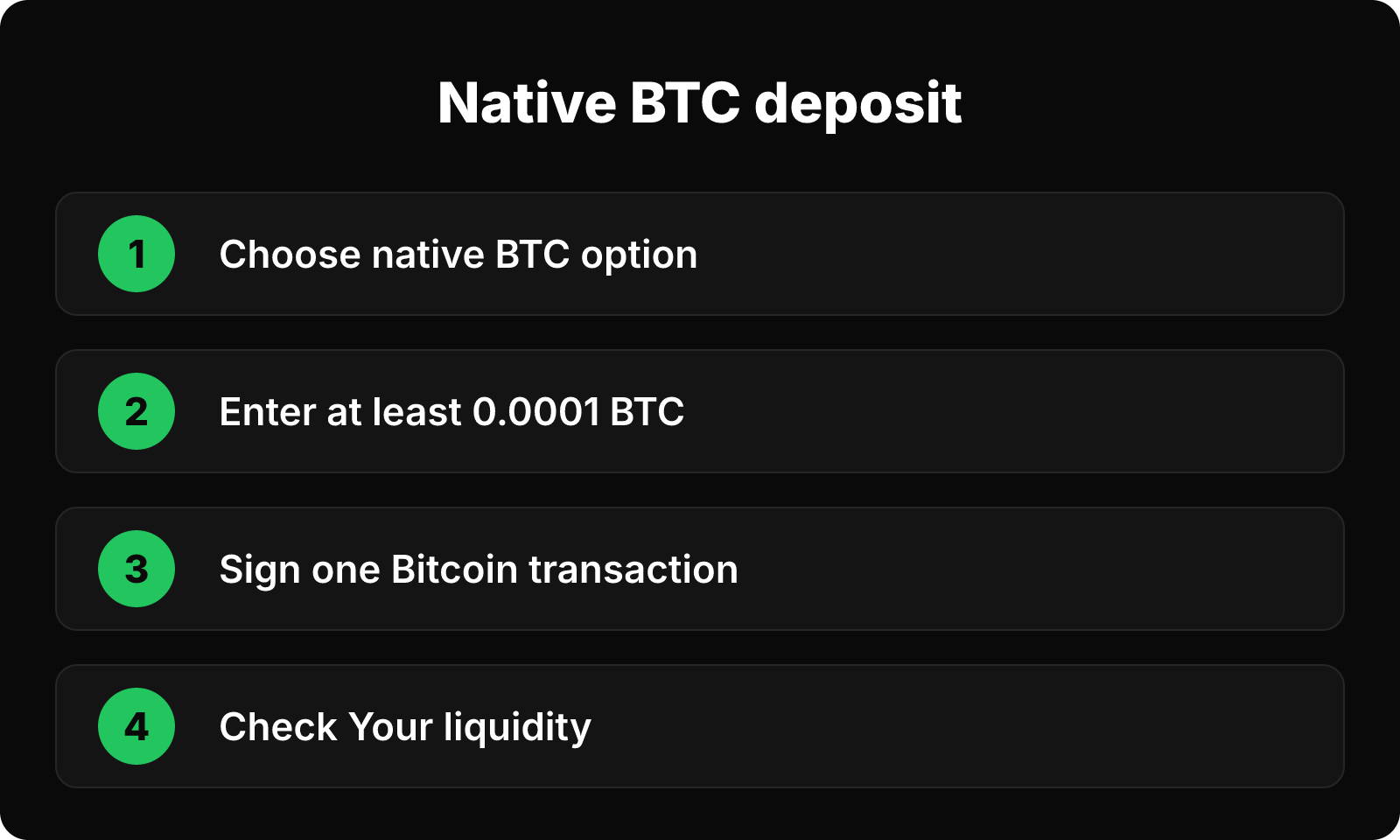
- Open teleswap.xyz/liquidity and choose the native BTC option.
- Enter your amount. A first deposit must be at least 0.0001 BTC. Check the 0.1% locker fee in the summary.
- Sign the single Bitcoin transaction from your Bitcoin wallet, choosing a miner fee rate that suits your timing.
- Wait for confirmation, then check Your liquidity.
Path B: WBTC (Polygon) or BTCB (BNB Smart Chain)
- Connect an EVM wallet on the right network and keep a little gas token (POL or BNB).
- Select the WBTC/TeleBTC or BTCB/TeleBTC pool and open Add Liquidity.
- Enter your amount and confirm the transactions your wallet requests.
- Check that Your liquidity has updated.
Holding native BTC but want the EVM path? You can swap BTC to WBTC on Polygon first. For most Bitcoin holders the native path is simpler: one transaction and no EVM wallet.
How to Collect Fees and Withdraw
Fees and principal are handled separately, so you can collect earnings without leaving the pool.
- Native BTC positions: claiming fees and withdrawing are both Bitcoin transactions, and the BTC goes to your Bitcoin address. Budget for a miner fee each time, since claiming small amounts often can cost more than you collect.
- EVM positions: use Collect Fees to claim earnings and Remove Liquidity to take out your principal.
- Back to native Bitcoin: if you withdrew WBTC and want BTC in your own wallet, the WBTC (Polygon) to BTC route takes you back to Bitcoin.
Because both reserves are pegged near 1:1, the BTC you take out should be close to what you put in, plus uncollected fees. That holds only while both pegs hold and the contracts work as designed.
Frequently Asked Questions
How do I provide Bitcoin liquidity and get paid in BTC?
Deposit native BTC, WBTC, or BTCB into a TeleBTC pool at teleswap.xyz/liquidity, and you earn a share of swap fees in BTC. Native BTC takes one Bitcoin transaction and no EVM wallet. WBTC (Polygon) and BTCB (BNB Smart Chain) are deposited from an EVM wallet.
Where do Bitcoin liquidity provider rewards come from?
They come from fees paid by swaps routed through the pool. When users swap through the TeleBTC pools, liquidity providers earn a share of the fees in proportion to their share of the pool.
What APR can I expect?
The APR changes and nobody can promise it. On 2026-11-19 the 7-day averages were 19.38% for BTCB/TeleBTC on BNB Smart Chain and 4.15% for WBTC/TeleBTC on Polygon. Future returns depend on swap volume and on how much liquidity joins the pool.
Is there impermanent loss in TeleSwap's BTC pools?
Effectively no, as long as both assets hold their 1:1 Bitcoin pegs. Both sides are Bitcoin representations trading near 1:1. The remaining risk is a depeg of one asset.
What is the minimum deposit for native BTC?
A first deposit must be at least 0.0001 BTC. Native deposits pay a 0.1% locker fee and a 0% protocol fee, plus the Bitcoin miner fee.
What is TeleSwap and how is TeleBTC secured?
TeleSwap lets you bridge, swap and earn on Bitcoin, and TeleBTC is its trustless wrapped Bitcoin, backed 1:1 by BTC. TeleBTC is minted only after a Bitcoin transaction is verified by an SPV light client. Custody is collateral-backed and slashable.
How do I withdraw my BTC?
Native BTC positions withdraw through a Bitcoin transaction to your Bitcoin address, and EVM positions use the Remove Liquidity tab. You can claim fees separately through Collect Fees (or a Bitcoin claim transaction for native positions) without touching your principal.
Conclusion
When you provide Bitcoin liquidity in TeleSwap's TeleBTC pools, you earn a share of swap fees, paid in BTC, from a pool where both sides track Bitcoin. Three points to keep in mind:
- The yield is a fee-to-liquidity ratio. The rates above are past 7-day averages (19.38% and 4.15% on 2026-11-19), not a promise of future returns.
- The BTC/BTC design removes most divergence risk. What's left is peg risk and contract risk.
- Bitcoin holders can join with a single native transaction, with no EVM wallet, gas or approval.
If that trade-off suits you, check the live pool data and start with an amount that makes sense against the transaction fees.