Is Bitcoin Yield Safe? 8 Risks to Check Before You Deposit (2026)

In June 2022, Celsius froze withdrawals, and customers who had deposited Bitcoin for an attractive interest rate could not get their coins out. So, is Bitcoin yield safe? It is never risk-free, but it can be reasonably safe if you know where the yield comes from and what can break along the way. Bitcoin pays you nothing on its own. Any interest on BTC comes from someone doing something with your coins, and each of those activities carries its own risk.
This guide covers the eight Bitcoin yield risks to check before depositing anywhere. For each one you get a real example and a short list of questions to ask. No prior DeFi knowledge is needed.
Key Takeaways:Bitcoin has no built-in yield, so every BTC return must come from an identifiable activity such as lending, trading fees, or options, as Maestro's FAQ explains.Centralized lenders Celsius and BlockFi both filed for bankruptcy in 2022 after paying yield funded by re-lending customer deposits.Advertised and realized yields can differ widely: Lombard's LBTC targeted 2.5%+ but realized about 0.4% in the 30 days to October 25, 2026.A wrapped Bitcoin token is only as safe as whatever backs it, whether that is a custodian, a multi-sig committee, or a cryptographic proof.Yield paid in BTC keeps your Bitcoin exposure, while yield paid in a platform token adds that token's price risk.
Table of Contents
- Where Does Bitcoin Yield Come From?
- Risk 1: Who Holds Your Bitcoin?
- Risk 2: Is Your BTC Being Re-Lent?
- Risk 3: Can the Code Be Exploited?
- Risk 4: What Backs the Wrapped Token?
- Risk 5: Will Impermanent Loss Eat Your Gains?
- Risk 6: Is the Rate Real or Just Advertised?
- Risk 7: Is the Yield Paid in BTC?
- Risk 8: Can the Rules Change After You Deposit?
- How Do Common Bitcoin Yield Options Compare?
- Can I Earn Interest on Bitcoin Safely? A Pre-Deposit Checklist
- Frequently Asked Questions
- The Bottom Line
Where Does Bitcoin Yield Come From?
Bitcoin yield is always paid by a third party, never by the Bitcoin network. Ethereum rewards people who stake ETH. Bitcoin runs on proof-of-work, so new coins go only to miners, and holders get nothing by default, as Starknet's overview of Bitcoin yield points out.
Think of it like cash. Notes in your drawer earn nothing. Interest only appears when you hand the money to a bank and the bank lends it out. With Bitcoin, the "bank" might be a lending company, a smart contract, a trading pool, or an options strategy, and each one fails in a different way.
Our earlier guide to 7 ways to earn yield on Bitcoin in 2026 covers the options themselves. This article looks at what can go wrong with them.
Risk 1: Who Holds Your Bitcoin? (Custody Risk)
If someone else holds your private keys, their solvency is your risk. On centralized yield platforms (often called "CeFi"), you send BTC to the company and the app shows a balance. That balance is a promise from the company, not coins you control.
Celsius froze withdrawals on June 12, 2022, and filed for Chapter 11 bankruptcy on July 13, 2022. BlockFi followed on November 28, 2022. Starknet sums up the pattern: these lenders "promised high yields by leveraging user deposits but failed when liquidity dried up".
What to check:
- Who holds the keys: you, a smart contract, or a company?
- Does the company publish proof of reserves, and who verifies it?
- Do the terms of service say deposits become company property?
Risk 2: Is Your BTC Being Re-Lent? (Rehypothecation)
Rehypothecation means the platform lends out your deposit again, sometimes several times over, to produce the yield it pays you. Imagine lending your car to a friend who rents it to a stranger, who then uses it as collateral for a loan. Each step adds someone who might not give it back.
This is how many high CeFi rates were funded. Some providers now say plainly that they don't do this. Abra, for example, says it does not rehypothecate client assets for its own benefit, while also admitting its BTC strategy can still lose money. Treat any claim like that as a vendor statement until an auditor confirms it.
A related risk is liquidation. Some strategies borrow against your BTC to run hedged trades. If the price moves sharply, that borrowed position can be force-closed at a loss.
What to check: Does the agreement allow re-lending? Is leverage involved? Who are the borrowers, and how much collateral do they post?
Risk 3: Can the Code Be Exploited? (Smart Contract Risk)
DeFi removes the company but puts code in its place, and code can have bugs. A smart contract is a program on a blockchain that holds funds and follows fixed rules. If the rules contain a mistake, an attacker can drain the contract in minutes.
On March 13, 2023, the Euler Finance lending protocol lost about $197 million to a flash-loan exploit, even though its code had been audited. The attacker later returned the funds, which is unusual. DefiLlama's hacks tracker lists hundreds of similar incidents.
An audit is a snapshot, not a guarantee. Code that has held a lot of value for a long time without being drained tells you more than a new protocol with several audit badges.
What to check: Is the code open-source? Who audited it, and when? How long has it been live, and has it been exploited before? Is there a bug bounty?
Risk 4: What Backs the Wrapped Token? (Bridge and Depeg Risk)
Most onchain Bitcoin yield doesn't use real BTC. It uses a wrapped token that is supposed to be redeemable 1:1 for BTC. Your BTC gets locked somewhere and a stand-in token is issued on Ethereum, BNB Chain, Polygon, or another chain. That stand-in is only worth what you can reliably redeem it for.
When it breaks, it can break completely. In July 2023 the Multichain bridge collapsed after its CEO was detained, and the wrapped assets it had issued lost their backing. In August 2024, BitGo's plan to move WBTC to joint custody with BiT Global, a firm tied to Justin Sun, led some DeFi protocols to reconsider their WBTC exposure.
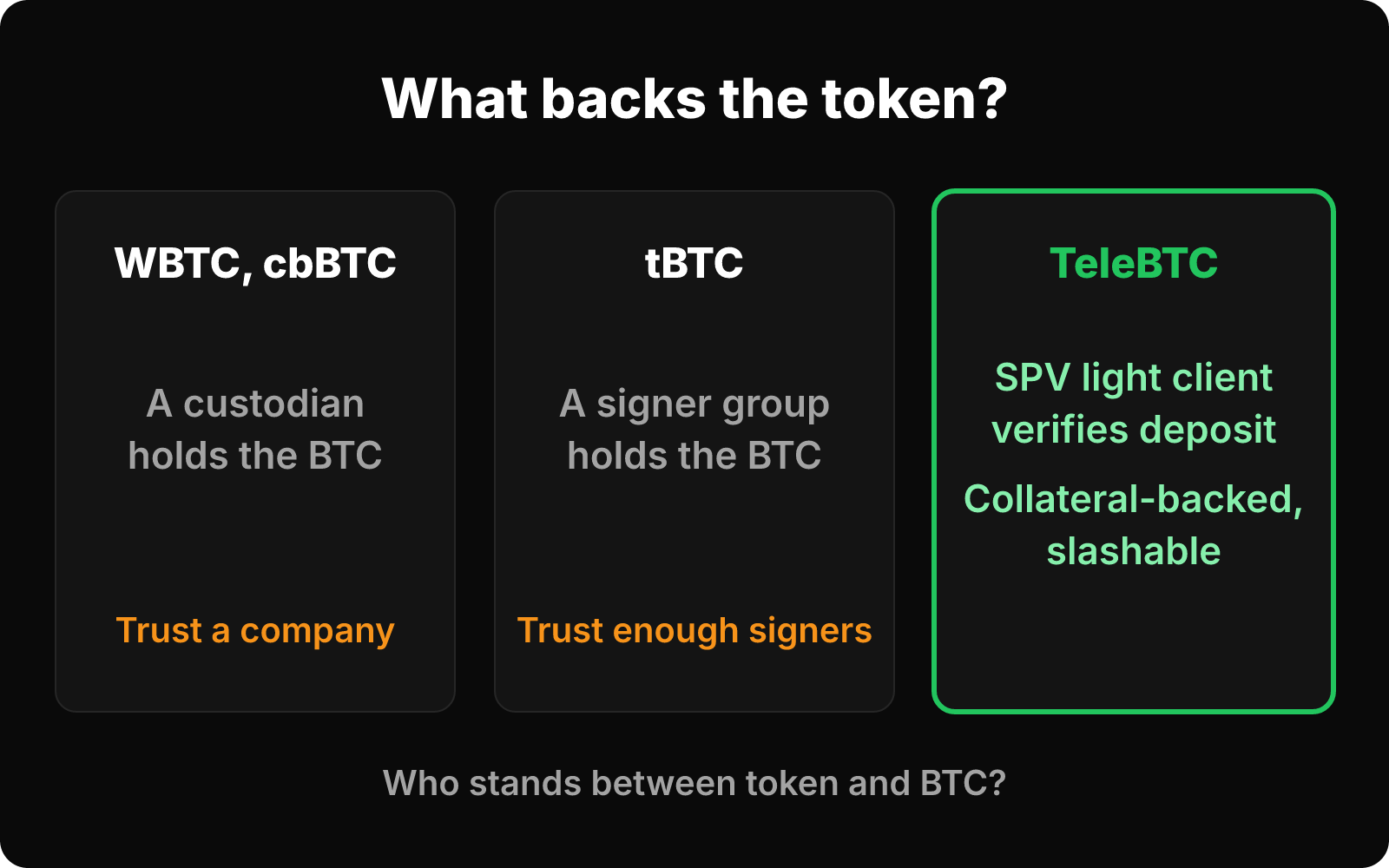
The question that matters is what stands between the token and the real BTC?
- WBTC and cbBTC: a custodian holds the BTC. You are trusting that company.
- tBTC: a threshold-signing group of operators holds the BTC. You are trusting that enough of them stay honest.
- TeleBTC: TeleSwap's 1:1 wrapped Bitcoin is minted only after an SPV light client verifies the Bitcoin deposit. Custody is collateral-backed and slashable, rather than resting on a custodian or multi-sig committee. For more, see how SPV light-client bridges work.
Receipt tokens such as Lombard's LBTC add a further layer. They can trade below the BTC they represent if the market loses confidence.
What to check: Who or what holds the underlying BTC? Can you check the reserves on-chain? Has the token ever lost its peg? How long does redeeming back to native BTC take?
Risk 5: Will Impermanent Loss Eat Your Gains?
Impermanent loss is the gap between what you'd have if you had just held your coins and what you have after providing liquidity to a trading pool. You supply tokens, and traders pay you fees. When one token's price moves against the other, the pool sells the one that's rising, so you end up holding more of the one that's falling.
In a standard 50/50 pool, if one asset doubles in price relative to the other, you end up about 5.7% worse off than if you had held, according to Uniswap's documentation on liquidity returns. In volatile pairs, that can offset a large share of the fees earned.
Pools that pair two Bitcoin-pegged tokens have little impermanent loss while both hold their peg. But the risk doesn't go away. It turns into Risk 4: if one token depegs, traders will sell it into the pool and the pool fills with the weaker token.
What to check: Are the two assets in the pool price-correlated? What happens if one of them depegs? Do the fees realistically cover the price risk?
Risk 6: Is the Rate Real or Just Advertised? (Variable-Rate Risk)
The headline number on a yield page is usually a target, a maximum, or a recent high, not what you'll actually earn. Yield comes from activity, and activity changes, so most Bitcoin yields are variable.
Two examples show the gap. In August 2026 Lombard moved LBTC to a Bitwise-managed covered-call strategy targeting a net APY of 2.5% or more, yet its realized yield averaged about 0.4% in the 30 days to October 25, 2026, based on DefiLlama data. Nexo's "up to 5.5%" BTC rate requires a balance above $5,000 and Platinum loyalty status, which means holding NEXO tokens worth at least 10% of your portfolio.
Also be wary of incentive-driven yields. Abra notes that yields funded by protocol token subsidies tend to spike and then fall once the incentives end.
What to check: Is the rate realized or targeted? What has the 30- or 90-day average been? Which tier, balance, or lock-up does the headline rate need?
Risk 7: Is the Yield Paid in BTC? (Payout-Currency Risk)
A 5% yield paid in a platform token is not the same as a 5% yield paid in Bitcoin. If the platform token falls 50%, your "5%" becomes 2.5% in real terms, and you may also have had to buy the token to qualify for the rate.
Points programs are a step further removed. Maestro states that points that reference BTC without generating yield are "not real yield".
What to check: What currency is the yield paid in? Do you have to hold a platform token to unlock the rate? Is part of the APR made up of points or emissions?
Risk 8: Can the Rules Change After You Deposit? (Strategy and Regulatory Risk)
The product you deposit into may not be the product you hold six months later. LBTC launched as a Babylon staking token and became a covered-call strategy in 2026. Depositors went from staking exposure to options exposure, which is a different risk profile.
Regulation can change things too. Since the GENIUS Act of 2025, US payment stablecoin issuers may not pay interest just for holding the coin. Lock-up periods add to this risk, because if the rules change while your BTC is locked, you can't leave.
What to check: Can the operator change the strategy without your consent? Is there a lock-up or withdrawal queue? Which jurisdiction is the provider in?
How Do Common Bitcoin Yield Options Compare?
Here is how the main Bitcoin yield options map to the eight risks, using publicly reported data. Rates are variable and change over time.
| Option | Yield source | Who holds the BTC | Paid in | Main risks | Reported rate (date) |
|---|---|---|---|---|---|
| Self-custody (just holding) | None | You | N/A | Key loss only | 0% |
| CeFi lending (e.g., Nexo) | Loans to borrowers | Company | BTC or platform token | 1, 2, 6, 7 | "Up to" 5.5%, tier-gated (Oct 2026) |
| Liquid receipt token (LBTC) | Covered calls | Protocol / smart contract | BTC value accrual | 3, 4, 6, 8 | ~0.4% realized vs 2.5%+ target (Oct 2026) |
| Tokenized fund (Abra BTCaf) | Lending 35.1%, basis 30.2%, options 21.4%, RWA 13.3% | Collateral at Fireblocks Trust | BTC | 1, 2 (liquidation), 6 | Not stated in sources |
| TeleSwap Earn (teleBTC pools) | Swap fees | Smart contract | BTC | 3, 4, 5 (via depeg), 6 | 2.87% and 23.35%, 7-day avg, variable (Nov 20, 2026) |
Abra's BTCaf allocation is as reported on Abra's product page on November 6, 2026. No option scores zero risk except doing nothing. What matters is choosing risks you understand and can check yourself, rather than trusting a company's word.
Can I Earn Interest on Bitcoin Safely? A Pre-Deposit Checklist
You can earn interest on Bitcoin more safely by limiting how much you risk and checking every link in the chain before you deposit. Here is the order we use:
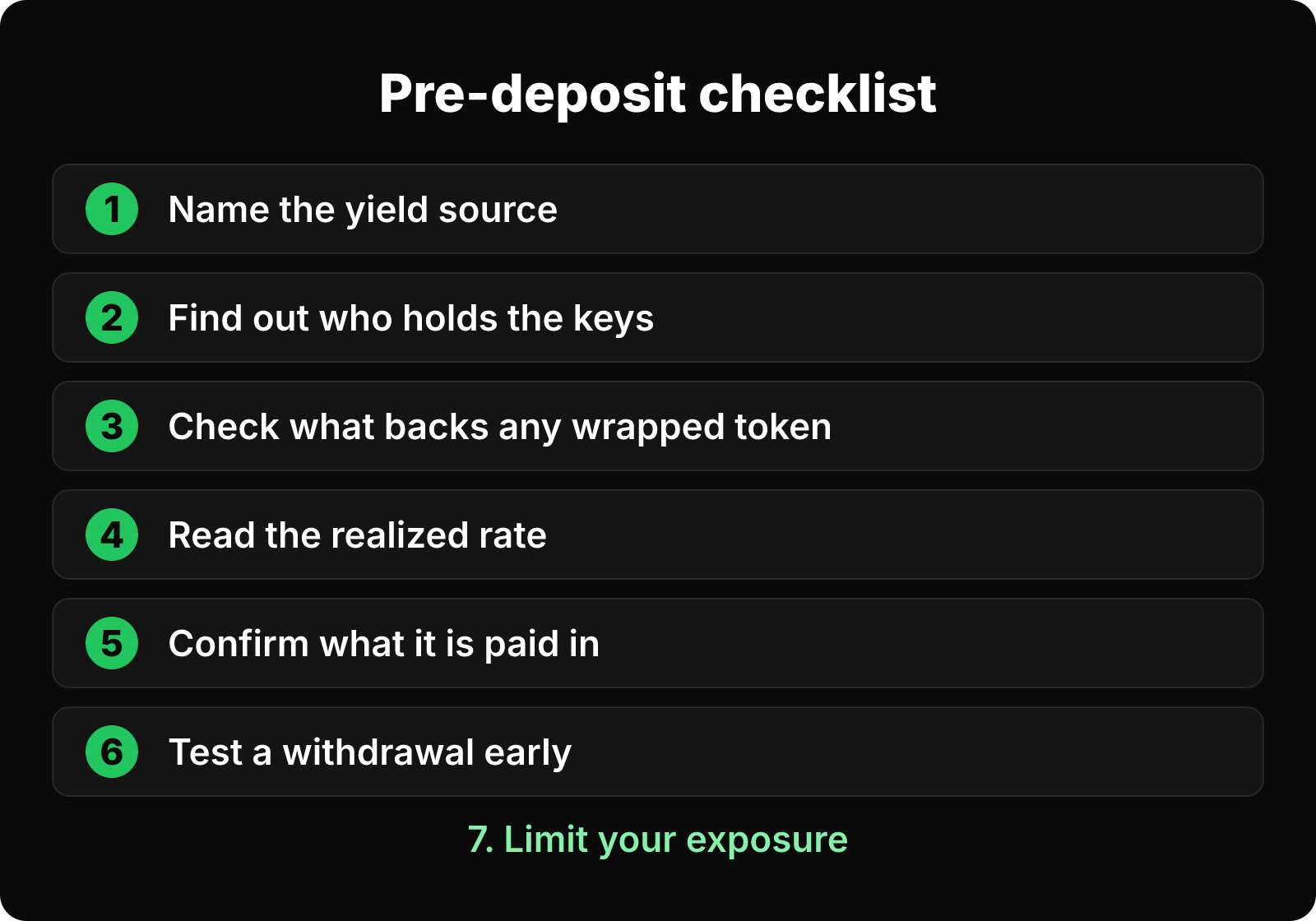
- Name the yield source in one sentence. If you can't explain who pays you and why, don't deposit.
- Find out who holds the keys. Prefer setups where you or verifiable code hold them over setups where a company does.
- Check what backs any wrapped token. Is it a custodian, a signer committee, or a cryptographic proof?
- Read the realized rate, not the headline. Look at 30-day and 90-day averages.
- Confirm what the yield is paid in. BTC-denominated yield keeps you holding Bitcoin.
- Test a withdrawal early. Deposit a small amount, withdraw it, and time how long it takes.
- Limit your exposure. Never put more into a single yield product than you could afford to lose.
One option built around several of these checks is TeleSwap Earn. You provide single-sided liquidity to the teleBTC pools on Polygon and BNB Smart Chain, and the yield is the fees paid by swaps through those pools, paid out in BTC. It is variable and is not protocol staking.
You can deposit native BTC from a Bitcoin wallet in one Bitcoin transaction, with no EVM wallet, gas, or approval needed. Claims and withdrawals are Bitcoin transactions too, and the BTC arrives at your Bitcoin address. The first deposit must be at least 0.0001 BTC, with a 0.1% locker fee, a 0% protocol fee, and the Bitcoin miner fee.
As of November 20, 2026, the 7-day average APR on the TeleSwap liquidity page was 2.87% for WBTC/teleBTC on Polygon and 23.35% for BTCB/teleBTC on BNB Smart Chain. Both rates are variable, and the gap between them shows why you should check the pool and the date before relying on any number. According to TeleSwap network stats, $573.7M has been bridged across 609,113 transactions and 13 networks, with $48.1M in the last 30 days.
If you hold BTC and want WBTC or BTCB for the EVM-wallet route, use the BTC → WBTC (Polygon) or BTC → BTCB (BNB Smart Chain) routes. The same risks still apply: smart contracts, peg risk on the paired token, and variable fees.
Frequently Asked Questions
Is Bitcoin yield safe?
Bitcoin yield is never risk-free, but some types are much safer than others. Because Bitcoin has no native yield, every return relies on a third party, a smart contract, or a wrapped token. Your safety depends on who holds your keys, what backs the token, and whether the yield source is real economic activity.
Can I earn interest on Bitcoin safely?
You can reduce risk a lot, but you can't remove it completely. Choose options where you or verifiable code hold custody, yields come from identifiable fees, and payouts are in BTC. Test withdrawals with small amounts first, and spread deposits across products.
What are the biggest Bitcoin lending risks in 2026?
The biggest Bitcoin lending risks in 2026 are counterparty default, rehypothecation, and gaps between advertised and realized rates. Lombard's LBTC, for example, targeted 2.5%+ but realized about 0.4% in the 30 days to October 25, 2026. Strategy changes and new regulations can also change a product after you deposit.
Why doesn't Bitcoin pay staking rewards like Ethereum?
Bitcoin uses proof-of-work, so new coins go to miners and holders earn nothing. Ethereum's proof-of-stake pays validators for locking up ETH. Any Bitcoin yield has to come from outside activity such as lending, trading fees, or options.
Is wrapped Bitcoin as safe as real Bitcoin?
No. Wrapped Bitcoin adds the risk of whatever backs it. WBTC and cbBTC rely on custodians, tBTC relies on a signer group, and TeleBTC relies on SPV light-client proofs with collateral-backed, slashable custody. Any wrapper can depeg if its backing fails or is questioned.
What is impermanent loss in simple terms?
Impermanent loss is the value you give up by providing liquidity instead of simply holding your coins. When one asset in a pool rises relative to the other, the pool leaves you holding more of the weaker one. In a standard 50/50 pool, if one asset doubles, the loss is about 5.7%.
Is a higher APR a sign of higher risk?
Usually, yes. A higher APR often means more risk, temporary incentives, or a short-term spike. Check whether the rate is realized or targeted, which period it covers, and whether it relies on token emissions that will end.
The Bottom Line
Is Bitcoin yield safe? It is as safe as the weakest link between your BTC and the source of the yield. Bitcoin itself pays nothing, so always identify who is paying you. A wrapped token is only as good as what backs it. And realized rates, not headline rates, show what you'll actually earn.
If you want BTC-denominated yield from swap fees that you can deposit straight from a Bitcoin wallet, look at the current, dated, variable pool rates on the TeleSwap liquidity page, start small, and run each of the eight checks above first.