Bitcoin Layer 2 Mainnet Explained: Why It Matters for DeFi

A Bitcoin Layer 2 mainnet is a live network built on top of Bitcoin that handles real BTC and adds speed or smart contracts that Bitcoin itself doesn't offer. "Layer 2" means it extends Bitcoin rather than replacing it. "Mainnet" means it's live, real money is moving, and mistakes now cost real money. The rest of this guide covers how these networks work and what they make possible in decentralized finance (DeFi).
Here's an analogy. Bitcoin is a courthouse: slow and expensive to visit, but its rulings are final. A Layer 2 is a bar tab. You open it once, run up dozens of small transactions, and settle the total at the end. The real question with any Layer 2 is simple: if the bartender disappears, can you still get your money back?
Key Takeaways:A Bitcoin Layer 2 mainnet is a live, real-value network that extends Bitcoin with faster payments or smart contracts without changing Bitcoin's own rules.Bitcoin processes roughly 5–7 transactions per second, according to Spark's scaling research, which is why extra layers exist.Citrea launched its mainnet on January 27, 2026 as a ZK rollup whose withdrawals rely on Bitcoin plus at least one honest challenger, per Bitcoin.com.The difference between a Bitcoin Layer 2 and a sidechain comes down to the exit: a sidechain relies on a federation or signer set to release your BTC.A "mainnet" launch marks when real money starts moving on a network, and it says nothing about how much you have to trust the people running it.
Table of Contents
- What Is a Bitcoin Layer 2 Mainnet?
- Why Does Bitcoin Need a Layer 2 at All?
- How Does a Bitcoin Layer 2 Work?
- Bitcoin Layer 2 vs Sidechain: What's the Difference?
- Which Bitcoin Layer 2 Mainnets Are Live in 2026?
- Why Does a Bitcoin Layer 2 Matter for DeFi?
- Is a Layer 2 the Only Way to Use BTC in DeFi?
- A 5-Point Checklist Before You Deposit
- Frequently Asked Questions
- Conclusion
What Is a Bitcoin Layer 2 Mainnet?
A Bitcoin Layer 2 is an off-chain network that is anchored to Bitcoin and extends what it can do without altering Bitcoin's base consensus rules. As Bitrue's explainer puts it, an L2 isn't a rival blockchain. It works more like an extension that leans on Bitcoin as the final record.
Now for the "mainnet" part. Every blockchain project goes through two stages:
- Testnet: a rehearsal network that uses worthless test coins. Developers break things on purpose to find bugs.
- Mainnet: the production network. The coins are real, the transactions are final, and users' money is at stake.
So when a headline says "Citrea mainnet is live" or "Stacks launched mainnet," it means the network has moved from rehearsal to opening night. You can now deposit real BTC, and whatever happens to it actually happens.
One more definition. Layer 1 is Bitcoin itself, the base chain secured by proof-of-work mining, with a new block about every 10 minutes. Layer 2 is everything built on top of that.
Why Does Bitcoin Need a Layer 2 at All?
Bitcoin is deliberately small and simple, so it can't handle high transaction volume or complex financial apps on its own. That's a design choice, not a flaw.
After the SegWit upgrade, each Bitcoin block holds roughly 3,000–4,000 transactions, which works out to about 5–7 transactions per second, according to Spark's research on Bitcoin scaling.
Why not just make blocks bigger? Because bigger blocks make it more expensive to run a full node, the software that independently checks every transaction. Fewer people can afford to run one, and control over validation concentrates in fewer hands.
The second limit matters more for DeFi. Bitcoin's scripting language is not Turing-complete, meaning it can't run arbitrary programs the way Ethereum can. Galaxy Research notes that this restraint is part of what makes Bitcoin so robust. It's also why you can't run a lending market or a decentralized exchange directly on Bitcoin.
Our take is that in 2026 the speed argument for Layer 2s is weaker than people assume. Base-layer fees averaged around $0.40 in October 2026, per Bitcoin.com, and the same source says several business models built for high-fee conditions "have not survived contact with an empty mempool." The stronger reason for an L2 today is programmability: being able to do things with BTC, not just send it more cheaply.
How Does a Bitcoin Layer 2 Work?
Nearly every Bitcoin Layer 2 follows the same three-step cycle: lock, transact, settle. Bitrue describes the lifecycle like this:
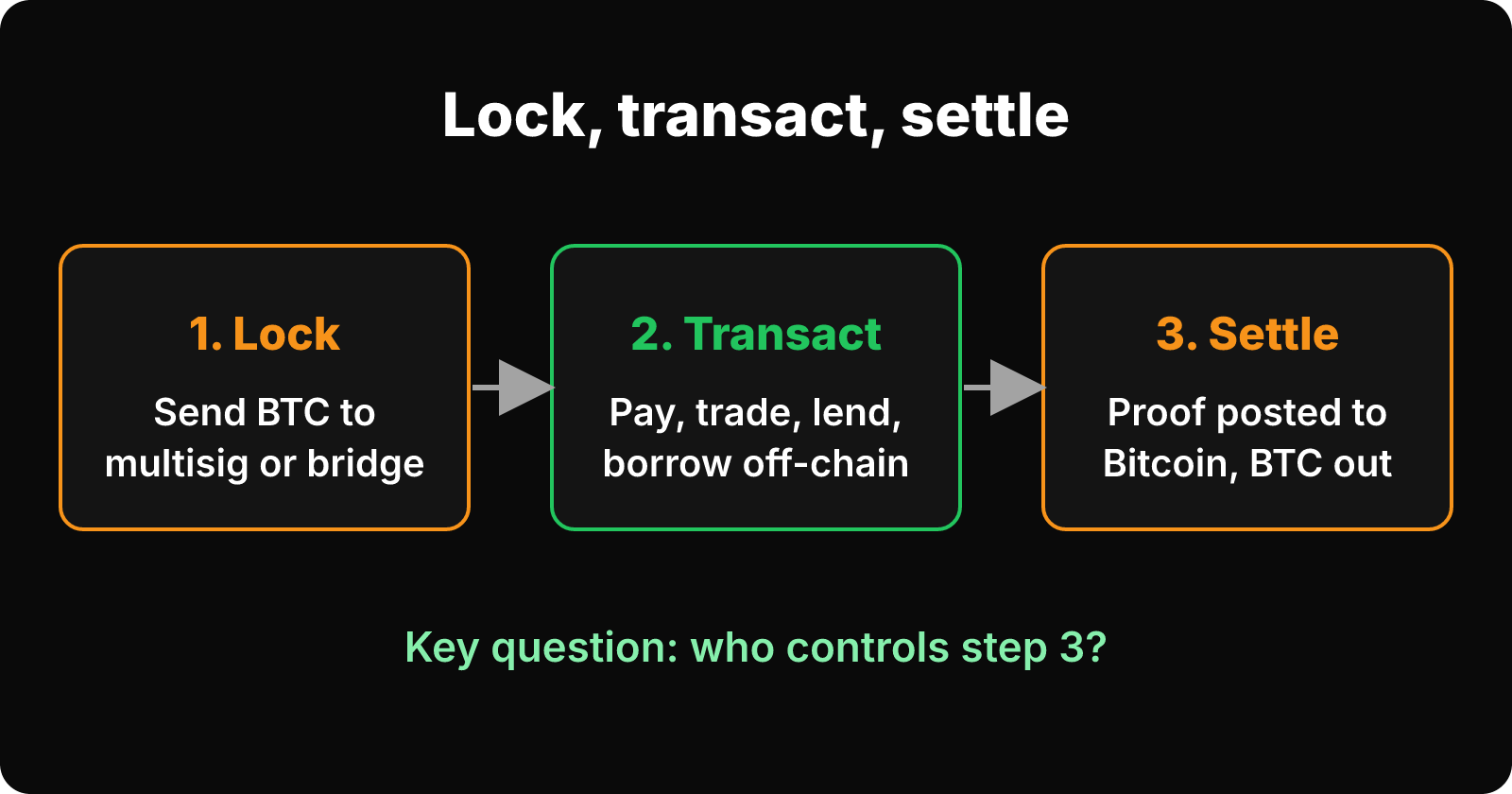
- Lock. You send BTC to a special address on Bitcoin, often a multisig (an address that needs several keys to spend from) or a bridge. This is a normal Bitcoin transaction with a normal fee, but you only do it once.
- Transact off-chain. Activity happens in a payment channel, sidechain, or rollup. You can pay, trade, lend, or borrow as many times as you like, and none of those individual moves touch the Bitcoin blockchain.
- Settle. The Layer 2 posts a compressed summary or cryptographic proof back to Bitcoin. When you want out, you withdraw and your BTC is released on Layer 1.
Back to the bar tab. Step 1 is handing over your card. Step 2 is ordering all night. Step 3 is the final charge. What separates good L2 designs from risky ones is who controls step 3: Bitcoin's own rules, or a group of people trusted to act honestly.
Different L2s handle step 2 in different ways:
- Payment channels (Lightning): bidirectional channels connected into a routing network, so payments can route between people who don't share a direct channel.
- Sidechains (Liquid, Rootstock): a separate blockchain with its own block producers, connected to Bitcoin by a peg.
- Rollups (Citrea): a chain that executes contracts off Bitcoin and posts proofs to Bitcoin so its activity can be checked.
- Economically linked chains (Stacks): miners spend BTC to win the right to produce blocks, which ties the chain to Bitcoin economically instead of through shared hash power.
For more on how the wrapped tokens in step 2 differ, see our wrapped Bitcoin tokens list.
Bitcoin Layer 2 vs Sidechain: What's the Difference?
The difference comes down to who can stop you from withdrawing. On a sidechain, a federation or signer set holds the locked BTC and decides when to release it. On a stricter Layer 2, Bitcoin's own rules, or a cryptographic proof checked against Bitcoin, guarantee your exit.
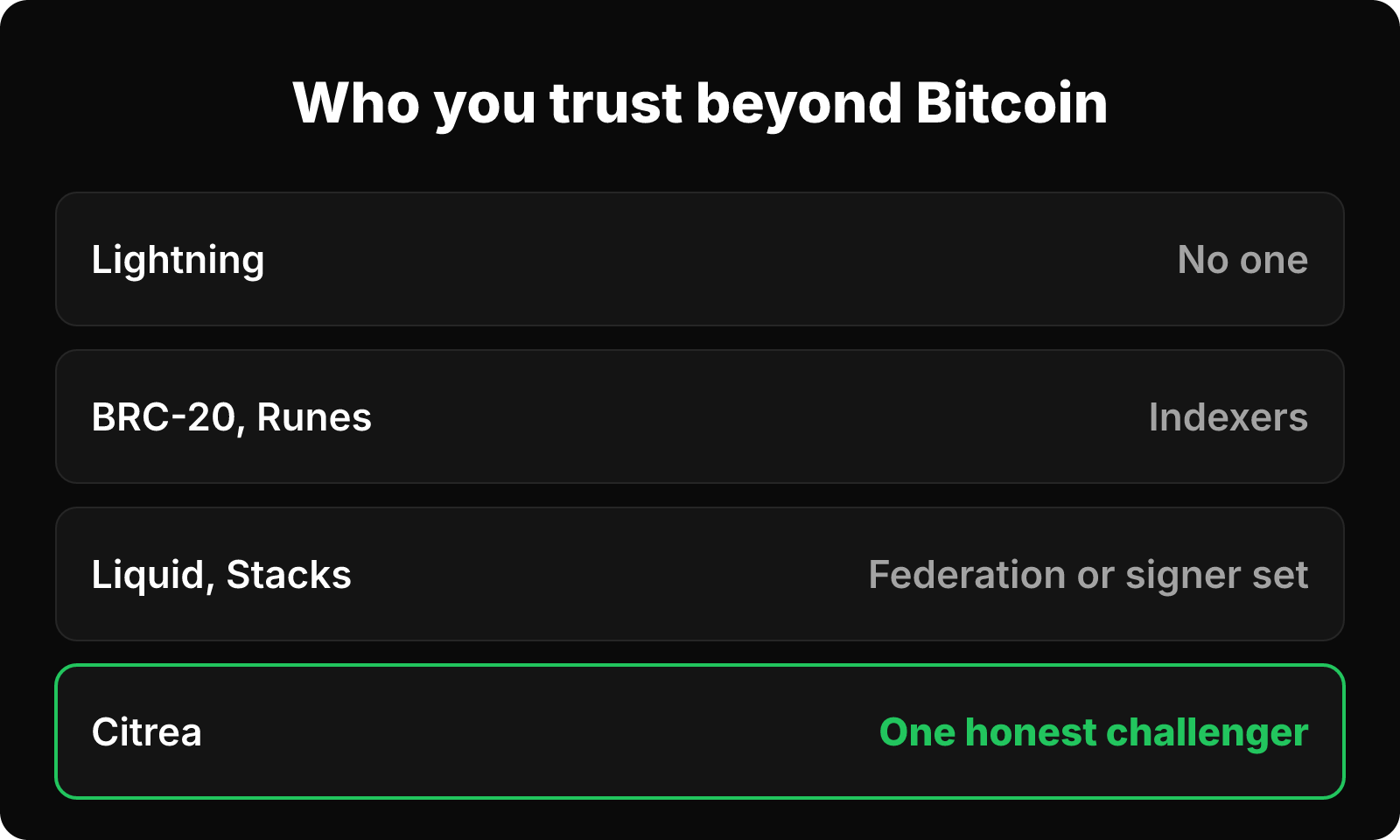
In practice the industry uses "Layer 2" loosely, and many projects called L2s are technically sidechains. The more useful way to think about it is as a spectrum. Bitcoin.com's framework groups Bitcoin programmability into four routes, where trust rises as capability rises:
| Route | What it enables | Examples | Who you trust beyond Bitcoin |
|---|---|---|---|
| Native Script & Taproot | Multisig, timelocks, vaults, payment channels, staking | Lightning, Babylon, Ark-style protocols | No one |
| Layer-1 metaprotocols | Tokens tracked by off-chain indexers | BRC-20, Runes, OpNet | Indexers agreeing on balances |
| Sidechains / anchored chains | Full smart contracts (EVM or Clarity) | Rootstock, Liquid, Stacks | A peg federation or signer set |
| BitVM-based rollups | Full smart contracts with Bitcoin-enforced exits | Citrea | At least one honest challenger |
Lightning needs no extra trust but mostly does payments. Sidechains can run full DeFi apps, but you're trusting a group of signers with your coins. BitVM rollups try to get the best of both, and they're the newest design.
Bitcoin's covenant debate fits in here too. Proposed opcodes such as OP_CAT would let L2s build more trust-minimized designs, but as Bitrue notes, that debate is still unresolved.
Which Bitcoin Layer 2 Mainnets Are Live in 2026?
Lightning (2018), Stacks (2021), and Citrea (January 2026) are three of the most widely cited Bitcoin Layer 2 mainnets, and each sits at a different point on the trust spectrum. Here's how the main networks compare, based on the sources available as of November 2026:
| Network | Design | Mainnet | Trust model | Main use |
|---|---|---|---|---|
| Lightning | Payment channels | 2018 | Bitcoin only | Fast, cheap payments |
| Stacks | Proof of Transfer, Clarity VM | January 2021 | Economic link to BTC | DeFi via sBTC (Zest, Bitflow, Hermetica) |
| Liquid | Federated sidechain | Not covered in our sources | Federation | Exchanges, confidential transfers |
| Rootstock | EVM-compatible sidechain | Not covered in our sources | Merged mining + peg | Ethereum-style smart contracts |
| Citrea | ZK rollup + BitVM2 bridge | January 27, 2026 | One honest challenger | EVM DeFi with cBTC |
| BOB, Bitlayer, Merlin, Mezo | Various | 2024–2025 | Various | EVM DeFi |
Size varies enormously. Stacks reports roughly $123M in total value locked, while Citrea sat around $1.56M by mid-2026, both according to the Stacks blog. That's a vendor source, so check it independently. Bitcoin.com separately describes Citrea's TVL as "single-digit millions" and calls it proof of concept. It also says 2026's consolidation "wiped out much of the long tail" of smaller L2 projects.
Here's the nuance most explainers miss. A mainnet launch tells you when real money starts flowing. It doesn't tell you when the security model is finished. Many networks launch with upgradeable contracts, admin keys, or a small signer set that the team plans to decentralize later. Two networks can both say "mainnet" and still carry very different risk.
Why Does a Bitcoin Layer 2 Matter for DeFi?
Bitcoin Layer 2s matter for DeFi because they let BTC holders lend, borrow, trade, and earn yield on their Bitcoin without selling it. Most BTC sits idle.
Galaxy Research makes the case directly: most production Bitcoin L2s are EVM-compatible, so apps built for Ethereum can be ported over, and BTC works as both the gas token and the main asset in DeFi on these networks. Galaxy also argues that a strong DeFi ecosystem is the single most important factor for long-term L2 adoption, since the top apps by TVL on Ethereum L2s are lending markets, DEXs, and derivatives platforms.
What does that look like for an ordinary holder?
- Borrowing: put BTC up as collateral and borrow stablecoins.
- Trading: swap BTC for other assets on a decentralized exchange, with no custodial exchange account involved.
- Earning: supply BTC to liquidity pools or lending markets, where traders and borrowers pay fees. Stacks says stackers have historically earned up to ~10% APY in BTC. That's a vendor-reported historical figure, not a guarantee of future returns.
The catch is fragmentation. BTC on L2s is spread across L-BTC, RBTC, sBTC, cBTC, and more, which Bitcoin.com warns splits liquidity and multiplies failure points. Before chasing yield, read 8 risks to check before you deposit.
Is a Layer 2 the Only Way to Use BTC in DeFi?
No. You can also use BTC in DeFi by moving it to established smart-contract chains as tokenized BTC. Galaxy identifies WBTC, tBTC, and cbBTC as the incumbents and notes that Bitcoin L2s have to offer higher yields than BTC DeFi on Ethereum to pull liquidity away from them.
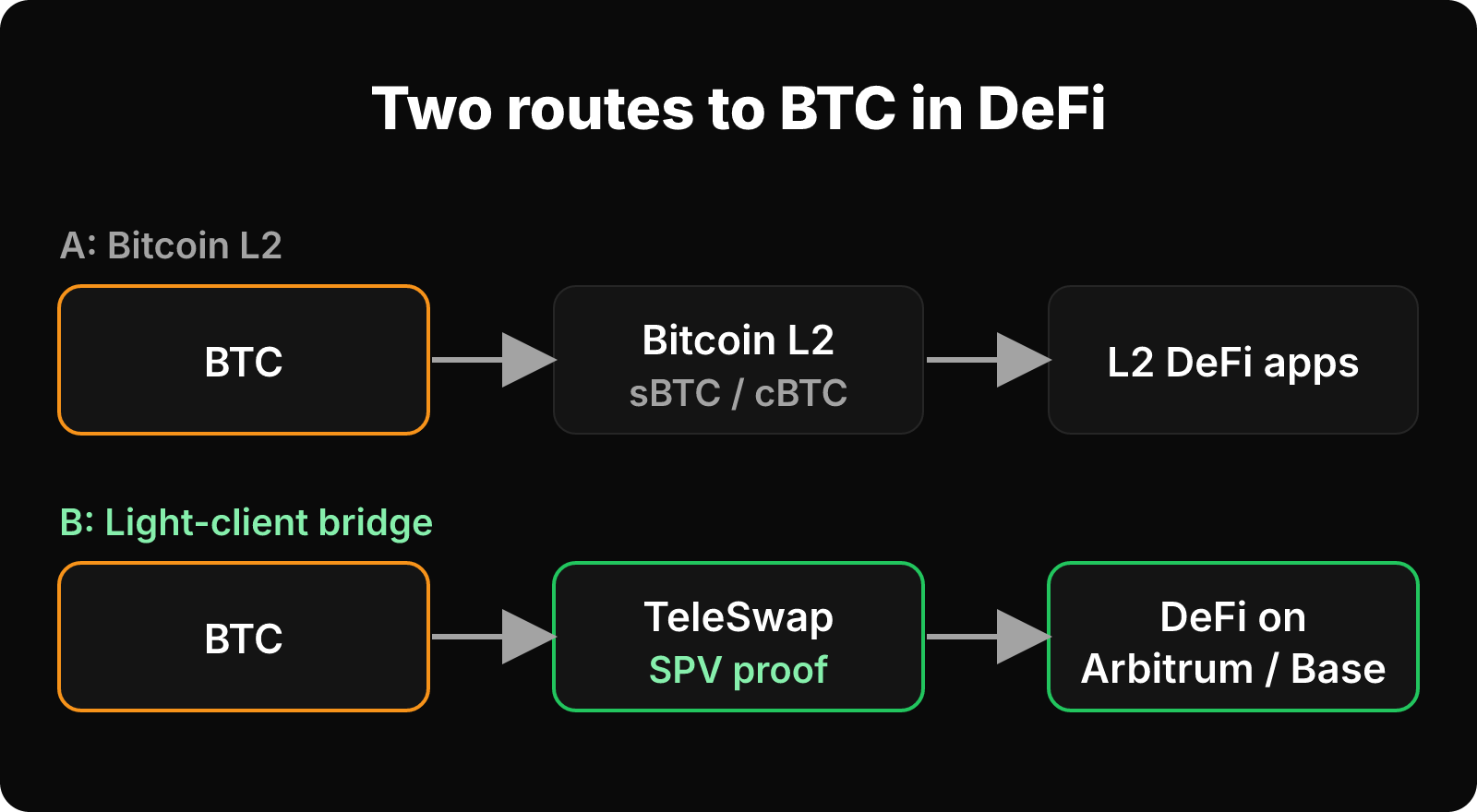
For many users the question isn't "which Bitcoin L2 should I use?" It's "where is the deepest liquidity for what I want to do?" Often that's Ethereum or the Ethereum L2s, which already have mature lending markets and exchanges.
The routes don't share the same trust model:
| Option | Where it's used | Main trust assumption |
|---|---|---|
| Native L2 BTC (sBTC, cBTC) | Stacks, Citrea | Signer set or one honest challenger |
| WBTC | Ethereum and EVM chains | Custodian |
| cbBTC | Ethereum, Base | Coinbase as custodian |
| tBTC | Ethereum and others | Threshold signer network |
| TeleBTC | EVM chains, TON, Solana | Slashable collateral; minted only after a verified Bitcoin transaction (SPV light-client proof) |
TeleSwap is a Bitcoin bridge that verifies Bitcoin transactions on the destination chain using SPV (Simplified Payment Verification) light-client proofs, so nothing is minted without a verified Bitcoin transaction. Instead of moving to a new L2, you can swap BTC in one step into assets on chains that already have deep DeFi liquidity, such as BTC to USDC on Arbitrum or BTC to ETH on Base. Fast swaps settle in about 10 minutes. According to TeleSwap network stats (retrieved November 28, 2026), the protocol has bridged $585,066,172 across 624,817 transactions on 13 supported networks, including $48.9M in the last 30 days.
Bitcoin L2s and cross-chain bridges aren't really competitors. An L2 brings DeFi to Bitcoin; a bridge brings Bitcoin to existing DeFi. Plenty of holders will end up using both. For a deeper comparison, see trustless swaps vs custodial exchanges.
A 5-Point Checklist Before You Deposit
Before you send BTC to any Layer 2 mainnet, find out exactly how you'd get it back. Use these five questions:
- What's the exit path? Can you withdraw on your own using Bitcoin's rules, or do signers have to approve it? Look for the words "unilateral exit," "federation," or "challenger" in the docs.
- Who holds upgrade keys? If a small team can change the contracts overnight, your funds are only as safe as their keys.
- How much liquidity is there? Check independent dashboards like DefiLlama's chain rankings rather than project blogs. Thin liquidity means worse prices and harder exits.
- How long has it been live? A network that went live in 2026 hasn't had time to be tested the way Lightning (2018) or Stacks (2021) have.
- Is the yield explained? Yield comes from someone paying: borrowers, traders, or token emissions. If you can't name who's paying, be cautious.
Finally, size your positions carefully. As Bitcoin.com points out, there's no deposit insurance, and a failed peg has no recovery path.
Frequently Asked Questions
What does "mainnet" mean for a Bitcoin Layer 2?
Mainnet means the Layer 2 is live and handling real BTC instead of worthless test coins. Before mainnet, projects run on a testnet to find bugs. After launch, transactions are final and real money is at risk. Mainnet doesn't mean the network is fully decentralized or finished.
Is a Bitcoin Layer 2 the same as a sidechain?
Not exactly: a sidechain depends on a federation or signer set to release your BTC, while a stricter Layer 2 lets Bitcoin's rules or cryptographic proofs enforce your withdrawal. In everyday use the terms get mixed, and sidechains like Liquid and Rootstock are often called L2s. Check the exit mechanism to know which one you're dealing with.
Is the Lightning Network a Bitcoin Layer 2?
Yes, Lightning is the best-known Bitcoin Layer 2 and has been on mainnet since 2018. It uses payment channels secured by Bitcoin itself. It's built mainly for payments, not lending or trading.
Are Bitcoin Layer 2s safe?
Bitcoin Layer 2s add risk on top of Bitcoin, and how much depends on the design. Lightning relies on Bitcoin alone, sidechains rely on signers, and BitVM rollups like Citrea rely on at least one honest challenger. Smart-contract bugs, bridge failures, and admin-key risks apply too, and there's no deposit insurance.
Can I earn yield on Bitcoin with a Layer 2?
Yes, you can earn yield by supplying BTC to lending markets, liquidity pools, or staking-style programs on Layer 2s, but returns aren't guaranteed. Yield comes from borrowers, traders, or token incentives, and it can fall or disappear. Every option carries smart-contract and bridge risk. See 7 ways to earn yield on Bitcoin for alternatives.
Do I need a Bitcoin Layer 2 to use BTC in DeFi?
No, you can also use BTC in DeFi by bridging it to established chains like Ethereum, Arbitrum, or Base. Options include custodial tokens like WBTC and cbBTC, and light-client bridges that verify Bitcoin transactions with SPV proofs. The right choice depends on where the liquidity you need lives and which trust model you're comfortable with.
Conclusion
A Bitcoin Layer 2 mainnet is Bitcoin's way of adding speed and smart contracts without touching its base rules. A few points to remember:
- "Mainnet" means real money is on the line, not that the security model is finished.
- The difference between an L2 and a sidechain is the exit: who, if anyone, can block your withdrawal.
- In 2026, programmability is the real reason L2s matter, because base-layer fees are already low.
If you want to put BTC to work in DeFi today, you don't have to wait for a young L2 to build up liquidity. You can swap native BTC into assets across 13 supported networks with a light-client-verified bridge at teleswap.xyz. See how it works in the documentation.