Agent Payments Protocol Explained: How AI Agents Pay in 2026

An agent payments protocol is a shared set of rules that lets an AI agent, meaning software acting on your behalf, pay for things without a person typing in card details. Each protocol answers three questions. Did a human actually approve this purchase? What is the agent allowed to spend? How does the money move? In 2026 there isn't one protocol. There are several. Google's AP2 handles the proof that you said yes. Coinbase's x402 lets an agent pay a website in stablecoins, one request at a time. Card networks like Mastercard and Visa are building their own versions on top of existing cards.
You've probably already had an AI book a restaurant table or summarize a document. The next step is an AI that pays for small things like a data lookup, a research report or a flight it found. This guide explains how that works from scratch. No crypto background needed.
Key Takeaways:An agent payments protocol is a standard that lets AI software pay on a human's behalf, with signed proof of permission and limits on what it can spend.Google announced the Agent Payments Protocol (AP2) on 16 September 2025, and version 0.2 followed on 28 April 2026, according to API Evangelist.AP2 does not move money; it creates signed "mandates" that prove what a human authorized, and those mandates then travel over card or stablecoin rails.The x402 payment protocol revives the web's long-unused HTTP 402 "Payment Required" code so an agent can pay for a single API call in USDC and receive the data right away.Card fees of $0.10–$0.30 per transaction make sub-cent machine-to-machine payments uneconomic, which is the main reason stablecoin payments for AI agents took off, per FluxA.
Table of Contents
- What Is an Agent Payments Protocol, in Plain English?
- Why Can't AI Agents Just Use a Credit Card?
- How Does the x402 Payment Protocol Work?
- How Does AP2 Prove a Human Said Yes?
- Which AI Agent Payment Protocols Matter in 2026?
- Why Do Stablecoin Payments for AI Agents Make Sense?
- What Can Go Wrong With AI Agent Payments?
- What Can You Do With Agent Payments Today?
- Frequently Asked Questions
- The Bottom Line
What Is an Agent Payments Protocol, in Plain English?
An agent payments protocol works like a signed permission slip plus a spending card, both written in a format any computer can check.
Picture an assistant who books your work travel. You don't give them your bank login. You give them a company card with a limit, and a note: "Book me a flight to Lisbon under $400 for next Tuesday." The airline accepts the card. Finance can check the note later if something looks off.
AI agents need that same arrangement, except nobody is there to read the note. So the note has to be cryptographically signed, which means it's sealed with a digital signature that only you could have produced, and any later tampering would show. The card has to be scoped too: it works for this merchant, up to this amount, until this date.
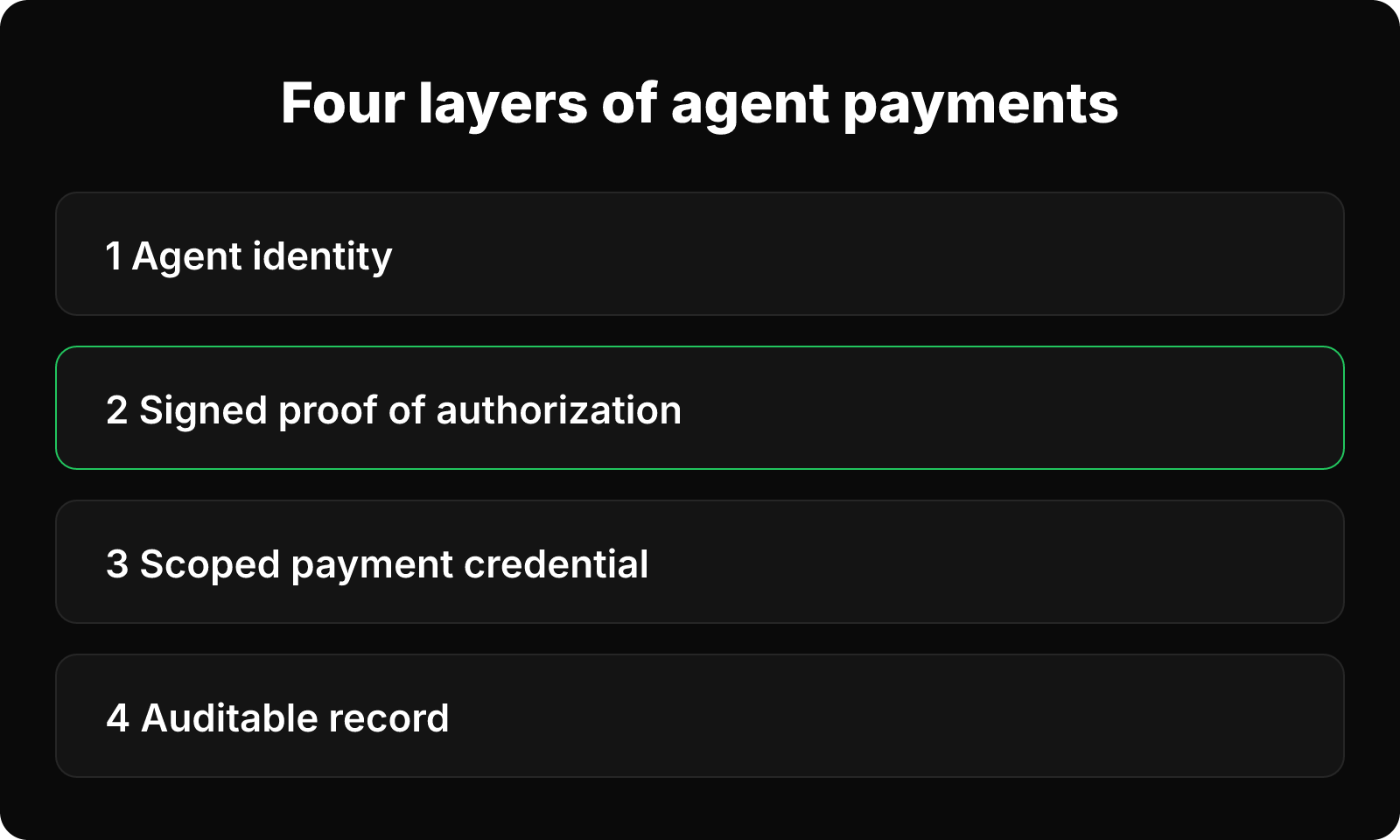
Most 2026 frameworks split agent payments into four layers. RejoiceHub's breakdown describes them like this:
- Agent identity: who is this agent, and who stands behind it? (Some people call this "know-your-agent.")
- Signed proof of authorization: evidence that a real human approved the purchase.
- Scoped payment credential: a limited token, wallet, or budget the agent can spend from.
- Auditable record: receipts and logs that merchants and banks can use to settle disputes.
Each protocol in this article covers one or two of these layers. None covers all four well. Keep that in mind and the landscape gets much easier to follow.
Why Can't AI Agents Just Use a Credit Card?
Card payments were designed for humans making a few large-ish purchases, and AI agents make many tiny ones with no human watching. Three problems come up quickly.
Problem 1: The fees are larger than the purchase
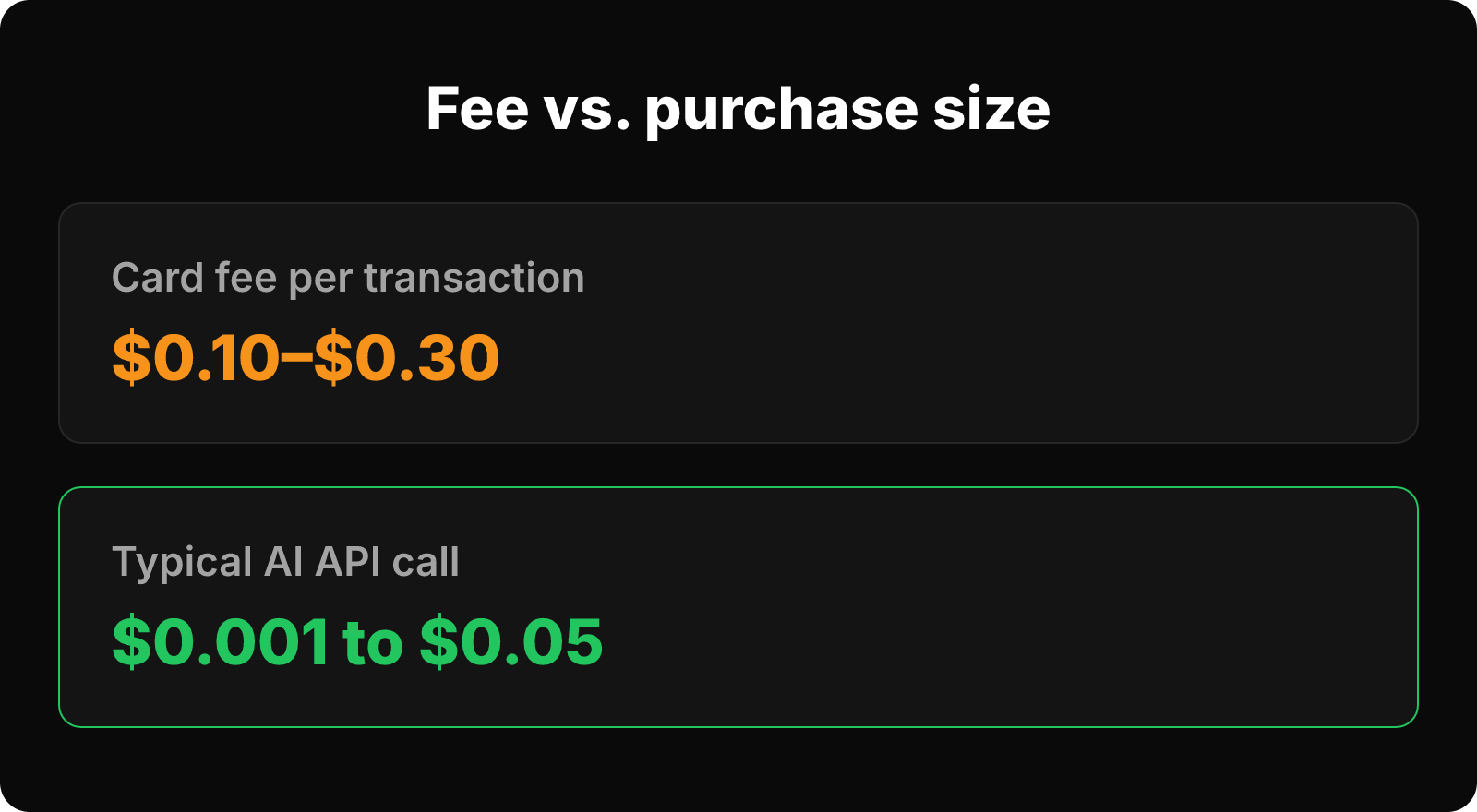
Card processing usually carries a fixed fee of about $0.10–$0.30 per transaction, while a typical AI API call costs somewhere between $0.001 and $0.05, according to FluxA's analysis. Paying 20 cents to send half a cent doesn't work. That's why machine-to-machine payments, where one program pays another directly, have pushed toward cheaper rails.
Problem 2: Checkout pages assume a person
Look at an online checkout. CAPTCHAs, one-time SMS codes, "confirm you're not a robot" boxes. All of it exists to keep bots out. An agent payments protocol has to let approved bots in while still keeping fraudsters out.
Problem 3: Nobody knows who's liable
If your agent books the wrong hotel, who pays? You? The agent developer? The merchant? RejoiceHub calls this a critical question that no protocol has fully answered yet. Signed mandates, covered below, are the industry's first attempt at producing evidence for these disputes.
How Does the x402 Payment Protocol Work?
x402 lets a website charge an AI agent per request by replying "pay first" with a price, and serving the content once the agent pays in stablecoins.
Some background helps. Every time your browser loads a page, the server returns a status code. 200 means "OK." 404 means "not found." The authors of the web's rules also reserved code 402, "Payment Required", but no standard way to use it ever appeared, and it sat largely unused for decades.
Coinbase's x402 finally put it to work. Think of a vending machine that tells you the price when you press a button:
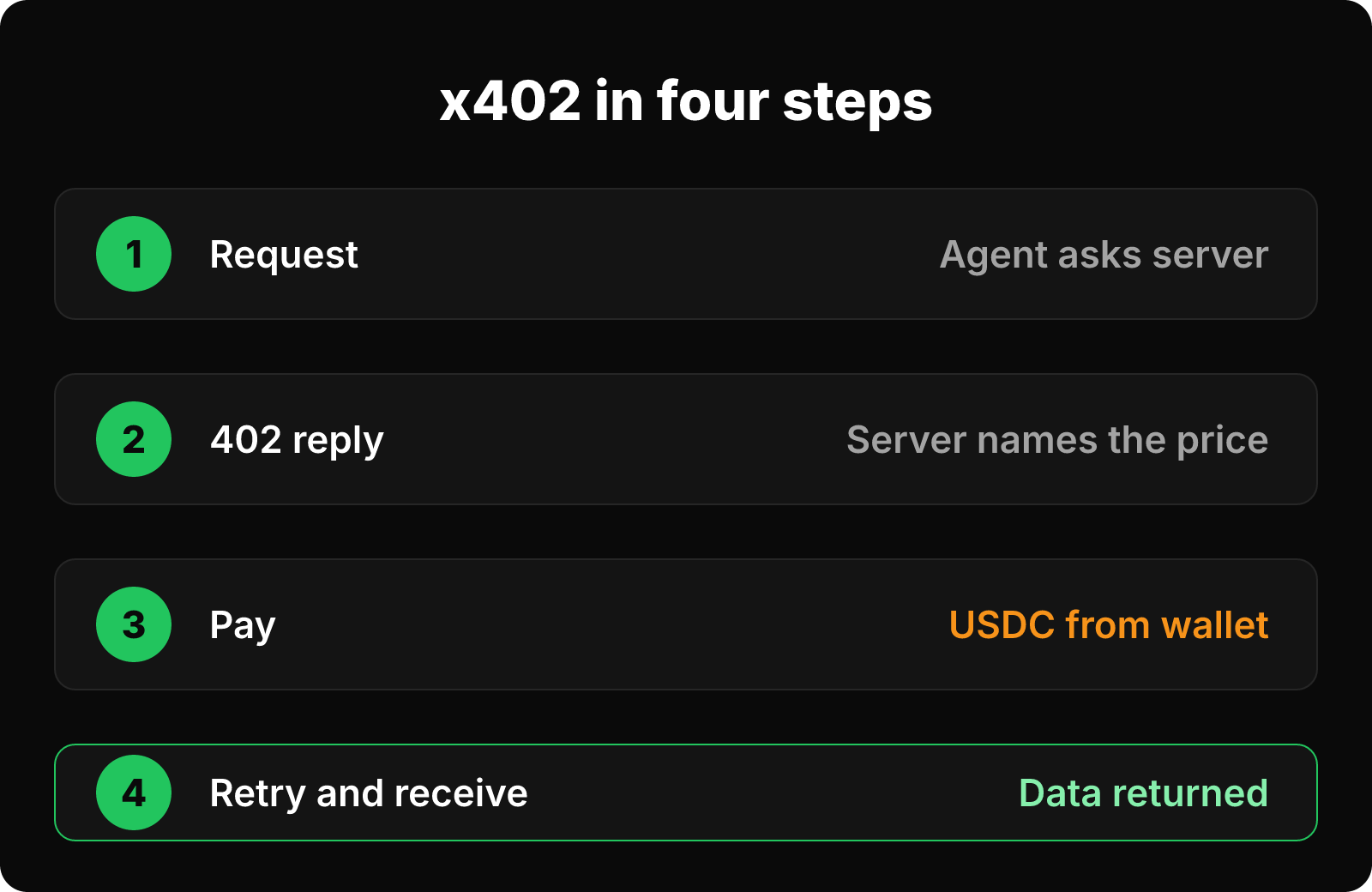
- Request: the agent asks a paid service for something, such as a stock quote or a dataset, without logging in.
- 402 reply: the server answers "402 Payment Required" and includes the amount, the address to pay, and which blockchains it accepts.
- Pay: the agent sends that amount in USDC, a dollar-pegged stablecoin, from its wallet.
- Retry and receive: the agent sends the request again with proof of payment, and the server hands over the data.
No account, API key, or monthly invoice is involved. FluxA reports the whole cycle takes about two seconds and costs as little as $0.001 on Base, Coinbase's low-fee network. These are unverified vendor figures, so read them as rough estimates rather than guarantees.
The x402 Foundation launched in September 2025, co-governed by Coinbase and Cloudflare. x402 V2 followed in December 2025 with wallet-based identity and multi-chain support. In February 2026, Stripe integrated x402 for USDC payments on Base. All three milestones come from Crossmint's protocol comparison.
How Does AP2 Prove a Human Said Yes?
Google's Agent Payments Protocol (AP2) creates signed digital "mandates" that record what you authorized, and it leaves the actual movement of money to cards or stablecoins.
This trips up a lot of newcomers. AP2 isn't a payment network, and it never touches your money. It's a standard format for permission. The specification and reference code are open-source under the Apache-2.0 license on Google's AP2 GitHub repository.
Mandates: the signed permission slip
A mandate is a tamper-evident statement of intent. AP2 has used different names for these across versions, but the idea stays the same:
- Intent mandate: your broad instruction, like "buy running shoes, size 10, under $120."
- Cart or checkout mandate: the specific item and price the agent found, which you (or your earlier rules) approve.
- Payment mandate: the authorization for the payment itself.
Version 0.2, released 28 April 2026, centers on checkout and payment mandates plus receipts, per API Evangelist's summary.
Human Present vs. Human Not Present
AP2 supports two flows. In Human Present, you're around to tap "approve" when the agent finds the item. In Human Not Present, you signed a mandate earlier ("buy concert tickets the moment they drop, max $150") and the agent acts while you sleep. The second is more useful and also riskier, because everything depends on how carefully that original mandate was written.
On governance: in late April 2026, AP2 was reportedly donated to the FIDO Alliance, the group behind passkeys. API Evangelist calls it a donation, while IntelliPay says Google "contributed" the mandate format. The sources differ on detail, but both point to FIDO involvement.
Which AI Agent Payment Protocols Matter in 2026?
Six protocols shape AI agent payments in late 2026, and they complement each other more than they compete. We compared them across governance, the problem they solve, the payment rails they use, and how mature they are, using Crossmint, Presenc, and explainx.ai as sources.
| Protocol | Who's behind it | What it solves | Money moves via | Status (per sources) |
|---|---|---|---|---|
| AP2 | Google; FIDO Alliance stewardship reported | Signed proof of human authorization | Cards or stablecoins (AP2 itself moves nothing) | Spec v0.2 (Apr 2026); 60+ partners |
| x402 | Coinbase; x402 Foundation with Cloudflare | Pay-per-request for APIs, data, compute | USDC on Base, Ethereum, Polygon, Solana and others | In production; V2 since Dec 2025 |
| ACP | OpenAI + Stripe | Agent-to-merchant checkout in chat | Cards via Stripe | Launched Feb 2026; shifted to app-based model Mar 2026 |
| MPP (Machine Payments Protocol) | Stripe + Tempo | Streaming micropayments under a pre-set spending limit | Stablecoins and fiat | Mainnet 18 Mar 2026; 100+ services at launch (vendor-reported) |
| TAP (Trusted Agent Protocol) | Visa | Verifying agent identity and messages | Visa cards | Pilot to early production |
| Agent Pay / AP4M | Mastercard | Agent credentials, permissions, settlement | Cards, bank accounts, stablecoins | Agent Pay 2025; AP4M announced 10 Jun 2026 |
Read the table as layers, not as rivals. In a single purchase, AP2 could carry the signed mandate, Visa TAP could confirm the agent's identity, and x402 could move the money. Presenc describes the field as "narrowed but not consolidated," and that seems right.
Card networks aren't sitting still. Mastercard's Agent Pay issues Agentic Tokens, 16-digit stand-ins tied to your real card but limited to agent purchases, and records your authorization as Verifiable Intent, per IntelliPay. Its June 2026 AP4M announcement included stablecoin settlement, with agent permissions initially recorded on Polygon, Solana, and Base, as explainx.ai reported citing CoinDesk.
Why Do Stablecoin Payments for AI Agents Make Sense?
Stablecoins give AI agents digital dollars that settle quickly, cost little to send on low-fee networks, and need no bank account to receive.
A stablecoin is a crypto token designed to stay worth $1. USDC, issued by Circle, is the most common one in agent payments. To an AI agent, it has three advantages over cards:
- Programmable: a wallet can hold rules such as "never send more than $5 per hour" in code instead of in a bank's fraud system.
- Cheap at tiny sizes: on low-fee networks like Base or Solana, sub-cent payments are practical. With a card, they aren't.
- Open: any server can accept payment without a merchant account, which matters when the "merchant" is a weekend developer's API.
The forecasts are large. McKinsey projects $3–5 trillion in global agentic commerce by 2030, as cited secondhand by FluxA. Treat projections like that as a sign of interest, not a fact about the future.
Here's something most explainers leave out. Where your stablecoins sit matters as much as whether you hold any. An x402 server might only accept USDC on Base. Your agent's wallet might hold USDC on Ethereum. Your savings might be in Bitcoin, which these agent protocols don't settle in natively. They assume the money is already in the right place on the right network, and moving it there is a separate step.
What Can Go Wrong With AI Agent Payments?
The biggest risks are agents being tricked into paying, agents holding permissions that are too broad, and unclear liability when something goes wrong.
Our view: moving the money is the easy part. Stablecoin rails already move value quickly. The hard part is the permission slip, meaning how much the agent is allowed to do and how anyone proves it later. Many real losses are likely to come from mandates written too loosely, not from failed payments.
Security risks
- Tool poisoning: a malicious tool description can steer an agent into a payment you never intended, as RejoiceHub documents.
- Leaky plumbing: in April 2026, OX Security reportedly disclosed an architectural flaw in MCP (Model Context Protocol, the standard many agents use to connect to tools), said to affect about 200,000 instances, per RejoiceHub.
- Over-scoped credentials: giving an agent a wallet with your whole balance is like giving the travel assistant your house keys. Budgets, per-merchant limits, and single-use cards reduce the damage.
Structural risks
- Fragmentation: with six-plus overlapping standards, merchants face real integration costs, and some protocols will fade.
- Bank transfer gaps: instant bank rails such as FedNow and SEPA Instant have no trusted-agent protocol yet, so banks carry more of the fraud burden, UMCA Technologies notes.
- Vendor-heavy data: much of the adoption data comes from companies selling agent payment tools. Be skeptical of vendor figures, including those in this article.
- Stablecoin exposure: stablecoins carry issuer, regulatory, and network risks that card balances don't.
For more on weighing protocol risk, see our trustless swap vs custodial exchange comparison.
What Can You Do With Agent Payments Today?
You can start by giving an AI agent a small, separate stablecoin budget on a network your target services accept, and you can widen its permissions as you gain confidence. A practical five-step path:
- Pick the use case first. Paying per API call or per data request points to x402. Buying physical goods inside a chat assistant points to card-based flows like ACP or Agent Pay.
- Check which network the service accepts. x402 supports USDC on Base, Ethereum, Polygon, Solana and others, per Crossmint. Match your funding to that.
- Use a dedicated agent wallet. Never connect an agent to your main savings wallet. Fund a separate one with only what you're prepared to lose.
- Set hard limits. Per-transaction caps, daily budgets, and approved-merchant lists. If your tool supports signed mandates, write them narrowly.
- Review receipts weekly. The audit trail is only useful if somebody reads it.
Funding an agent wallet from Bitcoin
Many people who are curious about agent payments hold Bitcoin, not USDC on Base. TeleSwap lets you bridge and swap native BTC into tokens on other chains, such as USDC on Base or USDC on Solana, in one step. Its light-client bridge means nothing is minted without a verified Bitcoin transaction, and fast swaps settle in about 10 minutes. Fees are paid in Bitcoin assets, and a Teleporter covers destination-chain gas, so you don't need ETH on Base first. As of 27 November 2026, TeleSwap has bridged $583.7M in total volume across 622,560 bridge transactions on 13 supported networks, per TeleSwap network stats.
Start small. Fund the agent wallet with enough for a week of experiments, see how it behaves, and then decide. Our guide on bridging Bitcoin to Base walks through the steps.
Frequently Asked Questions
What is the Agent Payments Protocol (AP2)?
AP2 is an open standard, announced by Google in September 2025, that lets AI agents carry signed proof of what a human authorized them to buy. It doesn't move money. It produces cryptographic "mandates" that card networks, banks, or stablecoin rails can check before and after a payment. In late April 2026 it was reportedly donated to the FIDO Alliance.
What is the x402 payment protocol?
x402 is a Coinbase-originated protocol that lets websites charge AI agents per request using the HTTP 402 "Payment Required" status code. The server replies with a price, the agent pays in USDC on a supported blockchain, and the server returns the content. No account or API key is needed.
Are AP2 and x402 competitors?
Mostly no, because they solve different layers of the same problem. AP2 proves a human approved a purchase, and x402 moves stablecoin payments for individual web requests. A single transaction could use both, with AP2 carrying the authorization and x402 settling the payment.
Why do AI agents use stablecoins instead of credit cards?
Stablecoins make tiny, frequent payments affordable, and cards don't. Card processing typically has a fixed fee of $0.10–$0.30 per transaction, while many AI API calls cost under $0.05. Stablecoins on low-fee networks can settle sub-cent amounts quickly, and they can enforce spending rules in code.
Is it safe to let an AI agent spend my money?
It can be reasonably safe if you limit what the agent can access. Use a separate wallet with a small balance, set per-transaction and daily caps, and write narrow mandates. The main risks are agents being manipulated by malicious tools and permissions that are too broad, not the payment rails failing.
Who is responsible if an AI agent makes a wrong purchase?
There's no settled answer yet. Liability depends on the payment method, the merchant's terms, and the evidence available. Signed mandates such as AP2's exist partly to provide that evidence in disputes, but the legal framework is still developing.
Can I fund an AI agent wallet with Bitcoin?
Yes, indirectly: you convert BTC into the stablecoin and network your agent's services accept. Most agent payment protocols settle in USDC on networks like Base or Solana, not in native Bitcoin. A Bitcoin bridge such as TeleSwap can swap native BTC into USDC on those networks in one step.
The Bottom Line
An agent payments protocol is how software gets permission to spend your money and proves it had that permission. AP2 handles the proof, x402 and MPP handle stablecoin micropayments, and Visa and Mastercard are adapting cards for agents. What still needs work is writing tight permissions and agreeing on who pays when an agent gets it wrong.
If you want to try machine-to-machine payments yourself, give an agent a small, capped stablecoin wallet on the network your target service accepts. If your starting point is Bitcoin, you can swap BTC directly into USDC on Base or Solana at teleswap.xyz.