Swap Crypto Without KYC in 2026: 6 Options by Custody

To swap crypto without KYC, use a service that asks for no account or ID, such as a DEX, an instant swapper, a P2P escrow, an atomic swap or a light-client bridge like TeleSwap. What differs is custody, meaning who holds your coins during the swap. Say you want to trade $200 of Bitcoin for a stablecoin, but the exchange app asks for a passport scan, a selfie and a utility bill. Usually people in that spot aren't hiding anything. They just want to trade from their own wallet without giving a company a file on themselves.
"No KYC" sites don't all work the same way. Some never touch your coins. Some hold them for a few minutes, and some can freeze them while they screen the deposit. This guide compares six options by who holds your money during the swap, along with time, fees and sign-up rules.
Key Takeaways:"No KYC" only tells you what a service asks of you; custody tells you who can freeze or lose your funds.Instant swap services often call themselves non-custodial, but your deposit goes to an address the provider or its partner controls, and flagged deposits can be held until you show ID (Coingape).DEXs like Uniswap keep custody in your own wallet, but they only swap tokens that are already on the same chain.TeleSwap moves native BTC to EVM chains, TON and Solana through a light-client bridge, and it has processed 622,560 bridge transactions worth $583.7M (TeleSwap network stats, retrieved 2026-11-27).Skipping KYC doesn't remove your tax obligations: EU DAC8 crypto reporting rules apply from 1 January 2026.
Table of Contents
- What Does It Mean to Swap Crypto Without KYC?
- Why Custody Matters More Than the "No KYC" Label
- No KYC Crypto Swap Options Compared Side by Side
- Which Non-Custodial Crypto Swap With No KYC Fits You?
- How TeleSwap Swaps Bitcoin Without a Custodian
- Walkthrough: Swap BTC to USDC on Arbitrum
- Is a Crypto Exchange Without ID Verification Legal and Safe?
- Frequently Asked Questions
- Conclusion
What Does It Mean to Swap Crypto Without KYC?
KYC ("Know Your Customer") is the identity check that regulated financial companies run before they serve you. In crypto, that usually means uploading a government ID, a selfie and sometimes proof of address before you can trade.
A no KYC crypto swap lets you trade one coin for another without that check. In most cases you don't create an account at all. You pick the coins, paste a receiving address and send funds, and multiple comparison sites describe the same basic flow (Koinly).
The second idea you need is custody, which means who controls the private keys, the secret codes that can move your coins.
Think of a coat check. You hand over your coat and get a ticket back. Usually you get the coat back, but for that stretch of time someone else holds it, and they can decide not to give it back. Keeping the coat on is self-custody. Nobody can keep it from you, and nobody can help if you lose it either.
Crypto swap services sit somewhere on that scale. Some keep your coat on you the whole time, some take it for ten minutes, and some take it for as long as their compliance team wants.
Why Custody Matters More Than the "No KYC" Label
Here's what most "best no-KYC exchange" lists leave out. "No KYC" describes the policy today. Custody describes what happens when the policy changes.
One example is GhostSwap, which advertises no account and no routine KYC. The same listing notes that it routes swaps through third-party processing partners and that flagged deposits can be held pending ID or proof of where the funds came from (Coingape). PegasusSwap works the same way: no standard registration, but AML (anti-money-laundering) monitoring with possible holds (Koinly).
That isn't a scandal. It's how a deposit-address model works. If your coins sit in an address someone else controls, that someone can pause them.
A simple framework for comparing options is the three-question custody test:
- Who holds the keys while the swap is in progress? Is it your wallet, a company, an escrow, or a smart contract with public rules?
- What can that party do to your funds? Can they freeze them, delay them or demand documents, or are they limited by code and collateral?
- What enforces the outcome? Is it a company's promise, a reputation system, or cryptographic proof checked on-chain?
Apply those questions and the "non-custodial" label on many instant swap sites looks different. There it usually means the provider doesn't keep an account balance for you. It doesn't mean your funds never touch the provider's infrastructure. For more on this distinction, see our guide to trustless crypto swaps vs custodial exchanges.
No KYC Crypto Swap Options Compared Side by Side
The table below lines up six categories by custody, typical time, published fees and sign-up rules. Fee figures come from the cited sources and change often, so check the live quote before you send anything.
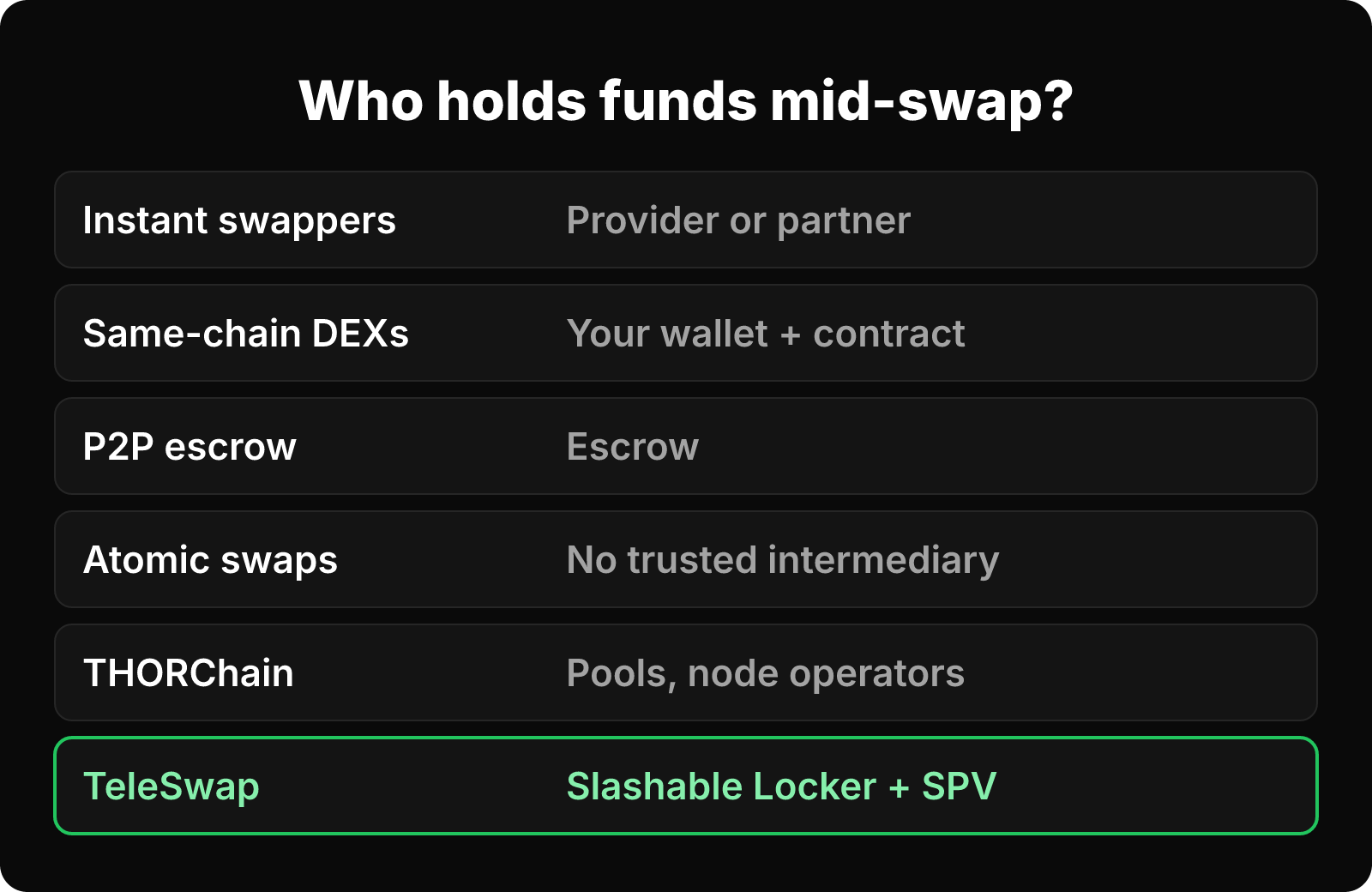
| Option (examples) | Who holds funds during the swap | Typical time | Published fees | Sign-up / ID |
|---|---|---|---|---|
| Instant swap services (ChangeNOW, SimpleSwap, GhostSwap) | Provider or its partner, at a deposit address | Minutes after your deposit confirms | ChangeNOW: 0.5%–4%, built into the rate (Bleap) | No account for standard swaps; flagged deposits can trigger ID requests |
| Same-chain DEXs (Uniswap, PancakeSwap) | Your own wallet → smart contract → your wallet | One transaction on that chain | Uniswap v3 pools: 0.05%, 0.30% or 1%, plus gas (Coingape) | None for crypto-to-crypto; fiat on-ramps use KYC'd third parties |
| P2P with escrow (Bisq, Hodl Hodl) | Escrow between buyer and seller | Depends on payment method and counterparty | Bisq 1 BTC: 0.15% maker / 1.15% taker (Bleap) | No central account; reputation matters |
| Atomic / submarine swaps (Boltz, BasicSwap) | Hash time-locked contracts; no trusted intermediary | Depends on block confirmations on both chains | Varies by provider/node | None; BasicSwap requires running your own node |
| Cross-chain liquidity networks (THORChain / THORSwap) | Liquidity pools secured by node operators | Depends on source-chain confirmations | ~0.45% plus network fees (Bleap) | None at protocol level |
| Light-client bridge + swap (TeleSwap) | Collateral-backed, slashable Locker; TeleBTC minted only after an SPV proof of your Bitcoin transaction | Fast swaps settle in ~10 minutes | Shown in the quote; all fees payable in Bitcoin assets | Permissionless protocol; you swap from your own wallet |
Two patterns stand out. A DEX keeps custody with you but can't move native Bitcoin between chains. The easiest cross-chain option, an instant swapper, holds your funds in the middle.
Which Non-Custodial Crypto Swap With No KYC Fits You?
None of these is "best" for everyone. Each one fits a different job.
Instant swap services: one-off convenience
If you want to turn a small amount of one coin into another without installing anything, instant swappers are the simplest route. GhostSwap lists 1,600+ pairs (Coingape), and AceChange says it supports 4,000+ pairs across 70+ coins. The cost is counterparty risk: you're trusting the provider and its screening partners while your deposit sits with them. Some, such as PegasusSwap, offer a pre-deposit AML score check, which is worth using.
DEXs: staying on one chain
If your coins are already on Ethereum, Arbitrum or BNB Chain and you want a different token on that same chain, a DEX is the cleanest non-custodial crypto swap with no KYC. You connect a self-custody wallet like MetaMask or Trust Wallet, and the swap happens against a liquidity pool. The limit is that a DEX can't take in your native Bitcoin.
P2P escrow: buying BTC directly from people
Bisq and Hodl Hodl match buyers and sellers, and escrow holds the coins until both sides confirm. The trade-offs are higher taker fees (1.15% on Bisq 1, per Bleap), a learning curve, and slower trades.
Atomic and submarine swaps: maximum trust-minimization
Boltz moves BTC between Lightning, Liquid and on-chain Bitcoin without custody. BasicSwap does atomic swaps across BTC, XMR, LTC and a few others, but you need to run a local node that stays online during the swap (Godex). Both suit technical users, and both are limited to specific assets and layers.
THORChain: native cross-chain swaps
THORChain swaps native assets across chains without wrapped tokens, using liquidity pools that node operators secure. You're trusting the network's security rather than one company. For alternatives, see best THORChain alternatives for native Bitcoin swaps.
TeleSwap: Bitcoin into DeFi on EVM chains, TON and Solana
If you want native BTC to become USDC, ETH or SOL on another chain, and you want a Bitcoin-verified proof to decide whether the swap goes through, a light-client bridge is the most direct fit. The next section explains how it works.
How TeleSwap Swaps Bitcoin Without a Custodian
TeleSwap is a trustless Bitcoin bridge and swap protocol that moves BTC to EVM chains, TON and Solana and swaps it into their tokens, verified by an SPV light client instead of a custodian or multi-sig committee.
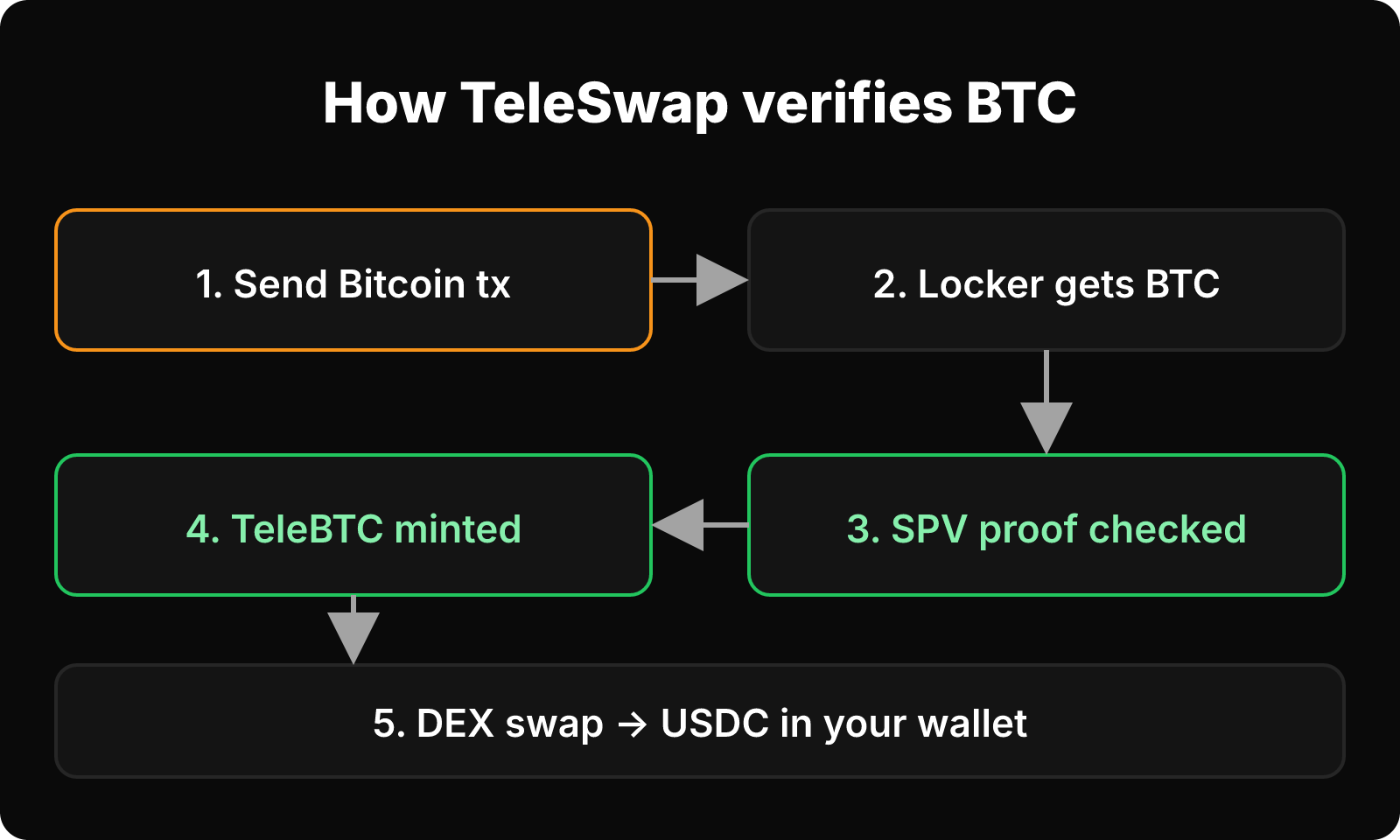
Run it through the three-question custody test:
- Who holds the keys? Your BTC goes to a Locker, a protocol role backed by collateral that can be slashed if the Locker misbehaves.
- What enforces the outcome? An SPV (Simplified Payment Verification) light client checks that your Bitcoin transaction is included in the proof-of-work chain. Nothing is minted without a verified Bitcoin transaction.
- What do you receive? TeleBTC, a 1:1 collateral-backed representation of BTC, is minted and routed through a DEX into your chosen token, which lands in your wallet.
Compared with wrapped-BTC tokens like WBTC or cbBTC, TeleBTC is the trust-minimized alternative because its minting is decided by a verified Bitcoin transaction proof, inheriting Bitcoin's security model. See the wrapped Bitcoin tokens list for who holds the BTC behind each type.
You can pay all fees in Bitcoin assets, and a Teleporter covers gas on the destination chain for you. That removes the step where many cross-chain swaps get stuck for newcomers.
According to TeleSwap network stats (retrieved 2026-11-27), the protocol has processed $583.7M in total bridged volume across 622,560 bridge transactions on 13 supported networks. In the last 30 days it handled $49.2M, about $1.6M per day, with a peak of $3.3M on 2026-11-14.
TeleSwap is also integrated as a Bitcoin swap provider in the Rango, Rubic and DZap aggregators, and through the Rango integration in MetaMask and Trust Wallet. Full details are in the TeleSwap documentation.
Walkthrough: Swap BTC to USDC on Arbitrum
Here's what a typical swap looks like when you want stablecoins on a low-fee chain from Bitcoin in a wallet you control.
- Open the route. Go to the BTC → USDC (Arbitrum) page on TeleSwap. Other routes work the same way, such as BTC → ETH on Ethereum or BTC → USDT on Solana.
- Enter the amount of BTC you want to swap and review the quote, including fees and the estimated USDC you'll receive.
- Add your destination address. This is the Arbitrum wallet that will receive USDC. Check it twice, because crypto transfers can't be reversed.
- Send the Bitcoin transaction from your own Bitcoin wallet as instructed.
- Wait for verification. Fast swaps settle in about 10 minutes. The light client verifies your transaction, TeleBTC is minted, and the DEX swap runs.
- Receive USDC in your Arbitrum wallet. The Teleporter covers the destination gas, so you don't need ETH on Arbitrum first.
The reverse direction works too: you can swap USDC on Arbitrum back to native BTC.
Is a Crypto Exchange Without ID Verification Legal and Safe?
Using a crypto exchange without ID verification is legal in many places, but the rules depend on your country, and you're still responsible for your taxes. Check your local rules.
Three points matter in 2026:
- Tax reporting hasn't gone away. The EU's DAC8 directive, which extends tax reporting to crypto-asset service providers, applies from 1 January 2026 (EUR-Lex, Directive (EU) 2023/2226). Skipping KYC on a swap doesn't change what you owe on gains.
- Fiat almost always means KYC. Most sources agree that bank and card on- and off-ramps trigger identity checks, even when the swap itself doesn't (Coingape). Uniswap's fiat on-ramp, for example, runs through third-party providers.
- Licensing is often missing. Coingape reports finding no NYDFS, FCA or MiCA licenses for the no-KYC platforms it reviewed. That doesn't make them illegitimate, but you may have little regulatory recourse if something goes wrong.
On safety, the biggest everyday risks are phishing clones of popular swap sites, sending to the wrong address, and smart contract bugs. Bookmark the real URLs and test with a small amount first. Be skeptical of "top 10" lists too, since many are published by the vendors they rank. For more, read No KYC crypto swap: answers to common questions.
Frequently Asked Questions
Can I swap crypto without KYC legally?
In many jurisdictions, yes, but legality depends on where you live. Crypto-to-crypto swaps on DEXs and other non-custodial protocols usually require no identity check. Your tax obligations don't change, though. In the EU, for example, DAC8 reporting rules apply from 1 January 2026.
Are instant swap services really non-custodial?
Not completely: your deposit goes to an address the provider or its partner controls until the swap finishes. "Non-custodial" usually means they don't keep an account balance for you. Some, like GhostSwap and PegasusSwap, can hold flagged deposits until you provide ID or source-of-funds information.
Can I buy crypto with a bank card without KYC?
Generally no: bank and card payments almost always trigger identity checks. No-KYC options mostly cover crypto-to-crypto swaps. P2P escrow platforms like Bisq are the main exception, but they're slower and charge higher taker fees.
Does TeleSwap require an account?
No account balance is held for you: TeleSwap is a permissionless protocol, and you swap from your own wallet. Your Bitcoin transaction is verified by an SPV light client before TeleBTC is minted and swapped into your chosen token. If you use TeleSwap through an aggregator or wallet integration, check that interface's own terms as well.
What is the safest way to swap BTC to another chain without KYC?
Choose an option where code and Bitcoin proofs enforce the outcome, not a company's discretion. Light-client bridges like TeleSwap only mint after a verified Bitcoin transaction and use collateral-backed, slashable Lockers. THORChain relies on node-operated vaults, and instant swappers rely on the provider. Whichever you pick, start with a small test amount.
How long does a no KYC crypto swap take?
It depends on the method. A same-chain DEX swap completes in a single transaction. Bitcoin-based swaps wait for Bitcoin confirmations, and TeleSwap's fast swaps settle in about 10 minutes. P2P escrow trades can take longer because a human counterparty has to confirm payment.
Conclusion
Swapping crypto without KYC in 2026 is easy. The hard part is knowing who holds your money while it happens. Instant swappers trade convenience for a stretch of provider custody and the chance your deposit gets screened. DEXs keep you in control but stay on one chain. P2P and atomic swaps reduce trust but cost you time or technical setup.
If you want native Bitcoin working on Ethereum, Arbitrum, Base, Solana or another supported chain without a custodian in the middle, TeleSwap's light-client bridge is built for that. It has handled $583.7M across 622,560 transactions so far, and fast swaps settle in about 10 minutes. Start with a small amount and see how it works.