Swap Crypto No Fees? 8 Honest Answers (2026)

You found an app that promises you can swap crypto with no fees. You put in $500 of one coin and get back a bit less than $500 of another, even though no fee line appeared anywhere. Where did the difference go?
The short answer: you can't really swap crypto with no fees, apart from a few narrow cases such as some stablecoin-to-stablecoin pairs on certain exchanges. Nearly every other "zero-fee" swap still costs something. The cost shows up in the exchange rate, in network fees, or in the extra steps the trade needs. This guide shows where the money goes and how to work out the real price of a swap before you confirm it.
Key Takeaways:A truly zero-fee swap has zero maker and taker fees on every trading pair, with no conditions attached, and almost no platform clears that bar."Zero-fee" Convert and instant-swap tools usually build their margin into the quoted rate, and one snapshot measured that margin at 1.2%–3.8% on certain pairs (Exchange Flow).The real cost of a crypto swap is the gap between the mid-market value of what you send and the value of what you receive, after every fee and every step.For Bitcoin, the number of steps (deposit, trade, withdraw, bridge) often costs you more than the fee rate on any single step.TeleSwap lets you swap native BTC straight into tokens on other chains in one step, with all fees paid in Bitcoin assets, and it has handled 620,499 bridge transactions so far (TeleSwap network stats).
Table of Contents
- Can you swap crypto with no fees anywhere in 2026?
- How much does a crypto swap cost, really?
- Crypto swap fees explained: how do "zero-fee" apps make money?
- Which low fee crypto swap options exist in 2026?
- What does a $1,000 swap actually cost on each option?
- Why does swapping Bitcoin usually cost more?
- How do you check the true cost before you click?
- How do you do a low-cost BTC swap with TeleSwap?
- Frequently Asked Questions
- The Honest Bottom Line
Can you swap crypto with no fees anywhere in 2026?
Only in a few narrow cases. Truly free swaps exist mostly between stablecoins on a few centralized exchanges. Everywhere else, "no fees" is a discount, a promotion, or a cost moved into the exchange rate.
One useful test, used in a 2026 comparison of zero-fee exchanges, says a zero-fee claim counts only if all three of these are true:
- It covers every spot pair, not a hand-picked list.
- Both maker and taker fees are zero. A maker adds an order to the order book, such as a limit order that waits to be filled. A taker fills an order that is already there, which is what happens when you press "buy now."
- It has no conditions. You don't have to hold the platform's token, reach a VIP volume tier, or catch a promotion before it ends.
OKX is a good example. The same comparison reports its regular spot fees at 0.08% maker and 0.10% taker. Only stablecoin pairs such as USDC-USDT and PYUSD-USDT are 0%/0%. That is a real zero, but it only covers swapping one dollar token for another dollar token.
So if your goal is to turn Bitcoin into ETH, or USDT into BTC, assume you will pay something. What you can control is how much, and whether you can see it.
How much does a crypto swap cost, really?
It varies widely, from a fraction of a percent to several percent of the trade. Where you land depends on five cost layers, and most apps only show you one of them.
Think of buying foreign currency at an airport. The booth says "0% commission," but its exchange rate is worse than the one you see on Google. Crypto works the same way. Here are the five layers:
- Explicit fee. A percentage the platform shows you, such as a 0.10% taker fee.
- Spread. The gap between the market price and the rate you're quoted. This is where most "free" swaps make their money.
- Slippage and price impact. On a decentralized exchange (DEX), a large order in a small liquidity pool moves the price against you. Slippage is how far the final price ends up from the quote.
- Network fee (gas). What you pay the blockchain to process your transaction. On Ethereum it rises and falls with demand and with how complex the transaction is, according to ethereum.org's gas documentation. On Bitcoin, miner fees depend on how busy the mempool (the queue of waiting transactions) is, which you can check live on mempool.space.
- Movement costs. Withdrawal fees, bridge fees, and gas on the destination chain. You pay these every time your coins move between platforms or blockchains.
A swap that looks free can still be expensive once you count layers 2 through 5. A swap with a visible fee can be the cheapest option if it skips the other layers. For a deeper look at aggregator costs, see our swap aggregator comparison.
Crypto swap fees explained: how do "zero-fee" apps make money?
They charge through the exchange rate. If a platform quotes you a rate a little worse than the market rate, that difference is its fee. It just doesn't appear as a separate line.
The numbers can be large. An Exchange Flow rate snapshot (undated) found that ChangeNOW's standard-rate quotes were 1.203%–1.606% below mid-market on three pairs. Its fixed-rate quotes were 3.260%–3.769% below. SideShift's quotes were 1.889%–2.226% below. Mid-market is the halfway point between the best buy price and the best sell price. Changelly, by contrast, is reported to charge 0.25% of output on floating-rate swaps, with network fees on top.
Exchange "Convert" buttons work the same way. MEXC's own swap-cost comparison cites unnamed measurements putting embedded margins at 0.5%–4% per trade. On a $500 swap, that is $2.50 to $20 in costs you never see, while the fee shown is $0. MEXC is a competitor of the services it describes and the measurements are unnamed, so treat the figures as indicative, but the mechanism holds.
Fixed rate vs floating rate: which costs more?
A fixed rate locks your quote while your deposit confirms. A floating rate follows the market until the trade executes. Locking costs more because the service takes on the price risk while it waits. The ChangeNOW figures above show the gap: about 1.2%–1.6% floating versus about 3.3%–3.8% fixed.
Here is a point that most "zero-fee" round-ups leave out. A visible fee is honest pricing, and an embedded spread is pricing you can't easily check. If two services cost you the same overall, choose the one that shows its fee, because you can compare it next time.
Which low fee crypto swap options exist in 2026?
There are six main kinds of swap service, and each charges you in a different way. The cheapest choice depends on which coins you hold, which chain they're on, and whether you're willing to hand them to a custodian (a company that holds them for you).
| Option | Examples | How you pay | Published / measured cost | Main trade-off |
|---|---|---|---|---|
| Order-book exchange (CEX) | OKX, Bybit, Binance | Maker/taker fee + withdrawal fee | OKX 0.08% maker / 0.10% taker; zero only on certain stablecoin pairs (source) | Custodial, KYC required, deposit and withdrawal steps |
| CEX "Convert" button | Binance Convert, Kraken Convert | Spread inside the quote | No explicit fee; spread varies by platform and is not always published | Quote can differ from the spot price |
| Instant swap service | ChangeNOW, SideShift, Changelly | Built-in margin + network fee | 1.2%–3.8% below mid-market in one snapshot (Exchange Flow) | Possible AML holds; fixed rates cost more |
| DEX (AMM) | Uniswap | Pool fee + gas + price impact | Uniswap v3 tiers: 0.01%, 0.05%, 0.30%, 1% | Gas can be more than the pool fee on busy chains |
| P2P | Bisq, RoboSats | Trade fee + miner fees | Roughly 0.1%–1%, per vendor-reported figures | Slower, more manual |
| Native BTC cross-chain swap | TeleSwap | All fees paid in Bitcoin assets; a Teleporter pays destination gas for you | Fast swaps settle in ~10 minutes; one step from BTC to the target token | Built for Bitcoin routes specifically |
An AMM (automated market maker) is a DEX that trades against a pool of tokens instead of matching buyers with sellers. The pool fee goes to the people who supplied the tokens. A DEX aggregator searches several pools for the best route. That helps, but it doesn't guarantee the lowest total cost.
What does a $1,000 swap actually cost on each option?
The headline fee can range from $0 to about $38 on the same $1,000. Movement costs can then reverse that ranking. The figures below apply the published or measured rates from above. They illustrate how costs stack up and are not live quotes.
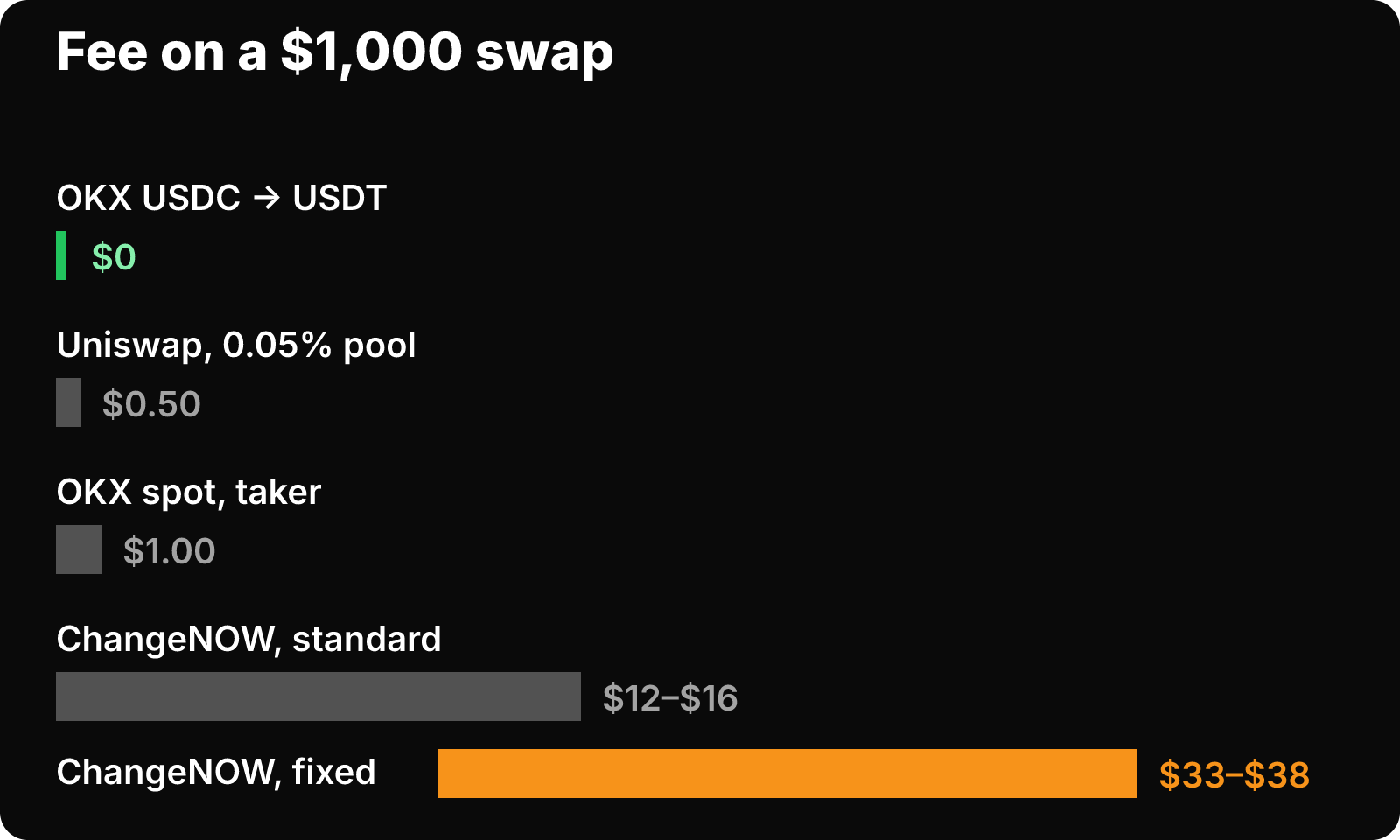
| Route | Rate used | Fee or spread on $1,000 | Also add |
|---|---|---|---|
| OKX USDC → USDT | 0% / 0% | $0 | Withdrawal fee if you move the funds out |
| Uniswap, 0.05% pool | 0.05% | $0.50 | Gas + price impact |
| OKX spot, taker order | 0.10% | $1.00 | Deposit wait + withdrawal fee |
| ChangeNOW, standard rate | 1.2%–1.6% | $12–$16 | Network fee |
| ChangeNOW, fixed rate | 3.3%–3.8% | $33–$38 | Network fee |
Notice what the $0 row needs: you must already hold a stablecoin on that exchange. Getting it there, and later getting it out, costs money. For most people the cheapest single fee isn't the cheapest trip overall.
Why does swapping Bitcoin usually cost more?
Bitcoin runs on its own chain, so turning BTC into a token on Ethereum, Solana, or another chain usually takes several steps, and each step adds a fee. A BTC-to-USDC swap often costs more because of the route, not because the trading fee is higher.
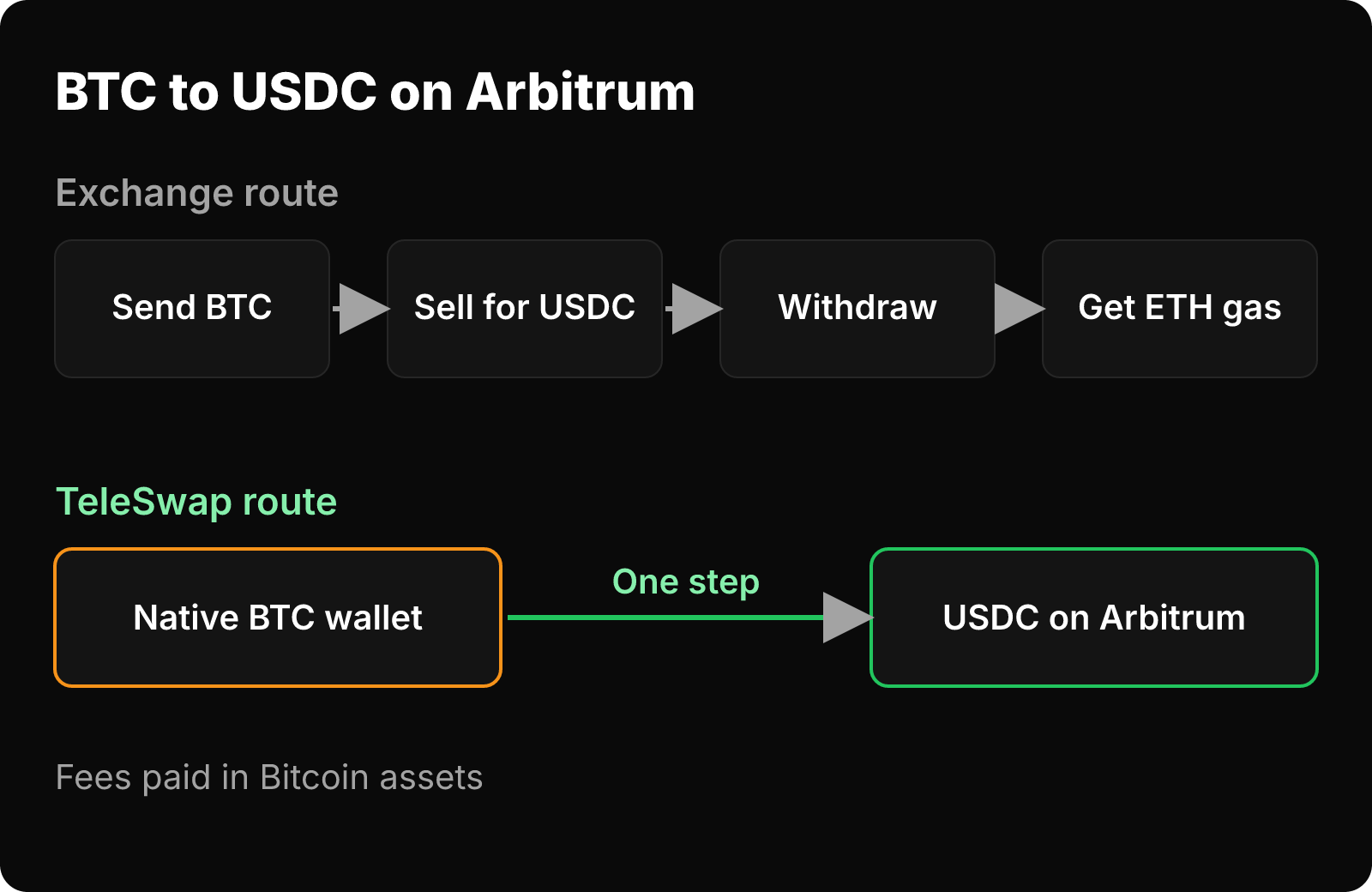
Here is a typical exchange-based route from BTC to USDC on Arbitrum:
- Send BTC to an exchange (Bitcoin miner fee, then a wait for confirmations).
- Sell BTC for USDC (taker fee or spread).
- Withdraw USDC to Arbitrum (withdrawal fee).
- Get some ETH on Arbitrum so you can pay gas for anything you do next.
That is four costs and two handovers to a custodian. Swapping wrapped BTC on a DEX skips the exchange but adds a cost of its own. Custodial wrapped tokens such as WBTC rely on a custodian to hold the real bitcoin behind them; our wrapped Bitcoin tokens list shows who holds the BTC for each type.
The most effective way to cut BTC swap costs is to remove steps rather than chase a lower fee rate. This is the problem TeleSwap was built to solve. You send native BTC from a Bitcoin wallet, and it delivers tokens on the destination chain in a single step. Your BTC mints TeleBTC, a token backed 1:1 by collateral, and TeleSwap routes it through a DEX into the token you asked for.
Nothing is minted until a Bitcoin transaction has been verified with SPV light-client proofs, which check the Bitcoin chain directly instead of relying on a multi-sig committee or a custodian (TeleSwap documentation).
Two design choices target the hidden costs described above:
- Fees are paid in Bitcoin assets. You don't need to buy a separate gas token before you start.
- A Teleporter pays the destination-chain gas for you. You don't arrive on Arbitrum or Base holding USDC but no ETH to move it.
TeleSwap still charges fees. What it removes is the deposit-trade-withdraw chain of costs. TeleSwap has bridged $582.2M in total across 13 supported networks, including $49.1M in the last 30 days (about $1.6M a day, peaking at $3.3M on 2026-11-14), according to TeleSwap network stats.
How do you check the true cost before you click?
Compare what you'll receive with what you're sending, both priced at the mid-market rate. The percentage gap between them is your all-in cost, whatever the app calls its fee.
Here is a five-minute check that works on any platform:
- Get the mid-market price. Check a price tracker for both coins at the same moment.
- Value what you're sending. Example: 0.01 BTC × BTC price = your input in dollars.
- Read the "minimum received" or final amount on the quote screen, after network fees.
- Value what you'll receive at the mid-market price.
- Work out the gap: (input value − output value) ÷ input value. A lower gap is better; if it looks high next to other options, shop around.
Run the check on two or three options at once, and include any withdrawal or bridge steps you'd need afterward. If a platform won't show the final received amount before you commit, treat that as a warning sign.
How do you do a low-cost BTC swap with TeleSwap?
Choose BTC and the token you want, review the quote, and send the BTC from your Bitcoin wallet. Fast swaps settle in about 10 minutes, and the tokens go straight to your address on the destination chain.
- Go to teleswap.xyz and pick your route, for example BTC to USDC on Arbitrum or BTC to ETH on Ethereum.
- Enter the amount and your destination address on the destination chain.
- Run the cost check above on the quote. Compare the amount you'll receive with the mid-market value of your BTC.
- Send the BTC from your Bitcoin wallet. Once the Bitcoin transaction is verified, TeleBTC is minted and swapped into your chosen token.
- Receive the tokens. A Teleporter has already paid the destination gas, so you don't need ETH or SOL sitting in the wallet beforehand.
You may already use an app where TeleSwap is built in. It is a Bitcoin swap provider inside the Rango, Rubic, and DZap aggregators, and through the Rango integration it's also reachable from MetaMask and Trust Wallet. Run the same cost check in whichever interface you use.
Frequently Asked Questions
Is Binance Convert really free?
It charges no separate trading fee, but the rate you're quoted can include a spread. Binance says the quote reflects market conditions, and convert tools across exchanges can quote rates that differ from spot. Run the mid-market check to see your real cost.
Can I avoid gas fees completely?
No, every on-chain transaction pays a network fee, though some services pay it for you. With TeleSwap, a Teleporter covers the destination-chain gas, and you settle all fees in Bitcoin assets. Gas is still paid, but you don't need to hold a separate gas token.
Is TeleSwap a no-fee swap?
No, TeleSwap charges fees, and you pay them in Bitcoin assets. Its cost advantage on BTC routes is that it replaces the multi-step deposit, trade, withdraw, and buy-gas route with a single trust-minimized swap from native BTC.
Are fixed-rate or floating-rate swaps cheaper?
Floating-rate swaps are usually cheaper. In one Exchange Flow snapshot, ChangeNOW's fixed-rate quotes were about 3.3%–3.8% below mid-market, compared with about 1.2%–1.6% for its standard rate. You pay extra for the price certainty.
Does a larger swap cost more in percentage terms?
On DEXs it often does, because of price impact. A large order in a small pool moves the price against you. On order-book exchanges, larger traders can reach VIP tiers with lower fees. OKX's VIP 1 tier starts at $100,000 in assets or $1M in 30-day volume.
Do DEX aggregators always find the cheapest swap?
No, they find the best route among the sources they check, and that isn't guaranteed to be the cheapest overall. Always compare the "minimum received" amount and include any bridge or withdrawal steps the route leaves out.
The Honest Bottom Line
Can you swap crypto with no fees? For stablecoin-to-stablecoin trades on a few exchanges, yes. For almost everything else, no. The cost is in the exchange rate, the gas, or the extra steps, so the question to ask is what you pay in total and whether you can see it.
- Judge any swap by the gap between the value you send and the value you receive at mid-market, not by its advertised fee.
- "Zero-fee" convert and instant-swap tools have measured margins of roughly 1%–4% on the rate.
- For Bitcoin, cutting out steps saves more than chasing the lowest fee rate. TeleSwap does this by swapping native BTC to tokens across 13 supported networks in one step, with fees paid in Bitcoin assets and destination gas covered.
If you hold BTC and want USDC or ETH on another chain, open a quote and run the five-minute cost check against your current route.