How to Start Bitcoin DEX Trading for Beginners (2026)

To start Bitcoin DEX trading as a beginner, send native BTC from your own wallet to a bridge-and-swap protocol such as TeleSwap and receive a token on another chain, with no account and no KYC. Bitcoin itself has no built-in way to swap tokens, so the swap always happens on another chain using a Bitcoin-backed token.
This guide shows you how to start Bitcoin DEX trading for beginners, starting from the BTC sitting in your own wallet. By the end you will have made one real trade, and you will know what each screen means, roughly what you pay, how long it takes, and what to do when something looks wrong.
Key Takeaways:Bitcoin's base layer can't run token swaps, so most "Bitcoin DEX trading" happens on other chains using a Bitcoin-backed token.What matters most is which BTC token you hold after the trade and who could freeze or lose the Bitcoin behind it.TeleSwap lets you send native BTC from your own wallet and receive tokens on chains like Ethereum, Arbitrum, Base, Polygon, BNB Chain, or Solana in a single flow.TeleSwap has processed 624,817 bridge transactions and $585.1M in total volume across 13 networks, according to TeleSwap network stats.On small trades, the Bitcoin network fee usually costs you more than slippage, so check mempool.space before you send.
Table of Contents
- What is Bitcoin DEX trading, in plain English?
- Native BTC vs wrapped BTC: what are you actually trading?
- Comparing the ways to trade native BTC on a DEX
- How to start Bitcoin DEX trading for beginners: what you need
- Step-by-step: your first native BTC swap with TeleSwap
- What does a decentralized Bitcoin exchange trade cost, and how long does it take?
- Common problems and fixes
- Frequently Asked Questions
- Your next step
What is Bitcoin DEX trading, in plain English?
Bitcoin DEX trading means swapping Bitcoin for other assets through software that runs on a blockchain, where you keep control of your funds the whole time and never open an account.
A centralized exchange (CEX) such as Coinbase or Binance works like a bank's currency desk. You hand over your money, they record a balance under your name, and you ask for it back when you want to leave. A DEX works more like a vending machine. You put something in, the machine follows fixed rules, and the output goes straight back to you.
The "machine" is usually an automated market maker (AMM). That's a pool of two tokens, and the price comes from the ratio between them. When you buy one token, its share of the pool shrinks and its price rises a little. That shift is called price impact. The most extra price movement you're willing to accept is your slippage tolerance.
As Bitcoin.com's DEX overview describes it, DEX use is wallet-based: you connect a wallet and trade, and the DEX never holds your funds in an account you have to withdraw from. Alchemy's directory lists 27 DEXs connected to Bitcoin. That's a directory count, not a safety ranking.
Native BTC vs wrapped BTC: what are you actually trading?
Bitcoin's scripting language is deliberately simple. It can lock coins behind signatures and timelocks, but it can't run the AMM pools Ethereum supports. So when people talk about trading BTC on Uniswap or a similar DEX, they almost never mean real bitcoin moving on the Bitcoin blockchain. They mean a token that represents bitcoin on another chain.
Those tokens differ in one way that matters: who holds the real BTC behind them. For a longer breakdown, see our wrapped Bitcoin tokens list.
- WBTC: real BTC held by custodians. The WBTC network uses a custodian model, so you trust that company to keep the coins and honor redemptions.
- cbBTC: issued by Coinbase and backed by BTC that Coinbase holds. Again, you're trusting a custodian.
- tBTC: uses a rotating group of signers with threshold cryptography. That's a decentralized committee, but still a committee.
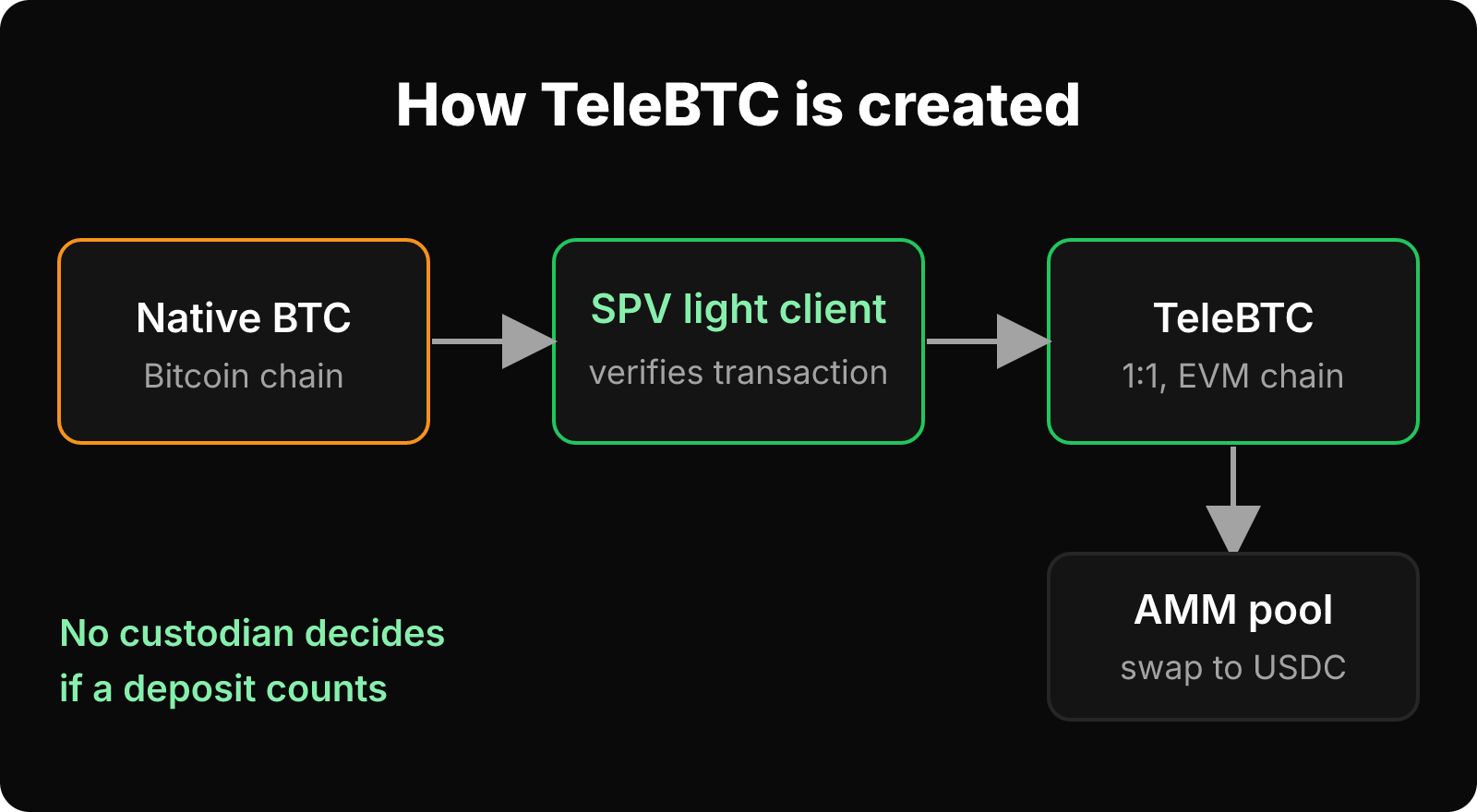
- TeleBTC: TeleSwap's 1:1 Bitcoin-backed token. A new TeleBTC is created only after a smart contract checks a real Bitcoin transaction using an SPV light client, a compact on-chain verifier of Bitcoin block headers and proof-of-work. Custody is collateral-backed and slashable. No custodian or multi-sig committee decides whether a deposit counts.
A point most guides miss: the bigger long-term risk is holding a BTC token whose backing depends on one company's honesty or a committee's keys. Choose the token you'd be comfortable holding for a month, then compare prices.
Comparing the ways to trade native BTC on a DEX
If you want to trade native BTC on a DEX, meaning you start with real bitcoin in your own wallet, you have four realistic routes. Here's how they compare for a beginner.
| Route | Starts from native BTC? | Account / KYC | Who backs your BTC during the trade | Steps for a beginner | Gas token needed? |
|---|---|---|---|---|---|
| CEX (buy, trade, withdraw) | Yes, but you deposit to the exchange | Required | The exchange holds your coins | Sign up, verify, deposit, trade, withdraw | No |
| Custodial wrap + EVM DEX (e.g., WBTC on Uniswap) | No, you must get WBTC first | Often, at the wrapping step | Custodian (WBTC model) | Acquire wrapped BTC, buy ETH for gas, connect wallet, swap | Yes |
| Bitcoin-layer venues (Spark/rollup-based DEXs) | Usually, via a dedicated wallet or layer | Typically no | Depends on the layer's design; newer infrastructure | Move BTC onto the layer, then trade | Varies |
| TeleSwap | Yes, sent straight from your Bitcoin wallet | No | TeleBTC: SPV-verified, collateral-backed, slashable | Pick a pair, enter a receiving address, send BTC | No for BTC → token (a Teleporter covers destination gas) |
Each route has a place. A CEX is still the easiest way to buy your first bitcoin with a debit card. Bitcoin-layer projects such as Spark-based venues are interesting, but speakers at a Bitcoin 2026 conference panel described much of that infrastructure as recently built. For someone who already holds BTC and wants a stablecoin or ETH in their own wallet, one-step bridge-and-swap is the shortest path.
TeleSwap is a non-custodial Bitcoin bridge and swap protocol. It verifies Bitcoin transactions on-chain with SPV light client proofs, creates TeleBTC 1:1, and routes it through a DEX into the token you chose. The protocol has handled $585,066,172 in total volume across 624,817 bridge transactions, including $48.9M over the last 30 days (peak day $3.3M on 2026-11-14), according to TeleSwap network stats, retrieved 2026-11-28.
How to start Bitcoin DEX trading for beginners: what you need
What you'll have done by the end: sent a small amount of native BTC from your own wallet and received a token, for example USDC on Polygon, in a wallet you control.
What you need before you start:
- A Bitcoin wallet you control. Any self-custody wallet where you hold the seed phrase. Bitcoin.org's wallet chooser is a neutral place to start. A hardware wallet is better for larger amounts.
- Some BTC in it. For your first trade, use an amount you'd be fine losing to a mistake. You're testing the process, not trying to profit.
- A receiving wallet on the destination chain. For Ethereum, Arbitrum, Base, Polygon, BNB Chain, or Optimism, that's an EVM wallet such as MetaMask or Trust Wallet. For Solana, use a Solana wallet. You only need its address to receive.
- Your seed phrases written on paper. These are the 12–24 words that restore each wallet. Never photograph them, never type them into a website, and never share them with "support."
- The official URL bookmarked. Type
teleswap.xyzyourself once, then bookmark it. Fake sites copy DEX interfaces.
In the BTC → token direction, you don't need ETH, MATIC, or BNB for gas. TeleSwap lets you pay all fees in Bitcoin assets, and a Teleporter (a permissionless protocol role) covers destination-chain gas for you. The mechanics are explained in the TeleSwap documentation.
Step-by-step: your first native BTC swap with TeleSwap
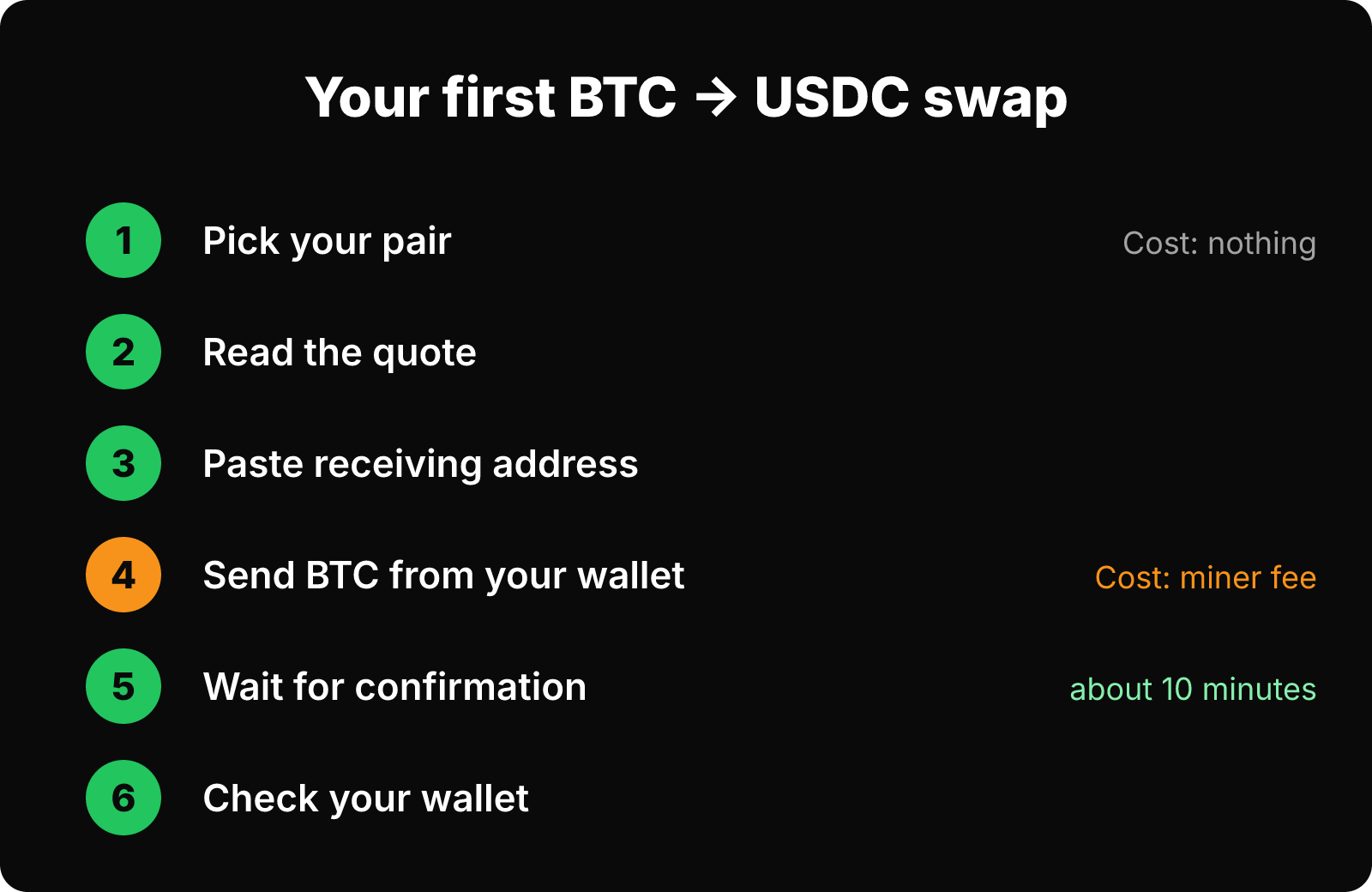
This example swaps BTC for USDC on Polygon (BTC → USDC on Polygon), a common first trade because the result is a dollar-denominated stablecoin that's easy to check. The flow is the same for other pairs. The interface may change over time, so treat the screen descriptions as a guide to what to look for.
Step 1: Open TeleSwap and pick your pair
What you'll see: a swap form with a "from" asset and a "to" asset plus a network selector. Set "from" to BTC and "to" to USDC on Polygon. Cost: nothing. Time: under a minute.
Check the network label carefully. USDC on Polygon is a different token from USDC on Ethereum, even though both are worth about one dollar.
Step 2: Enter the amount and read the quote
What you'll see: an estimated amount you'll receive, a breakdown of fees, and an estimated completion time. Cost: nothing yet, since a quote is just information. Time: a few seconds.
Read the "you receive" number, not just the price. If the gap between what you send and what you receive looks large compared with the amount, the trade is probably too small for the fixed Bitcoin network fee. That's covered in the cost section below.
Step 3: Paste your receiving address
What you'll see: a field for your destination wallet address, or a prompt to connect that wallet. Cost: nothing. Time: under a minute.
Copy the address from your EVM wallet, paste it, then check the first four and last four characters against your wallet. Clipboard-hijacking malware swaps addresses, so the visual check matters. Connecting a wallet only shares your public address.
Step 4: Send the BTC from your Bitcoin wallet
What you'll see: instructions to send BTC from your Bitcoin wallet. Your wallet then asks you to confirm the amount and pick a network fee. Cost: the Bitcoin miner fee, which depends on how busy the network is. Time: a minute to sign.
Before you approve, check current fee levels on mempool.space. If you choose a fee far below the going rate, your transaction can sit unconfirmed for hours. Send exactly the amount the interface asks for.
Step 5: Wait for Bitcoin confirmation and verification
What you'll see: a status view showing your Bitcoin transaction being detected, confirmed, and then processed on the destination chain. Cost: nothing extra. Time: fast swaps settle in about 10 minutes, though it can take longer if your Bitcoin transaction confirms slowly.
TeleBTC is only created once a light client has verified your actual Bitcoin transaction. No operator gets to decide that your deposit "probably arrived."
Step 6: Check your wallet
What you'll see: USDC arriving at your Polygon address. Cost: nothing. Destination gas was covered. Time: instant once settled.
If the balance doesn't appear in MetaMask, you may need to add the USDC token contract to your wallet's token list. To reverse the trade later, the return route is USDC on Polygon → BTC, which sends native BTC back to your Bitcoin address.
Prefer to stay inside apps you already use? TeleSwap is integrated as a Bitcoin swap provider in the aggregators Rango, Rubic, and DZap, and through the Rango integration it's also reachable in MetaMask and Trust Wallet. See our cross-chain swap aggregator guide for more.
What does a decentralized Bitcoin exchange trade cost, and how long does it take?
Every decentralized Bitcoin exchange trade has the same basic cost components. Understanding them saves beginners more money than chasing the best quote.
| Cost component | What it is | Fixed or proportional? | How to reduce it |
|---|---|---|---|
| Bitcoin network (miner) fee | Paid to miners to include your transaction in a block | Roughly fixed per transaction (based on size in vbytes, not BTC value) | Send when mempool fees are low. Avoid many tiny trades |
| Protocol / bridge fee | Shown in the quote before you commit | Check the quote | Compare the "you receive" figure, not headline rates |
| Price impact and slippage | How much your trade moves the AMM pool's price | Grows with trade size versus pool depth | Use liquid pairs (stablecoins, ETH). Split very large trades |
| Destination gas | Fee to execute on the destination chain | Fixed per transaction | On TeleSwap BTC → token routes, a Teleporter covers it |
The practical lesson: the Bitcoin miner fee depends on transaction size in bytes, not on how much BTC you send. So it costs about the same to move 0.001 BTC as 0.1 BTC, which makes very small trades expensive in percentage terms. Beginners who complain about high DEX fees have often swapped tiny amounts during a fee spike.
Timing: most of the wait comes from Bitcoin's roughly 10-minute average block interval. TeleSwap's fast swaps settle in about 10 minutes. A low miner fee is the most common reason a swap takes longer. See how long it takes to bridge Bitcoin.
Common problems and fixes
These are the issues beginners are most likely to hit.
- "My swap is stuck." Cause: your Bitcoin transaction hasn't confirmed, usually because the fee was too low. Fix: look up your transaction ID on mempool.space. If it's unconfirmed and your wallet supports Replace-By-Fee (RBF), bump the fee. Then wait.
- "Tokens arrived but I can't see them." Cause: your wallet isn't showing that token, or it's set to a different network. Fix: switch the wallet to the correct chain (e.g., Polygon) and import the token contract from a trusted source.
- "I picked the wrong network." Cause: you chose USDC on Ethereum when you meant Polygon, or the reverse. Fix: your EVM address is the same across EVM chains, so the funds are usually reachable once you switch networks in your wallet. Prevention is better: re-read the network label in Step 1.
- "Fees ate half my trade." Cause: a very small amount against a fixed miner fee. Fix: trade larger, less often, and when the mempool is quiet.
- "The site asked for my seed phrase." Cause: you're on a phishing site. Fix: close it right away. If you entered the phrase, move your funds to a new wallet now.
- "Reverse swap fails on the EVM side." Cause: going from a token back to BTC means signing a transaction on the EVM chain, which needs a small amount of the native gas token. Fix: keep a little of that chain's gas token in your wallet before starting a token → BTC swap.
- "The quote changed." Cause: prices move and quotes expire. Fix: refresh the quote and confirm the new "you receive" figure before sending. On volatile pairs, a slightly higher slippage tolerance prevents failed trades. On stablecoin pairs, keep it low.
Frequently Asked Questions
Can you trade Bitcoin on a DEX without KYC?
Yes, DEXs don't require accounts or identity verification because you trade directly from your own wallet. You connect a self-custody wallet and sign transactions yourself. Your local tax and reporting obligations still apply, so check the rules where you live. For more, see swapping crypto without KYC.
Is Bitcoin DEX trading safe for beginners?
It can be, provided you guard your seed phrase, use bookmarked official URLs, and start with small test amounts. Common beginner losses come from phishing and wrong-network mistakes. The second thing to check is which BTC-backed token you hold and who controls the bitcoin behind it.
Can I trade native BTC on a DEX, or only wrapped BTC?
You can start from native BTC by using a bridge-and-swap protocol that accepts bitcoin directly from your Bitcoin wallet. Bitcoin's base layer can't run AMM pools, so the swap itself happens on another chain using a Bitcoin-backed token. With TeleSwap, that token is TeleBTC, created 1:1 only after a light client verifies your Bitcoin transaction.
How long does a BTC-to-token DEX swap take?
TeleSwap's fast swaps settle in about 10 minutes. Most of the wait is Bitcoin block confirmation, so choosing a reasonable miner fee is the best way to avoid delays.
What is TeleSwap and how is TeleBTC different from WBTC?
TeleSwap is a non-custodial protocol for bridging, swapping, and earning on Bitcoin, and its TeleBTC token is verified by SPV light client proofs rather than held by a custodian. WBTC depends on custodians holding the underlying BTC. TeleBTC is only created after an on-chain light client verifies a real Bitcoin transaction, and custody is backed by collateral that can be slashed. TeleSwap has processed 624,817 bridge transactions across 13 networks, according to TeleSwap network stats.
Do I need ETH or another gas token to receive tokens?
No, not for BTC-to-token swaps on TeleSwap, because a Teleporter covers destination-chain gas and you pay fees in Bitcoin assets. For the reverse direction (token back to BTC), keep a small amount of the destination chain's gas token, since you'll sign a transaction on that chain.
Your next step
Learning how to start Bitcoin DEX trading for beginners comes down to three things. First, know that the swap happens on another chain, so pay attention to which BTC token you hold during it. Second, watch the fixed Bitcoin miner fee more closely than tiny price differences. Third, protect your seed phrase and the official URL like cash.
If you already hold BTC, the simplest first trade is a small native BTC → stablecoin swap that lands in your own wallet, with no account, no gas token, and no custodian deciding whether your deposit counts. Fast swaps settle in about ten minutes.
This article is educational and is not financial advice. Crypto assets are volatile, and you can lose money trading them.