cbBTC to BTC: How to Get Native Bitcoin Back in 2026

To turn cbBTC into BTC, redeem it through a Coinbase account, use a centralized swap service, or swap it with a non-custodial protocol like TeleSwap that pays native BTC to your own address. cbBTC is a stand-in for bitcoin, not bitcoin. You can't send it to a Bitcoin hardware wallet, and a Bitcoin address won't accept it.
Maybe you bought Bitcoin inside a Base app, or a lending protocol paid you out in it. Each exit route has its own costs and trust assumptions.
This guide assumes you're new to crypto. It covers what cbBTC is, the three practical exit routes, what each one costs, and a step-by-step walkthrough of the route we think suits most self-custody users.
Key Takeaways:cbBTC is a token issued by Coinbase and described as backed 1:1 by BTC held in Coinbase custody, so holding it means trusting Coinbase.There are three main ways to turn cbBTC back into native bitcoin: redeem through a Coinbase account, use a centralized swap service, or use a non-custodial cross-chain protocol like TeleSwap.From September 17–23, 2026, cbBTC traded between roughly 0.9986 and 1.0008 BTC, according to CoinGecko, so the peg itself is rarely your biggest cost.Your real exit cost is the total of chain gas, swap spread, protocol fees and the Bitcoin network fee, so compare the amount of BTC you receive, not the advertised rate.TeleSwap has processed $528.7M in bridged volume across 560,216 transactions, according to TeleSwap network stats.
Table of Contents
- What is cbBTC, and why isn't it bitcoin?
- Why unwrap cbBTC at all?
- cbBTC to BTC: the three exit routes compared
- What does it cost to convert cbBTC to bitcoin?
- Step-by-step: swapping cbBTC for native BTC with TeleSwap
- cbBTC vs WBTC vs TeleBTC: which wrapper deserves your trust?
- Five mistakes to avoid when you unwrap cbBTC
- Frequently Asked Questions
- Conclusion
What is cbBTC, and why isn't it bitcoin?
cbBTC (Coinbase Wrapped BTC) is a token on smart-contract blockchains that represents one bitcoin held by Coinbase. You send BTC to Coinbase, Coinbase locks it up, and you get an equal amount of cbBTC on a chain like Ethereum or Base. Coinbase launched it on Ethereum and Base in September 2024 and later added Solana, Arbitrum and Monad, according to the Monad Foundation.
Think of a coat check. You hand over your coat and get a numbered ticket. The ticket isn't the coat, and it's only worth something while the venue is open and honest. cbBTC works the same way: Bitcoin itself can't run the lending and trading apps on Ethereum, so a wrapped token lets your BTC visit those chains as a ticket while the coat stays in Coinbase's cloakroom.
The ticket has become popular. cbBTC's market cap was about $7.97 billion on October 12, 2026, with roughly $282.5 million in 24-hour trading volume, according to MetaMask's cbBTC price page. Circulating supply grew from about 89,000 tokens in March 2026 (Monad Foundation) to 95,861 by around August 2026 (CoinStats).
Why unwrap cbBTC at all?
If cbBTC tracks bitcoin's price, why bother converting? Because price is only one of the things you own when you own bitcoin.
- Self-custody. Native BTC in a wallet you control depends on your private keys and Bitcoin's proof-of-work network, not on any company. cbBTC depends on Coinbase continuing to hold and honor the reserves.
- Freeze risk. cbBTC is issued by a centralized company, and the custodial model means redemption depends on Coinbase's operations and policies.
- Cold storage. Hardware wallets and multisig vaults built for long-term saving hold native BTC. They don't hold an ERC-20 token on Base.
- Ownership you can verify. You can see cbBTC's total supply on-chain, but the bitcoin behind it sits in Coinbase's custody. The token contract can't prove the reserves exist.
The Eco 2026 wrapped-bitcoin comparison makes a similar point: wrapped BTC is a tool for using DeFi, not an upgrade on bitcoin. When you're finished using DeFi, the sensible default is to go back to the real asset.
cbBTC to BTC: the three exit routes compared
There are three realistic ways to get native bitcoin from cbBTC in 2026. They differ less in price than in who you have to trust along the way and where your bitcoin ends up.
Route 1: Redeem through a Coinbase account
This is the issuer's route. You send cbBTC to your Coinbase deposit address, Coinbase burns (destroys) the token, and the matching BTC is released to your Coinbase Bitcoin account. The Monad Foundation's write-up describes this burn-and-release mechanism.
The catch is that the bitcoin is still on Coinbase. To self-custody it, you have to make a second withdrawal to your own Bitcoin address. You also need a verified Coinbase account, and you should confirm that Coinbase accepts cbBTC deposits on the network your tokens are on. We couldn't verify Coinbase's current redemption and withdrawal fees, so check them on Coinbase directly before you move funds.
Route 2: A centralized swap service
Instant-exchange sites such as ChangeNOW list a cbBTC-to-bitcoin flow. You send cbBTC to their address and they send BTC to yours. While the trade is in progress, the service holds your funds, and the rate usually includes a spread you won't see as a separate fee.
Route 3: A non-custodial cross-chain protocol (TeleSwap)
TeleSwap, a Bitcoin bridge and swap protocol that uses SPV light client verification, turns tokens on EVM chains into native BTC sent to your own Bitcoin address. No exchange account is required. You connect a wallet, choose cbBTC, paste in a Bitcoin address, and sign. TeleSwap's dedicated pages include a cbBTC to BTC route from Ethereum and a cbBTC on Base route.
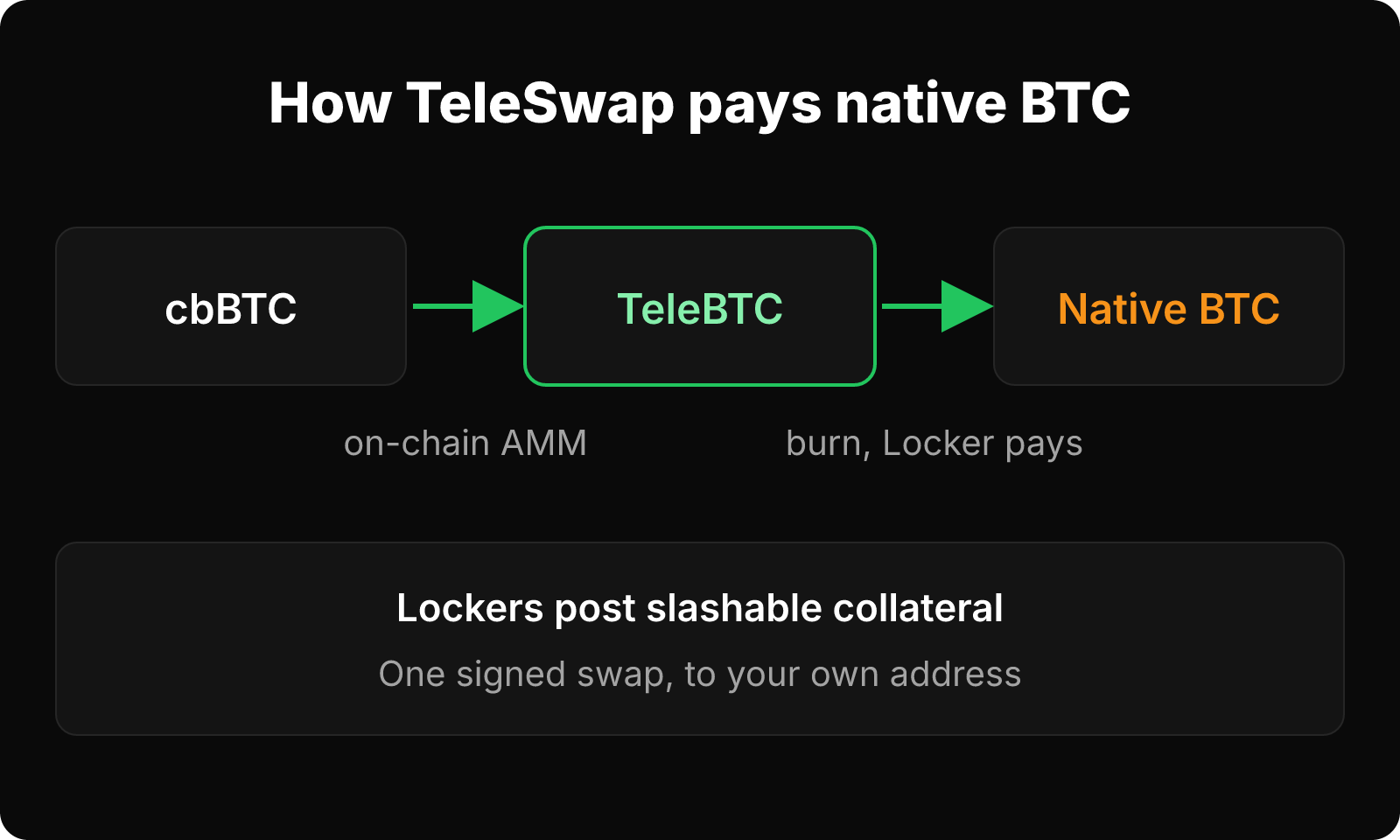
Behind the scenes, your cbBTC is swapped through an on-chain AMM into TeleBTC, TeleSwap's 1:1 Bitcoin-backed token. The TeleBTC is then burned, and a Locker pays out native BTC on the Bitcoin network. Lockers post collateral that can be slashed (lost) if they fail to pay, as described in the TeleSwap documentation.
TeleSwap has processed $528.7M in total bridged volume across 560,216 transactions on 13 supported networks, including $40.3M in the last 30 days, per TeleSwap network stats.
| Factor | Coinbase redemption | Centralized swap service | TeleSwap |
|---|---|---|---|
| Account needed | Yes, Coinbase account | Varies by service | No exchange account; connect your own wallet |
| Where your BTC lands | Coinbase balance (withdrawal needed) | Your Bitcoin address | Your Bitcoin address |
| Who holds funds mid-trade | Coinbase | The swap service | Smart contracts plus collateral-backed, slashable Lockers |
| Transactions you send | Two (deposit, then withdraw) | One deposit | One signed swap |
| Main cost components | Chain gas + Coinbase fees | Chain gas + spread/service fee | Chain gas + swap/protocol fee + BTC payout fee |
Our take: Many people assume the issuer's own redemption is the "real" or cheapest exit. For a self-custody user, it's often neither. You hand your coins back to the same custodian you were trying to get away from, then withdraw them again.
If you already keep funds on Coinbase, Route 1 is fine. If the goal is bitcoin in your own wallet, a one-step route that sends BTC straight to your address is more direct.
What does it cost to convert cbBTC to bitcoin?
The peg is rarely where you lose money. Between September 17 and 23, 2026, cbBTC traded in a range of about 0.9986 to 1.0008 BTC, according to CoinGecko's cbBTC/BTC chart. That's within about ±0.2% of 1:1. Fees and friction can cost more than that.
Every exit route adds up from the same five pieces:
- Source-chain gas. The fee to send a transaction on Ethereum or Base. It's usually much cheaper on Base, a layer-2 network, than on Ethereum mainnet.
- Swap spread or slippage. The gap between the quoted market price and the price you actually get. It grows with trade size and shrinks with deeper liquidity.
- Service or protocol fee. What the exchange, custodian or protocol charges for the conversion.
- Bitcoin network fee. Someone pays miners to include the payout transaction in a block. It depends on how busy the mempool (the queue of unconfirmed transactions) is.
- Extra hops. Any additional withdrawal, such as moving BTC from an exchange to your own wallet, adds another network fee and another wait.
The best comparison is simple: how many satoshis land in your wallet for each cbBTC you send? Get a quote from every route for the exact amount you're moving, subtract any second-hop withdrawal fee, and compare the final figures. A route that advertises "zero fees" but quotes a wide spread can end up the most expensive.
If you read our earlier guide to unwrapping WBTC to native Bitcoin and its fee comparison, the same approach applies, and the WBTC to BTC route works the same way.
Step-by-step: swapping cbBTC for native BTC with TeleSwap
Here's the full process from start to finish. We'll use cbBTC on Ethereum, but Base works the same way.
- Get a Bitcoin address you control. Open your hardware wallet or a self-custody Bitcoin wallet and copy a receiving address. Native SegWit addresses start with bc1.
- Check your source wallet. Make sure your EVM wallet (for example MetaMask) holds the cbBTC plus a small amount of ETH to pay gas on the chain you're swapping from.
- Open the route page. Go to the TeleSwap cbBTC (Ethereum) to BTC page at teleswap.xyz and connect your wallet.
- Enter the amount and your Bitcoin address. The quote shows how much BTC you'll receive after fees. That's your number for comparing routes.
- Approve and sign. The first time, your wallet asks you to approve TeleSwap to spend cbBTC. Then you sign the swap itself.
- Wait for the Bitcoin payout. The protocol turns your cbBTC into TeleBTC, burns it, and a Locker sends native BTC to your address. You can follow the payout in any Bitcoin block explorer.
- Confirm in your wallet. Once the transaction has Bitcoin confirmations, the coins are secured by your own keys.
Prefer to stay in an app you already use? TeleSwap is built in as a Bitcoin swap provider on the aggregators Rango, Rubic and DZap. Through the Rango integration, it's also available inside MetaMask and Trust Wallet.
For a broader walkthrough of non-custodial swaps, see our Trustless BTC Swap: 7-Step No-KYC Guide (2026).
cbBTC vs WBTC vs TeleBTC: which wrapper deserves your trust?
If you're unwrapping cbBTC now, it helps to know how it compares with the alternatives in case you come back to DeFi later. The central question for any wrapped bitcoin is the same: what stops the backing from disappearing?
| Token | Who secures the BTC | Redemption for ordinary users | Notable context |
|---|---|---|---|
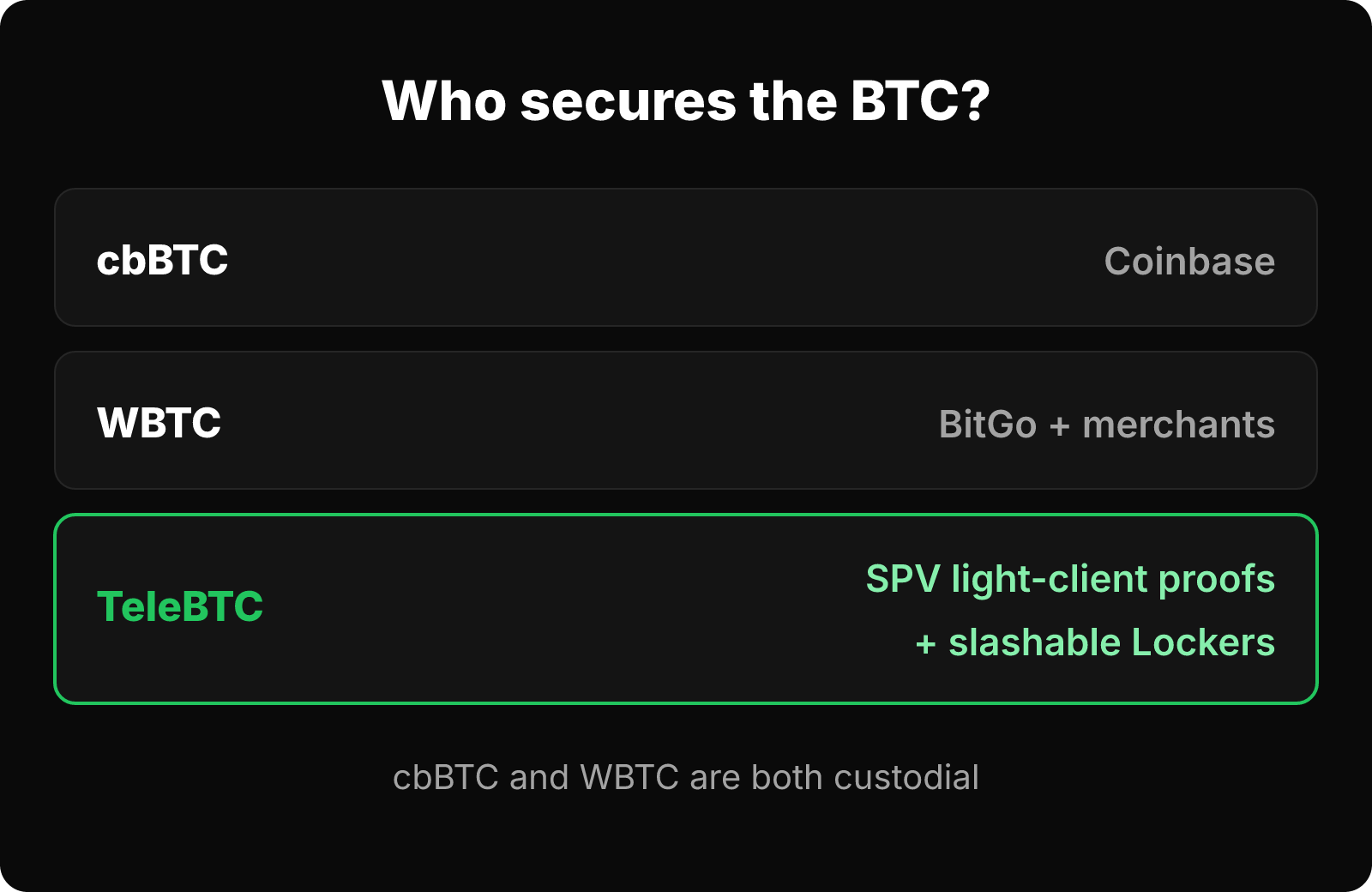
| cbBTC | Coinbase (single centralized custodian) | Via Coinbase account, or swap on the market | About 3.6x WBTC's 24h volume ($353M vs $97M) around August 2026, per CoinStats |
| WBTC | BitGo and its merchant network | Through approved merchants; most users swap on a DEX | A 2024 custody change involving BiT Global drew concerns over links to Justin Sun, per Coin Bureau |
| tBTC | Threshold Network signer set | Permissionless redemption | Decentralized threshold-signature model |
| TeleBTC | SPV light-client proofs plus collateral-backed, slashable Lockers | Burn for native BTC through TeleSwap | Nothing is minted without a verified Bitcoin transaction |
cbBTC and WBTC are both custodial. In each case a company holds the bitcoin, and you trust its reserves and its policies. The Eco comparison notes that for both tokens, redemption runs through authorized participants or direct custodian relationships, which is why most end users swap on a DEX instead. For a deeper look, see WBTC bridge custody risk vs trustless Bitcoin bridges in 2026.
TeleBTC takes a different approach. TeleSwap runs an SPV light client, a small program on the destination chain that checks Bitcoin block headers and transaction proofs directly. TeleBTC is minted only when the light client verifies a real Bitcoin deposit.
The BTC is held by Lockers who post collateral that can be slashed if they misbehave. Minting doesn't depend on a custodian or multisig committee's approval; it depends on a verified Bitcoin transaction.
Spreading across several wrappers only goes so far. If you hold three tokens that each depend on a different custodian, you still have custodian risk, just in three places. Removing the custodian from the minting process is a different kind of protection.
Five mistakes to avoid when you unwrap cbBTC
- Picking the wrong chain. cbBTC on Base and cbBTC on Ethereum are separate tokens on separate networks. Choose the route that matches where your tokens actually are.
- Sending cbBTC to a Bitcoin address. A Bitcoin wallet can't receive an ERC-20 token. Always go through a redemption or swap route.
- Depositing to Coinbase on an unsupported network. Check that Coinbase accepts cbBTC on your chain before you send. Deposits on unsupported networks can be difficult or impossible to recover.
- Converting very small amounts on Ethereum mainnet. Gas can take up a large share of a small swap. Move small balances from Base, or combine them before you exit.
- Comparing rates instead of what you receive. A good-looking rate means little if a withdrawal fee comes later. Compare the final number of sats that reach your wallet.
Frequently Asked Questions
Can I convert cbBTC to BTC without a Coinbase account?
Yes, you can use a swap service or a non-custodial protocol like TeleSwap instead of redeeming through Coinbase. Coinbase's direct redemption requires a Coinbase account. TeleSwap lets you connect your own wallet and receive native BTC at a Bitcoin address you control, with no exchange account involved.
Is cbBTC always worth exactly 1 BTC?
No. cbBTC is designed to track BTC 1:1, but its market price can move slightly away from that. CoinGecko data showed cbBTC trading between about 0.9986 and 1.0008 BTC from September 17 to 23, 2026. The 1:1 exchange applies to Coinbase redemption. On the open market the price is set by supply and demand.
How long does it take to unwrap cbBTC?
It depends on the route, and the biggest factor is usually Bitcoin block confirmations. A Coinbase redemption involves a deposit followed by a separate BTC withdrawal. Protocol routes like TeleSwap send BTC straight to your address, and TeleSwap's fast swaps settle in about 10 minutes. The quote screen shows the expected timing.
What is the cheapest way to convert cbBTC to bitcoin?
The cheapest route is the one that delivers the most satoshis to your own wallet for the amount you're converting. Add up source-chain gas, swap spread, service fees, the Bitcoin network fee and any extra withdrawal. Swapping from Base usually costs less in gas than swapping from Ethereum mainnet.
What's the difference between cbBTC vs WBTC?
cbBTC is held by Coinbase, while WBTC is held by BitGo and its merchant network. Both are custodial. Around August 2026, CoinStats reported cbBTC trading about 3.6 times WBTC's daily volume. For ordinary users, redeeming either one usually means swapping on the market, not redeeming directly with the custodian.
How does TeleSwap turn cbBTC into native BTC?
TeleSwap swaps your cbBTC into TeleBTC through an on-chain AMM, burns the TeleBTC, and a collateral-backed Locker sends native BTC to your Bitcoin address. TeleBTC is minted only after an SPV light client verifies a Bitcoin transaction. Lockers can be slashed if they fail to pay out. TeleSwap has processed $528.7M in bridged volume across 560,216 transactions, according to TeleSwap network stats.
Conclusion
cbBTC is a convenient way to use bitcoin in DeFi, but it's a receipt for BTC that Coinbase holds. Three points to remember:
- Converting cbBTC to BTC comes down to trust and destination more than price. In the cited snapshots the peg stayed within about ±0.2%. Fees, extra steps and custody are where the routes really differ.
- Judge every route by the sats that reach your own wallet, after all gas, spread and withdrawal fees.
- If self-custody is the goal, pick a route that pays straight to your Bitcoin address. TeleSwap does this in one signed transaction, using light-client verification and slashable collateral rather than a custodian.
Ready to turn your cbBTC back into native bitcoin you hold yourself?
This article is for educational purposes only and isn't financial advice. Always check current fees and supported networks before moving funds.