BTC to BNB: Swap Native Bitcoin to BNB Chain (2026)

To swap BTC to BNB without an exchange, send native Bitcoin from your own wallet through a non-custodial bridge such as TeleSwap. Fast swaps settle in about 10 minutes, and you don't need BNB for gas. You may have Bitcoin in your own wallet and want BNB or a token on BNB Chain. Most guides tell you to deposit on Binance, sell and withdraw. That works, but it means handing your Bitcoin to a company and paying its fees.
This guide explains how native Bitcoin gets onto BSC, what the different routes involve, which fees you will pay, and how to do the swap yourself, from a Bitcoin wallet to BNB in your BSC wallet.
Key Takeaways:Bitcoin can't run on BNB Chain directly, so every BTC to BNB route either sells your BTC on an exchange or locks it and issues a token that represents it on BSC.TeleSwap converts native BTC to BNB, USDT and other BEP-20 tokens in one flow, and fast swaps settle in about 10 minutes.A brand-new BSC wallet holds zero BNB for gas, and with TeleSwap that doesn't block you because a Teleporter pays the destination-chain gas.TeleBTC is minted only after a Bitcoin transaction has been verified by an SPV light client, while Binance's BTCB depends on Binance's custody.As of 2026-10-23, TeleSwap had processed $527.6M in total bridged volume across 558,895 transactions, according to TeleSwap network stats.
Table of Contents
- What does "BTC to BNB" actually mean?
- How does Bitcoin get onto BSC?
- Bitcoin to BSC: 5 routes compared
- Wallet setup for native BTC to BNB Chain
- How to swap BTC to BNB step by step
- What fees do you pay to swap BTC to BEP-20?
- Risks and common mistakes
- Frequently Asked Questions
- Conclusion
What does "BTC to BNB" actually mean?
A BTC to BNB swap turns Bitcoin, which lives on the Bitcoin blockchain, into BNB or another token on BNB Smart Chain (BSC). BSC is a separate blockchain with its own rules, its own wallets and its own fee token.
Think of the two as countries with different currencies and different banking systems. Bitcoin can't simply walk across the border. Something has to take your BTC on the Bitcoin side and hand you something of equal value on the BSC side.
Three terms are worth knowing before going further:
- BNB: the native coin of BNB Chain. Every transaction on BSC pays its fee (called "gas") in BNB, the way every Bitcoin transaction pays its fee in BTC.
- BEP-20: the token standard on BSC. USDT, USDC and wrapped Bitcoin tokens on BSC are all BEP-20 tokens. It is BSC's version of Ethereum's ERC-20.
- Chain ID 56: the network number wallets use to identify BNB Smart Chain, as listed in this BNB Chain wallet setup guide.
For a sense of scale: in October 2026, CoinGecko implied about 110.36 BNB per BTC, while CoinMarketCap listed 113.45 BNB per BTC on October 19 (CoinMarketCap BTC/BNB). The gap of roughly 3% likely comes from different timestamps and methods.
Treat any rate you read, including these, as a snapshot. Rely on the live quote you see before you swap.
How does Bitcoin get onto BSC?
Bitcoin gets onto BSC in one of two ways: someone sells your BTC for you, or your BTC is locked on Bitcoin and a token representing it is issued on BSC. Every product you will come across uses one of these two approaches.
Model 1: Sell it on an exchange
You deposit BTC with a centralized exchange, sell it for BNB, and withdraw on the "BEP-20 (BSC)" network. While your coins sit on the exchange, the exchange holds them. You need an account, usually with identity verification, and you pay a withdrawal fee on top of the trading fee.
Model 2: Lock and represent (wrapped Bitcoin)
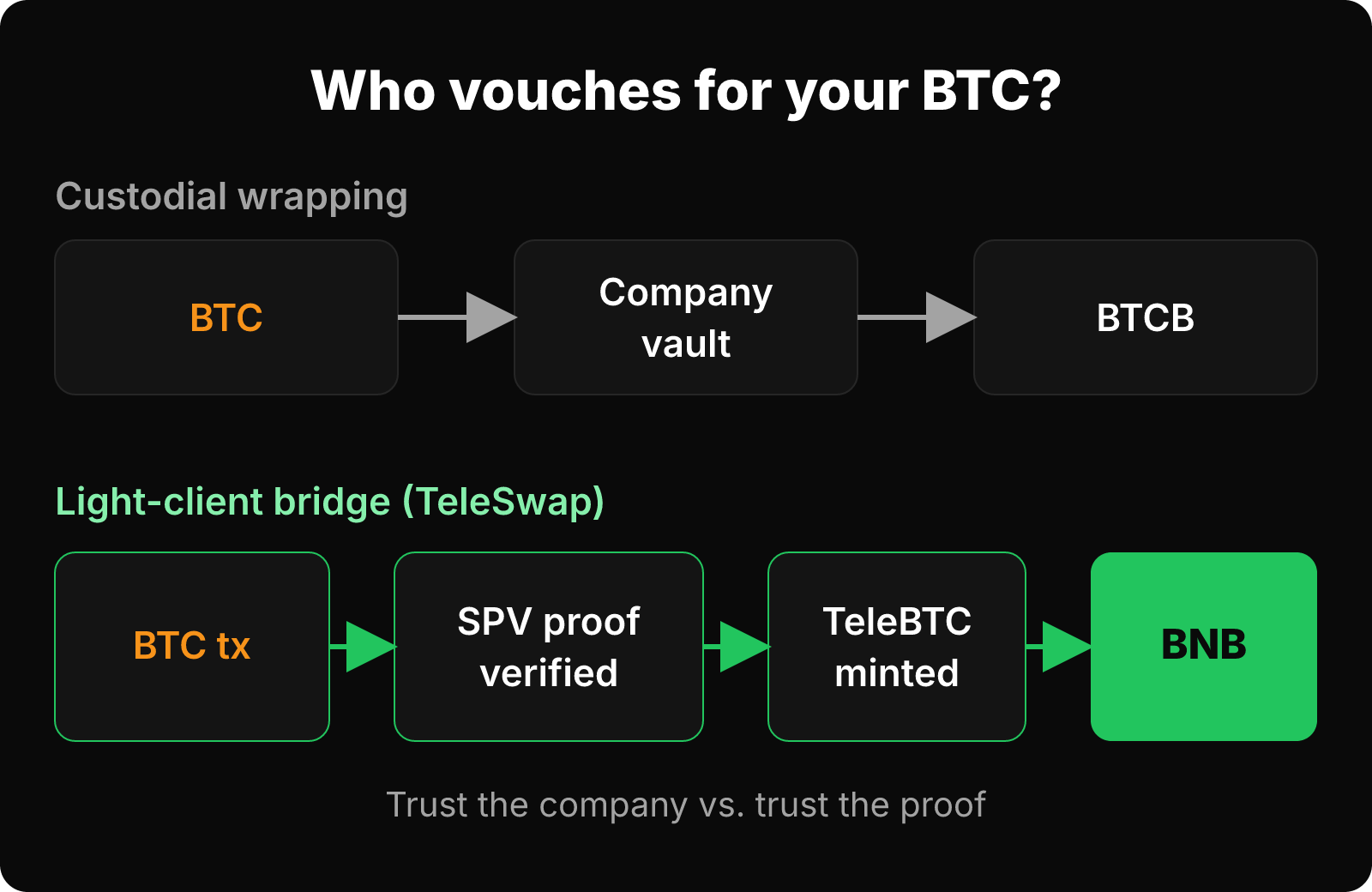
Your BTC is locked, and a token worth 1 BTC is issued on BSC. This is called "wrapped" Bitcoin. What differs between versions is who holds the locked BTC and how the system knows your deposit really happened.
- BTCB is a Bitcoin token on BSC (BTCB on BscScan). Binance issues it and holds the backing BTC, so you are trusting Binance's custody.
- TeleBTC is TeleSwap's wrapped Bitcoin. It is backed 1:1 by real BTC, and nothing is minted until a light client on the destination chain has verified the Bitcoin transaction with an SPV proof.
A light client can be compared to a notary who checks the paperwork themselves. A custodial setup is closer to a notary who takes the bank's word for it.
An SPV (Simplified Payment Verification) proof is a short mathematical receipt showing that a transaction is included in a Bitcoin block that has real proof-of-work behind it. TeleSwap's bridge checks that receipt. It doesn't rely on a company or a multi-sig committee to vouch for it, as the TeleSwap documentation explains.
The BTC behind TeleBTC is held by Lockers, who post collateral that can be slashed (taken from them) if they misbehave. That means custody is backed by money they can lose, so you don't have to rely on their reputation alone. For a broader comparison of custody models, see WBTC Bridge Custody Risk vs Trustless Bridges in 2026.
Bitcoin to BSC: 5 routes compared
Below, five ways of getting from Bitcoin to BSC are compared on what matters to a beginner. Fee figures for the third-party bridges come from Eco's 2026 BNB Chain bridge overview. They are vendor-reported, so check them on each protocol's own site.
| Route | Starts from native BTC? | Who holds your BTC | Account needed? | Need BNB for gas first? | Fee structure |
|---|---|---|---|---|---|
| TeleSwap | Yes, sent from your Bitcoin wallet | Collateral-backed, slashable Lockers; minting verified by SPV light client | No | No. A Teleporter covers destination gas | Paid in Bitcoin assets, shown in the quote; ~10 min fast swaps |
| Centralized exchange (e.g., Binance) | Yes, via deposit | The exchange | Yes, usually with KYC | No | Trading fee + flat withdrawal fee + network fee |
| Stargate | No. Needs assets already on another chain | Liquidity pools + LayerZero messaging | No | Gas on source chain | ~6 bps + source gas + messaging fee |
| deBridge (DLN) | No. Needs assets on a supported chain | Solvers fill your order | No | Gas on source chain | 0.005 BNB flat + 4 bps |
| Aggregators (LI.FI, Squid, Socket) | Varies by route | Depends on the underlying bridge | No | Usually | Underlying bridge fees + any aggregator fee |
The table shows something many readers miss. Most "bridge to BSC" tools don't start from native Bitcoin. They move tokens that are already on Ethereum, Arbitrum or another EVM chain. If your coins are in a real Bitcoin wallet, you would first have to get them onto one of those chains, which adds a second hop with its own fees and risks.
For another native-BTC option, compare it with Chainflip vs TeleSwap: Native BTC Swaps Compared (2026).
Low headline fees can also mislead. A bridge charging a few basis points can still cost more overall once you add the extra hop, the second set of gas fees and the BNB you have to buy just to make your first transaction on BSC. Compare the amount you actually end up receiving.
TeleSwap is also built into other apps as a Bitcoin swap provider. You can reach it through aggregators such as Rango, Rubic and DZap, and through MetaMask and Trust Wallet via the Rango integration.
Wallet setup for native BTC to BNB Chain
You need two wallets: one that holds your Bitcoin and one that can receive tokens on BSC. It takes about five minutes.
1. A Bitcoin wallet (the sending side)
Any self-custody Bitcoin wallet you control will do. Check that it holds enough BTC for the amount you want to swap plus the Bitcoin network fee. Bitcoin fees go up and down with demand for block space (the "mempool"), so check them on a tracker such as mempool.space before you send.
2. A BSC wallet (the receiving side)
MetaMask, Trust Wallet, Rabby or any other EVM wallet works. BSC addresses start with 0x, in the same format as Ethereum addresses. Many wallets list BNB Smart Chain already.
If yours doesn't, add it manually with:
- Network name: BNB Smart Chain
- Chain ID: 56
- Currency symbol: BNB
- Block explorer: bscscan.com
- RPC URL: use one from the official BNB Chain documentation
Copy your 0x address. That address is where your BNB will arrive.
How to swap BTC to BNB step by step
This walkthrough uses TeleSwap, the non-custodial Bitcoin bridge that turns native BTC into BSC tokens in a single flow. The on-screen wording may change over time. For the current details, see the TeleSwap documentation.
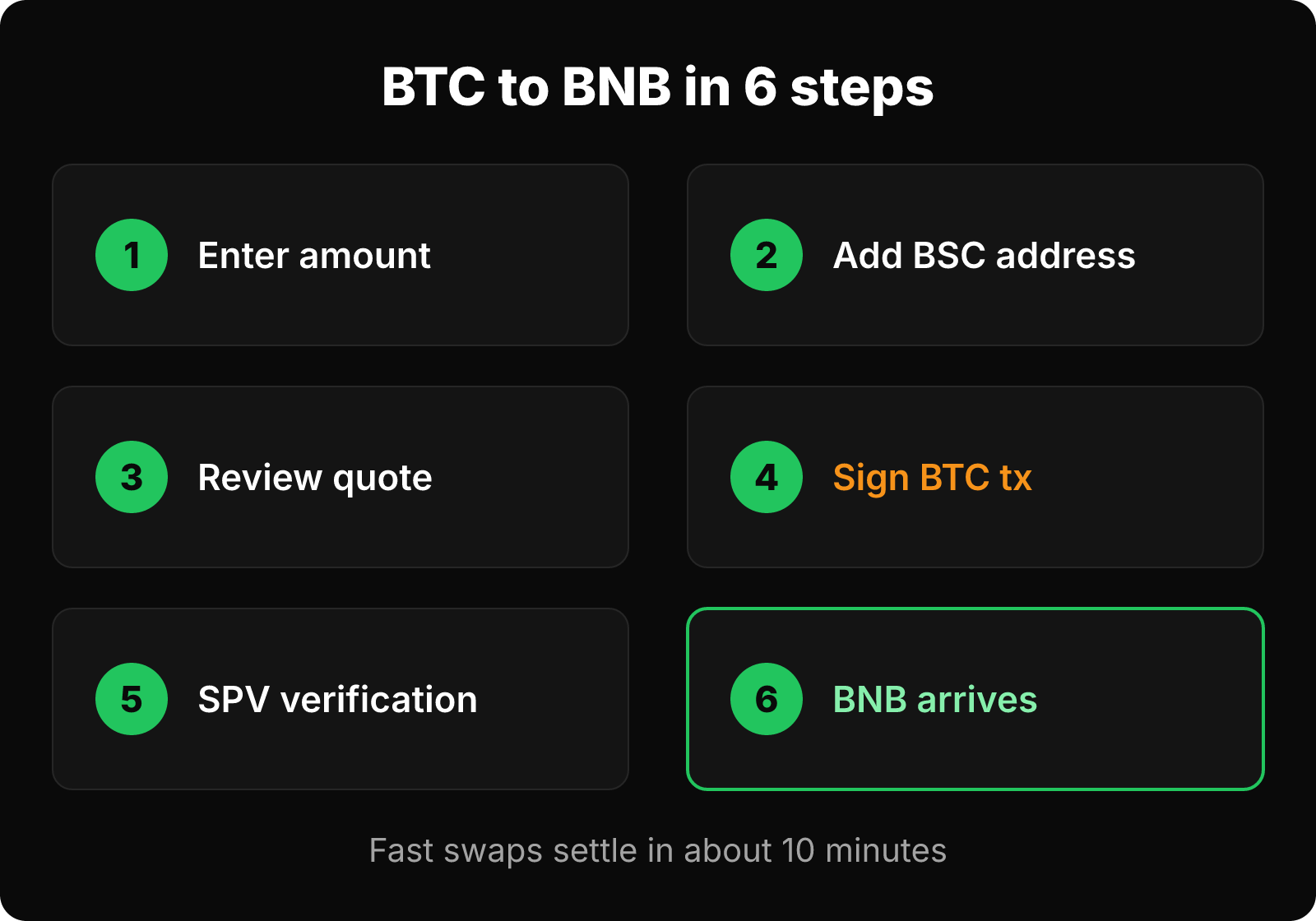
- Open the route page. Go to the swap BTC to BNB page on teleswap.xyz. BTC is already set as the source and BNB on BNB Smart Chain as the destination.
- Enter the amount. Type how much BTC you want to swap. The quote shows an estimate of the BNB you will receive.
- Add your BSC address. Paste the
0xaddress from your BSC wallet or connect the wallet. Check the first and last few characters. - Review the quote. Look at the final amount you receive, not only the rate. Fees are paid in Bitcoin assets, so you don't need any BNB for this.
- Send the Bitcoin transaction. Follow the on-screen instructions to sign and broadcast the transaction from your Bitcoin wallet.
- Wait and receive. The bridge verifies your Bitcoin transaction with an SPV proof, mints TeleBTC 1:1, swaps it to BNB through the AMM/DEX and delivers it to your address. A Teleporter pays the BSC gas. Fast swaps settle in about 10 minutes.
If you want a step-by-step walkthrough of the same flow with more context, read Trustless BTC Swap: 7-Step No-KYC Guide (2026).
Here is a worked example. Say you swap 0.01 BTC at the CoinGecko snapshot rate of about 110.36 BNB per BTC (CoinGecko BNB/BTC). That is roughly 1.1 BNB before fees and slippage.
The amount that actually arrives depends on the live rate, the Bitcoin network fee and the protocol fees shown in your quote. The quote screen is the number to go by. This example is not a forecast.
If you want a stablecoin rather than BNB, the same flow lets you swap BTC to USDT on BSC as a BEP-20 token. BTCB, USDC and ETH on BSC are also available.
What fees do you pay to swap BTC to BEP-20?
A swap from BTC to a BEP-20 token generally involves three costs: the Bitcoin network fee, the bridge/protocol fees, and the DEX price impact on the final swap. Here is what each one covers:
- Bitcoin network fee. This goes to Bitcoin miners, not to TeleSwap. It depends on how busy the mempool is and on the size of your transaction in bytes, not on how much BTC you send.
- Protocol fees. These pay the parties who keep the bridge running, such as Lockers, Teleporters and the protocol itself. They are paid in Bitcoin assets and shown in your quote before you confirm.
- DEX price impact. Turning TeleBTC into BNB is an on-chain trade, so a large order can move the price slightly. Larger swaps should pay closer attention to the quoted amount.
One cost you won't face here is buying BNB for gas before you can do anything. On many other routes that is the first obstacle: a new BSC wallet holds no BNB, and without BNB it can't make its first transaction.
TeleSwap avoids this because a Teleporter pays BSC gas on your behalf and the cost is settled in Bitcoin assets.
Risks and common mistakes
Every cross-chain route carries risk. The real question is which risks you take on and whether you understand them.
- Smart contract risk. Any bridge or DEX can have bugs. Multi-hop routes, for example Bitcoin → exchange → Ethereum → bridge → BSC, add a layer of risk at every hop. One direct route means fewer contracts in the path.
- Custody risk. With custodial wrapped tokens or an exchange, your BTC is only as safe as the company holding it. TeleSwap's design replaces trust in a company with SPV verification and slashable collateral, though it is still software and you should treat it as such.
- Wrong address or network. A Bitcoin address can't receive BEP-20 tokens, and a BSC address can't receive native BTC. Double-check which address goes in which field.
- Token variant mix-ups. Some BSC apps accept only particular versions of a token. Eco's guide notes, for instance, that most USDC on BSC is Binance-pegged rather than native Circle USDC (Eco). Check the token contract on BscScan before using it in an app.
- Price movement. BTC/BNB rates move constantly. CoinMarketCap showed BNB down 5.51% against BTC over 30 days (CoinMarketCap BNB/BTC).
This guide is not investment advice. Swap only what you mean to swap.
Per TeleSwap network stats (retrieved 2026-10-23), TeleSwap has bridged $527.6M across 558,895 transactions on 13 supported networks. Over the last 30 days it handled $40.4M, averaging about $1.3M a day, with a peak of $2.1M on 2026-10-08. A track record like this doesn't guarantee anything, but it shows the route is in regular use.
Frequently Asked Questions
Can I swap BTC to BNB without an exchange account?
Yes, you can swap BTC to BNB without an exchange account by using a non-custodial bridge such as TeleSwap. You send BTC from your own Bitcoin wallet and receive BNB at your BSC address. Your coins never sit in an exchange account.
How long does a BTC to BNB swap take?
With TeleSwap, fast swaps from BTC to BNB settle in about 10 minutes. Bitcoin produces a block roughly every 10 minutes, so a congested mempool or a low fee can make it take longer.
Do I need BNB in my wallet to receive tokens on BSC?
No, you don't need any BNB to receive a TeleSwap swap on BSC. A Teleporter pays the destination-chain gas for you, and fees are paid in Bitcoin assets. You will need a little BNB later if you want to send or use your tokens in BSC apps, and swapping into BNB itself covers that.
What is the difference between BTCB and TeleBTC?
BTCB is a Binance-issued token backed by BTC in Binance's custody, while TeleBTC is backed 1:1 by BTC held by collateralized, slashable Lockers, with minting verified by an SPV light client. With BTCB you trust a company. With TeleBTC, a new token is minted only after the bridge has checked cryptographic proof of a real Bitcoin transaction.
What is TeleSwap?
TeleSwap is a trustless Bitcoin bridge that lets you bridge, swap and earn with BTC across EVM chains, TON and Solana, including BNB Chain. It mints TeleBTC only after a light client has verified the Bitcoin transaction, and it can turn that TeleBTC into tokens such as BNB or USDT in the same step. As of 2026-10-23 it supports 13 networks, per TeleSwap network stats.
Can I swap BNB back to native Bitcoin?
Yes, TeleSwap supports the reverse route, BNB on BSC to native BTC. Use the BNB to BTC page. You send BNB from your BSC wallet and receive BTC at a Bitcoin address you control.
Conclusion: the shortest path from Bitcoin to BNB Chain
Converting BTC to BNB doesn't have to mean depositing on an exchange or taking two bridge hops. The three things to remember:
- Every route either sells your BTC or represents it with a token on BSC, so ask who holds the BTC and how deposits are verified.
- Most BSC bridges don't start from native Bitcoin. TeleSwap does.
- You don't need BNB for gas, there's no account to open, and fast swaps settle in about 10 minutes.
To try it, set up your BSC wallet, open the route page and check a live quote before you commit.